1099 Contractor Onboarding Timelines in Delivery Operations
Slow contractor onboarding costs delivery companies millions in idle capacity and legal risk.

The delivery industry solved speed on the customer end and forgot to solve it on the labor end. Full-time independent contractors doubled from 13.6 million in 2020 to 27.7 million in 2024. Last-mile delivery hit $177.94 billion in 2025 and is projected to clear $453 billion by 2035. None of that growth means much if a company still takes two weeks to get a driver from "applied" to "on the road," and the onboarding process at many companies still reflects that reality.
Same-day and next-day shipments are set to climb from 51% of volume in 2025 to 62% by 2027. That pressure lands squarely on the process deciding how fast a new contractor can actually pick up a route. Amazon's DSP network, with roughly 4,400 Delivery Service Partners and more than 390,000 drivers, plus Amazon Flex contractors layered on top, operates at a scale where onboarding has to run consistently across thousands of engagements. When a contractor sits idle waiting on paperwork, that is not a filing delay tucked away in some back office. The last mile already eats 53% of total shipping cost, and a single failed delivery costs retailers an average of $17.20. Idle capacity in that math is not a rounding error, it is the whole ballgame.
What the onboarding timeline consists of (the full sequence before a contractor turns a wheel)
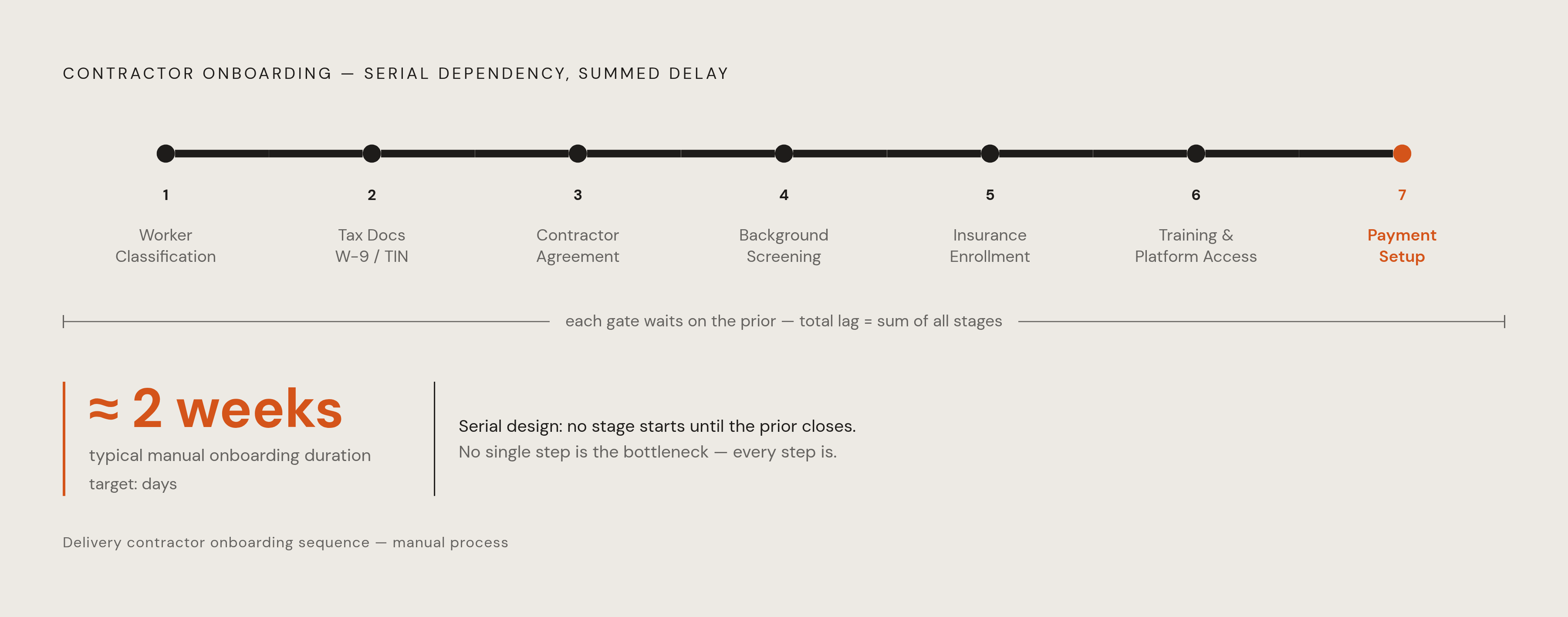
Onboarding is a chain of separate gates, and each gate has its own paperwork, its own compliance logic, and its own way of breaking.
Classification comes first, because it decides which tax forms apply and which legal tests govern the relationship going forward. Tax documentation comes next: a W-9 for domestic contractors, the right W-8 variant for foreign ones, signed and TIN-verified before the first dollar moves. Then the contractor agreement, covering scope of work, pay terms, IP, confidentiality, and language that backs up independent contractor status instead of undercutting it.
After the paperwork: credentialing and background screening. License validation, motor vehicle record checks, criminal background, insurance verification, a vehicle inspection where the work calls for one. Insurance enrollment follows, covering occupational accident, commercial auto, and cargo where relevant. Then training and platform access, covering route systems, the delivery app, safety rules, and any required certification. Payment setup closes the loop: bank or debit account on file, pay method chosen, backup withholding flagged if the TIN is missing or does not match.
Each of those seven stages can jam on its own. Most manual onboarding runs them one after another rather than in parallel, so the gap between application and first dispatch ends up as the sum of every delay across all seven stages, not just the worst one. What should take days routinely turns into weeks once paperwork starts bouncing back and forth by email, and the company footing the bill rarely notices until the roster on paper stops matching the trucks on the road.
Worker classification: the decision that shapes every step downstream
Classification is a legal determination, and multiple agencies run their own separate tests to check whether the label matches reality. Get this one wrong at the start and every downstream document inherits the mistake.
The IRS uses a three-factor test: behavioral control, financial control, and the type of relationship, with a specific set of questions probing each one. The DOL applies an economic reality test asking whether the worker actually depends on the business for a living; as of 2026 the agency has proposed a simpler two-plus-three factor framework and is not currently applying the 2024 independent contractor rule in its investigations. States pile a third layer on top. California's ABC test under AB 5, upheld by the Ninth Circuit in June 2024, presumes a worker is an employee unless the company clears all three prongs. Massachusetts and New Jersey run similarly strict standards, and states are increasingly active in enforcing these tests heading into 2026.
California's Prop 22 carve-out, upheld by the state supreme court in July 2024 in Castellanos v. State of California, exempts app-based gig workers from AB 5, but that exemption is platform-specific and does not cover most delivery DSP or courier setups. Courts scrutinize delivery arrangements especially hard: in Garza-Laureles v. Lab Logistics LLC (D. Conn., March 2026), couriers alleged misclassification because the company set their schedules, assigned their routes, dictated pickup and delivery procedures, required uniforms, and mandated specific operating guidelines. A defensible IC structure has to address well over 48 factors relevant across state and federal tests. Treating classification as a one-page checklist is how companies end up in court, and plenty do.
The financial exposure is not abstract. The IRS can claw back 41.5% of earnings in back taxes. California fines run up to $25,000 per violation. Grubhub's Lawson settlement closed at $24.75 million, finally approved in July 2026. An automotive parts distributor settled for $7 million covering 1,000 delivery drivers. Classification analysis has to be finished and documented before a W-9 goes out, before an agreement gets signed, before a single payment clears. It is not a task for year-end cleanup, no matter how tempting it is to treat it that way.
Tax documentation: the paperwork that unlocks payment and creates legal exposure if skipped
The W-9 has to be collected before the first payment, not chased down in December. Treating it as a condition of onboarding, rather than a follow-up task, is the whole point.
The form captures legal name, federal tax classification, and TIN, whether that is an individual taxpayer identification number or an EIN, and it has to be signed under penalty of perjury. An unsigned form does not count. If a contractor will not provide one, or hands over a TIN that does not match IRS records, the payer has to withhold 24% of every payment as backup withholding and send it to the IRS, even if the payment falls under the normal reporting threshold. The IRS TIN Matching service lets a payer check name-and-TIN combinations before filing, which cuts down on backup withholding surprises, though it requires registering on the IRS Payer Account File first.
2026 brought a real shift: the 1099-NEC reporting threshold jumped from $600 to $2,000 as of January 1, under the One Big Beautiful Bill Act signed in July 2025, and future adjustments are expected starting in 2027. That changes when a form has to be filed, not when the W-9 has to be on hand, and several states still run their own lower thresholds, so a multi-state delivery operation cannot assume the federal bump applies everywhere evenly. On top of that, the IRS is retiring the legacy FIRE electronic filing system for tax year 2026 (filed in early 2027), moving everyone over to the newer Information Returns Intake System.
Late-filing penalties for 2025 are tiered based on how late the form is filed. Survivable at small scale. Multiplying that exposure across a few hundred or a few thousand contractors turns it from a rounding error into an issue that reaches board meetings. Every week a contractor works without a validated W-9 on file is a week of exposure sitting on the books, and at high contractor volume, manual W-9 collection and TIN matching is one of the biggest single sources of onboarding lag.
The contractor agreement: what the document must do for both compliance and classification defense
Nothing in federal law says every engagement needs a written contract. Running without one anyway is a bad bet, because the agreement is the primary paper trail a company has if the IRS or the DOL comes asking questions about the relationship.
Scope of work needs to describe specific deliverables and deadlines. The closer an agreement reads like a job description, the more it works against IC status rather than for it. Payment terms should be a flat project fee, milestone payments, or a per-delivery rate, not an open-ended arrangement that functions like a salary in disguise. Good IC-reinforcing language covers the contractor's control over how the work gets done, ownership of their own tools and vehicle, freedom to work for other clients, and the absence of employee benefits.
The Garza-Laureles facts from 2026 show exactly where this breaks down: courts look past the contract's wording and check what actually happens day to day. If the company is assigning routes, setting schedules, and requiring uniforms, no amount of carefully drafted IC language will save it in court. The agreement should also cover IP ownership over any data or route information the contractor generates, confidentiality around customer data, what insurance the contractor has to carry, and how the relationship ends. A lot of onboarding stalls out entirely right here, tangled up in legal review, contractor questions, and back-and-forth negotiation, most of which disappears once a compliant template exists and can be signed digitally on the spot.
Credentialing and background screening: the verification steps specific to delivery contractors
Delivery work carries a layer of credentialing that most independent contractor work never touches, requiring driver's license validation, a motor vehicle record check, criminal background screening, and insurance verification. Major carrier networks, Major carrier networks have generally raised their screening expectations in recent years, and the bar keeps climbing.
Each of those credentials comes from a different source and runs on a different renewal clock. Licenses lapse. MVRs expire. Insurance policies can lapse or be cancelled mid-contract, creating gaps that may go undetected until an incident forces the issue. Credentialing is not a gate a contractor clears once and forgets, it needs ongoing monitoring to catch a lapsed license or a cancelled policy between onboarding and whatever dispatch happens six months later.
Crowdsourced and hybrid delivery models bring their own wrinkle: less direct control over how drivers are trained and how they behave on the road. The safer approach treats crowdsourced delivery as a supplement sitting on top of a credentialed core fleet. Manual credentialing, waiting on candidates to email documents, having staff review each one by hand, chasing down renewals that quietly expired, is a major reason delivery onboarding drags from days into weeks. It only becomes manageable at scale once it runs on continuous, automated monitoring rather than a one-time check at the door.
Insurance enrollment: occupational accident, commercial auto, and cargo coverage in the contractor onboarding sequence
Three kinds of coverage matter here. Occupational accident insurance covers a contractor's injuries on the job, built specifically for workers who do not qualify for standard workers' comp as employees. Commercial auto insurance covers the vehicle actually being used to deliver, and personal auto policies almost always exclude commercial use outright, so a contractor running deliveries on a personal policy is quietly uninsured, and so is the company relying on them. Cargo insurance covers the goods in transit, which matters most when contractors handle high-value or regulated freight.
The insurance gap is not hypothetical. A personal policy that lapses mid-contract, or a contractor who never had commercial coverage in the first place, creates liability exposure on every single dispatch until someone catches it. When contractors have to source and upload their own policy paperwork, enrollment slows to a crawl and errors creep in. When a company offers bulk-purchased coverage that contractors opt into during onboarding, insurance gets handled in the same sitting as the W-9 and the agreement signature, and the whole problem shrinks to a checkbox.
Buying in bulk also brings the per-contractor premium down, which matters directly to the bottom line once a network is managing coverage across thousands of drivers rather than dozens. None of this is a one-time fix, either. A contractor fully compliant on day one can slide into non-compliance six months later if nothing is watching for the policy to lapse, which loops right back to the same monitoring problem credentialing runs into.
Where manual processes cause the most timeline drag and what the bottlenecks cost operationally
Manual onboarding runs every stage in sequence: classification review, then the agreement goes out, then someone chases the W-9, then credentials get collected, then insurance gets verified, then payment setup happens last. Each step waits on the one before it, and on how fast the contractor responds, which is exactly the design flaw.
The drag points repeat across operations. Classification often gets skipped or done informally, which just banks retroactive risk for later. W-9s get emailed out and come back unsigned or with a TIN that does not match, and TIN matching gets done by hand or skipped. Agreements go out as PDFs and come back late, after negotiation or after just sitting in an inbox for a week. Credentialing documents arrive by email or through a clunky portal upload, and staff review each one manually and chase down whatever is missing. Insurance gaps become visible only at renewal time, or worse, when an incident forces the issue. Payment setup gets handled separately from everything else and does not get confirmed until the first pay cycle actually runs.
Added up, what should take days stretches into weeks, and contractors who cannot work do not work. The roster on paper is bigger than the capacity actually available on the road, which is a strange kind of fiction for an operations team to be running on. This scales badly, not well: a company running 10 contractors can absorb manual onboarding without much pain, but a 500-contractor network with constant churn cannot, and back-office overhead grows right alongside contractor count unless something automates the process. Delivery costs rose an average of 12% from 2024 to 2025. Idle contractor capacity is not a side effect of that trend, it is a direct contributor to it.
How purpose-built contractor management platforms compress the timeline and reduce compliance exposure
The fix is not new software so much as it is collapsing seven serial steps into one system that runs them side by side. Contractor management platforms built for this exact workflow let classification, tax forms, agreements, credentialing, and insurance enrollment happen in the same digital session instead of one slow relay race, which is the whole difference between two weeks and two days.
Digital W-9 collection paired with automated TIN matching catches mismatches before they turn into backup withholding headaches, rather than after the first payment already bounced. E-signature on a pre-built, compliance-checked agreement template turns what used to be days of legal back-and-forth into a five-minute step. Credentialing platforms that pull MVR, background check, and license data through API connections to state and vendor databases can clear a candidate in a fraction of the time a manual document review takes, and they keep watching afterward instead of stopping at the door. Insurance enrollment folded into the same flow, especially with bulk-purchased coverage contractors can opt into on the spot, closes what used to be one of the biggest and slowest gaps in the whole sequence.
None of this erases the underlying legal risk. Classification tests get harder every year, and no software fixes a company that sets schedules and requires uniforms while calling its drivers independent contractors, full stop. What automation buys back is the operational lag: the gap between a contractor applying and a contractor actually getting dispatched. In a market where the last mile already eats over half of total shipping cost and shipment speed expectations keep climbing, that gap is the one lever a company can actually pull without waiting on a court to redefine what "independent" means.