all-in-one compliance, insurance, and payment solutions for independent contractor programs
One system replaces three fragmented tools managing compliance, insurance, and payments.

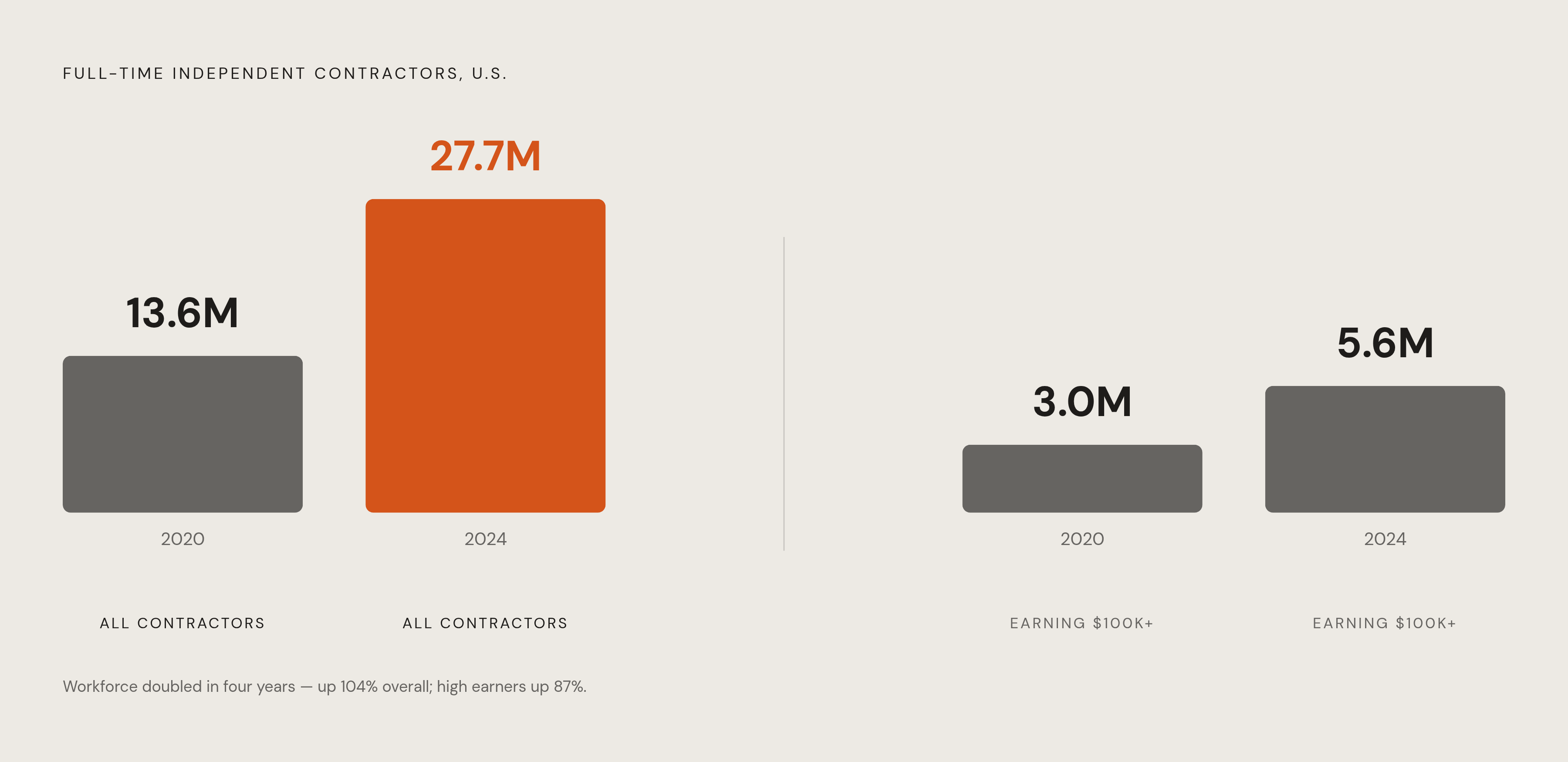
In fragmented IC programs, compliance gaps rarely surface because everyone assumes someone else owns what they can't see, a structural problem that becomes obvious only when a missing insurance certificate or tax form traces back to no clear owner. The independent contractor workforce doubled in four years, from 13.6 million full-time independents in 2020 to 27.7 million in 2024, and delivery operators are running networks that long ago outgrew the spreadsheets built to manage them. Compliance, insurance, and payments run as three separate systems in most IC programs, and that separation is where the cost and the legal exposure pile up. A setup that works fine for 50 contractors starts breaking, loudly and expensively, around 500.
The three systems every IC program actually runs on, and why they're usually separate
Every working IC program runs on three layers, whether anyone sat down and designed it that way or not. Compliance covers classification, credentialing, and the paper trail proving a contractor is actually a contractor and not an employee with a different tax form. Insurance covers occupational accident coverage, commercial auto, and cargo. Payments cover how fast contractors get paid, how tax forms get collected, and how 1099 filing happens without triggering backup withholding.
These three functions almost never sit in the same place: compliance lives in a spreadsheet or an HR tool, insurance runs through a broker relationship somebody's cousin recommended in 2019, and payments go through payroll or accounts payable. Nobody planned this. It happened because each function has its own owner, legal or HR for compliance, risk or finance for insurance, accounts payable for payments, and each owner picked the vendor that solved their own problem and moved on.
That division of labor made sense when contractor counts were small and changes were rare. It stops making sense the moment a single event, an expired license, a new delivery route, a lapsed insurance policy, needs to trigger action across all three systems at once. Fragmented systems don't talk to each other. So the trigger just doesn't fire, and nobody notices until something else forces the issue.
What compliance actually requires for a 1099 delivery workforce in 2026
Classification law isn't one test. It's several, and they don't agree with each other. The IRS runs a 20-factor test, the DOL applies an economic realities analysis, and a handful of states use ABC tests stricter than either one. Courts and agencies weigh how the engagement runs day to day far more than what the contract calls it. Slapping "1099 worker" on someone buys almost nothing if that person gets managed like an employee anyway, fixed schedule and all.
Federal enforcement keeps shifting under everyone's feet. The DOL's 2024 six-factor rule was paused in May 2025, and the agency has signaled a possible return to something closer to its 2021 standard. States like California and New Jersey keep enforcing their own rules regardless of what Washington does. California runs its own weather system here: the state Supreme Court upheld Prop 22 in 2024, locking in a compliance framework for delivery platforms that has nothing to do with federal posture and isn't moving.
None of this adds up to a one-time decision made at signup. Classification needs ongoing monitoring, not a single checkbox at onboarding. Every contractor's terms of engagement, their financial independence, the degree of control the company actually exercises day to day, needs periodic review as the relationship evolves. The fix in practice is keeping every contract, payment record, and tax form in one system of record, building a defensible file as you go instead of reconstructing one after a regulator calls. A 2026 legal update from oforce.com notes that the most consequential compliance developments right now come from regulators, not courtrooms, which means documentation quality is doing more work than legal argument ever will. People Managing People found that businesses with structured contractor onboarding see 30% lower compliance risk. Onboarding is where compliance posture gets set, for better or worse, and it's rarely revisited.
Where onboarding fragmentation creates the first wave of compliance and payment risk
Onboarding a 1099 contractor isn't employee onboarding minus the benefits paperwork. It's its own legal and tax process: a signed contractor agreement, proof of insurance and credentials, a W-9 or W-8BEN, identity verification, and whatever license checks the industry requires. Skip a step, or run it late, and the liability doesn't disappear. It just waits for someone to notice.
The W-9 shows what fragmentation actually costs in dollars. It has to get collected before the first payment goes out, not scrambled for at year-end, so the company can run TIN matching and avoid backup withholding. If a contractor never furnishes a correct taxpayer ID and the company fails to withhold, the company owes the IRS 24% of those payments out of pocket. Automated TIN matching at onboarding heads off the IRS's CP2100A "B-Notice," the letter that forces mandatory withholding once a mismatch surfaces.
The 2026 1099-NEC threshold moved up to $2,000 under the One Big Beautiful Bill, which trims filing volume at year-end. It does nothing for the underlying problem: by the time the threshold matters, the relationship has already run for months on whatever records happen to exist. Behavioral missteps compound the problem: fixed schedules, company job titles, and dictating how the work gets done can all convert a contractor relationship into an employment relationship in a regulator's eyes, and when onboarding, compliance, and payments sit in separate systems, there's rarely anyone watching for these patterns as they form. Structured onboarding cuts that risk, but only if the onboarding data stays connected to whatever tracks compliance and payments downstream. Split them apart and the benefit just evaporates.
The insurance gap that fragmented programs routinely leave open
Independent contractors don't get workers' comp through an employer. Full stop, no exceptions. That makes occupational accident insurance the main line of defense for delivery and field-based IC networks. OAI covers medical costs, disability income, and in some policies death benefits when a contractor gets hurt on the job. Without it, a serious injury becomes a cost the operator absorbs directly: medical bills that run catastrophic, plus a dispute that ends the contractor relationship and often lands in court a year later.
OAI has one key advantage over traditional workers' comp: flexibility. Pricing runs per mile, per delivery, per hour, or per period, which fits variable IC schedules far better than a flat premium. Commercial auto is the second piece almost every light-duty delivery contractor needs, and rates swing hard by vehicle type, state, and claims history. Litigation exposure and claims history vary significantly by state, and rates reflect those differences across delivery networks.
This is where fragmented programs get caught flat-footed. Insurance certificates get collected once, at onboarding, then filed somewhere apart from the compliance system and never looked at again. A policy lapses mid-engagement, the contractor keeps driving, and the operator has zero real-time visibility into any of it, right up until a claim arrives and there's no coverage to pay it. Operators who coordinate insurance purchasing across the whole network, instead of leaving every contractor to shop alone, lock in lower rates and a consistent coverage floor. That kind of bulk purchasing only works when insurance sits inside the same infrastructure as contractor management, not parked with a broker who checks in twice a year.
How payment speed and tax infrastructure shape the contractor relationship
Seventy percent of independent contractors say they chose contract work on purpose, which means they have options, and pay friction is a real reason to walk. Pay speed has become a genuine competitive factor in recruiting and keeping contractors, especially in delivery, where every platform fishes from the same pool of drivers.
Slow pay isn't just a contractor inconvenience, it's a symptom of a payment system disconnected from onboarding. When the two sit apart, operators end up chasing W-9s from contractors already three weeks into working, creating both a delay and the backup withholding exposure described above. Instant debit and same-day ACH have become table stakes for IC networks operating at scale. Delivery contractors running several engagements a week feel the cash-flow squeeze of weekly or biweekly pay cycles directly, and that squeeze pushes people toward whichever platform pays faster.
The 1099-NEC filing process is where all this fragmentation turns into an annual fire drill. If payment records sit in accounts payable and contractor records sit elsewhere, reconciling the two at year-end becomes a slow, error-prone manual audit that nobody catches until March. The new $2,000 threshold trims some volume, sure, but it doesn't touch the record-keeping gap underneath it. When payments, onboarding, and compliance data all live in the same place, tax filing turns into a reporting function instead of a reconciliation project, because the data was already sitting there, connected, waiting to get pulled.
How fragmentation turns manageable risks into compounding operational failures
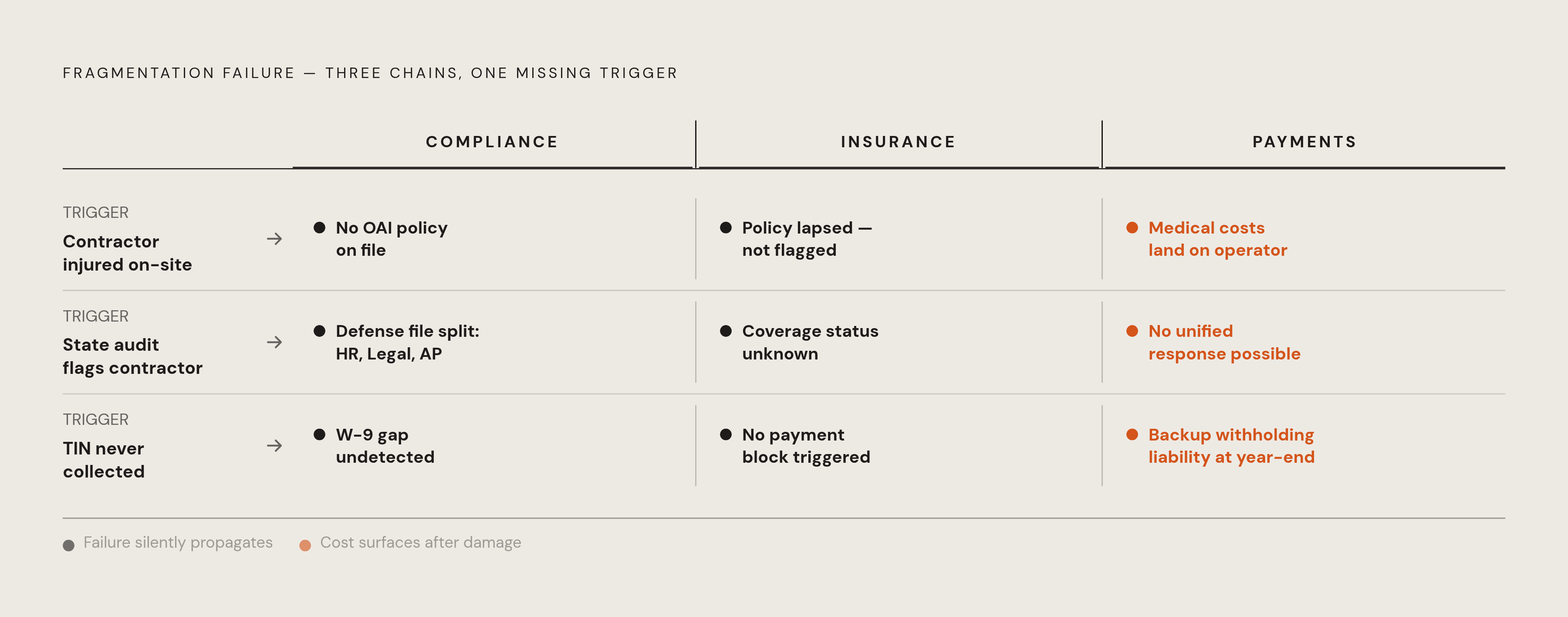
Any single gap on its own is easy to fix: one unverified credential, one lapsed certificate, one missing W-9. The trouble is fragmented systems don't surface these gaps until after they've already done damage. A contractor gets hurt with no OAI in place, medical costs land on the operator, litigation follows, and the coverage lapse surfaces only once the claim is filed. A misclassified contractor gets flagged in a state audit, and the defense file is scattered across HR, legal, and accounts payable, no single record proving the relationship stayed compliant throughout. A backup withholding liability shows up because a TIN was never collected, and nobody notices until accounts payable tries to reconcile payments against contractor files at year-end, months too late to fix cheaply.
The deeper problem is that each system sits on data the other two need and can't reach in real time. Compliance monitoring needs to know when a contractor is actively being paid, since payment activity signals an active engagement, but insurance verification should fire the moment onboarding wraps up, and if onboarding and insurance live apart, that trigger never goes off. Payment release should depend on compliance status, but when the systems don't talk, payments go out on schedule regardless of what's happening with credentials or coverage.
People Managing People's research found structured onboarding produces 25% higher project success rates, and the real driver behind that number is probably the data integration underneath the onboarding process, more than the onboarding steps themselves. At real scale, hundreds or thousands of contractors, manual reconciliation across disconnected systems doesn't just add risk. It becomes operationally impossible without hiring back-office staff in direct proportion to headcount, which is a cost structure nobody wants to explain to a board with a straight face.
What a unified IC program platform actually handles, and what to look for in one
A unified platform puts onboarding and credentialing, compliance monitoring, insurance administration, and payments into a single system of record. That means a shared data layer: a lapsed certificate, a completed onboarding step, or a released payment automatically updates everything connected to it. Separate modules exporting a CSV to each other once a day don't clear that bar, no matter what the sales deck calls it.
Real-time compliance monitoring does things a periodic audit structurally can't. It flags credential expirations before a contractor heads out without valid paperwork, catches insurance lapses and can pause payment release or flag the account for review before a claim surfaces, and keeps a running record of how the relationship actually operated, not a point-in-time snapshot that goes stale in six months.
Insurance built into the platform is what makes bulk purchasing possible in the first place. The operator coordinates coverage for the whole network instead of every contractor shopping alone, which lowers cost and raises the coverage floor at the same time. OAI and commercial auto priced at the program level, per mile or per delivery, do things an individual contractor's personal policy simply can't. Payment infrastructure built into that same system solves the W-9 chase for good: TIN matching happens during onboarding, payment release ties to compliance status, and 1099 data becomes a report pulled from records that already exist, not a reconciliation project someone dreads every January.
Evaluating a platform comes down to a short checklist. Onboarding should handle the contractor agreement, credential upload, tax forms, and TIN matching in one sequence; compliance monitoring needs real-time, configurable alerts instead of quarterly reminders that everyone ignores until the follow-up arrives. Insurance administration should actually manage OAI and commercial auto at the program level, not just hold a folder where certificates go to be forgotten, and payment rails need to support instant debit or same-day ACH rather than a standard weekly batch. Every contractor should end up with one defensible record spanning the entire relationship, start to finish. Platforms built from the ground up for 1099 networks, rather than employee HR software with a contractor module bolted on, tend to get the classification nuances right, because the logic of a 1099 relationship doesn't translate cleanly from a system designed around W-2 workers.
The tax form sequence shows the whole argument in miniature. W-9s have to get collected before that first payment goes out, or the company is on the hook for backup withholding, but when onboarding, compliance, and payments sit in three different systems, that timing slips more often than anyone likes to admit out loud. Platforms built specifically for 1099 delivery networks, GigSafe among them, automate that full sequence, TIN matching, identity verification, tax form collection, inside one workflow before the first payment processes. What used to be a multi-step handoff between systems becomes one record instead, and that record actually holds up when someone asks to see it.
Why operators who invest in unified infrastructure now will
Independent contracting reflects a structural shift in how delivery labor gets organized, and the numbers back it up. Full-time independents more than doubled between 2020 and 2024, and contractors earning over $100,000 a year grew from 3 million to 5.6 million over roughly the same stretch, an 87% jump that says this work is becoming a primary income source for a lot of people, not a side hustle they run on weekends. Operators running these networks on three disconnected systems aren't managing risk so much as storing it, quietly, until an audit, a lapsed policy, or a missed W-9 turns it into a bill with someone's name on it. The operators who unify compliance, insurance, and payments now build something that can add a thousand contractors without adding a proportional back office to babysit them, and that's the whole game. Everyone else finds out eventually that fragmentation was never free. It was just sitting on the books, unbilled, waiting for its due date.