Bulk Insurance Purchasing for Contractor Networks
Pooling contractor networks cuts insurance premiums thirty to forty percent.

Buy insurance one contractor at a time and every driver walks into underwriting as a stranger, priced from scratch, with no leverage and no data behind them. Pool a few hundred of those same drivers into one account and the math flips: same routes, same vehicles, same risk profile, and suddenly an actuary has something to work with. Bulk purchasing is a fundamental lever that shaves a few points off premium. It's a structural advantage a solo driver cannot buy their way into, no matter how clean their driving record is. The rest of this piece is about why that gap is real, and what happens to the operators who ignore it.
What bulk purchasing actually means in the contractor network context
Bulk or group insurance means the operator pools its whole contractor network under one program and negotiates as a single account, instead of leaving a few hundred drivers to negotiate separately, badly, or not at all. Carriers price risk on pool size, claims history, and how similar the drivers in that pool actually are to each other. A network of several hundred delivery drivers running comparable routes in comparable vans is a cleaner bet for an underwriter than any one driver walking in cold. The operator holds the policy, and contractors get rates and terms none of them could land shopping alone.
Most bulk setups now run embedded: coverage sits inside onboarding itself, so nobody shops for a policy, reads fine print, or forgets a renewal date buried in an inbox somewhere. That's a different animal from the per-gig micro-coverage some platforms offer through integrations, which insures a single delivery run and nothing past it. Bulk programs insure the relationship. Per-gig coverage insures the trip, and stops the second the trip ends.
The logic isn't new. Pooled volume has long been used as a bargaining weapon in other industries, stacking buying power to squeeze better terms out of suppliers. Contractor networks are running the same play against insurance carriers, just with delivery vans instead of other goods. And because the operator holds the policy centrally, it checks coverage for the whole fleet at once instead of chasing certificates contractor by contractor.
The scale of the contractor workforce that makes pooling viable
None of this works without volume, and the volume is there. Gig work touches roughly 70 million Americans in 2025, about 36% of the workforce, and platform-based labor generated $556.7 billion in 2024. Transportation and delivery aren't a slice of that story, they're most of it: ride-share and delivery services account for 58% of global gig economy revenue.
That concentration is the whole point. A delivery-focused bulk program insures one type of exposure at scale, across drivers who look nearly identical on paper. Same routes, same vehicle classes, same risk profile. That's exactly the kind of pool an actuary can price with confidence, and the bigger the network gets, the sharper the pricing gets. Scale doesn't just help here. It compounds.
The pricing advantages a pooled program unlocks that individuals cannot access
Carriers cut per-unit premiums when they underwrite one large, uniform block of risk instead of a stack of one-off applications. The whole logic behind volume discounting explains why it works for occupational accident insurance the same way it works for bulk freight rates. A driver buying OAI alone negotiates from zero every single time. An operator buying it for the whole fleet spreads the fixed cost of underwriting across hundreds of contractors, so the per-person price drops.
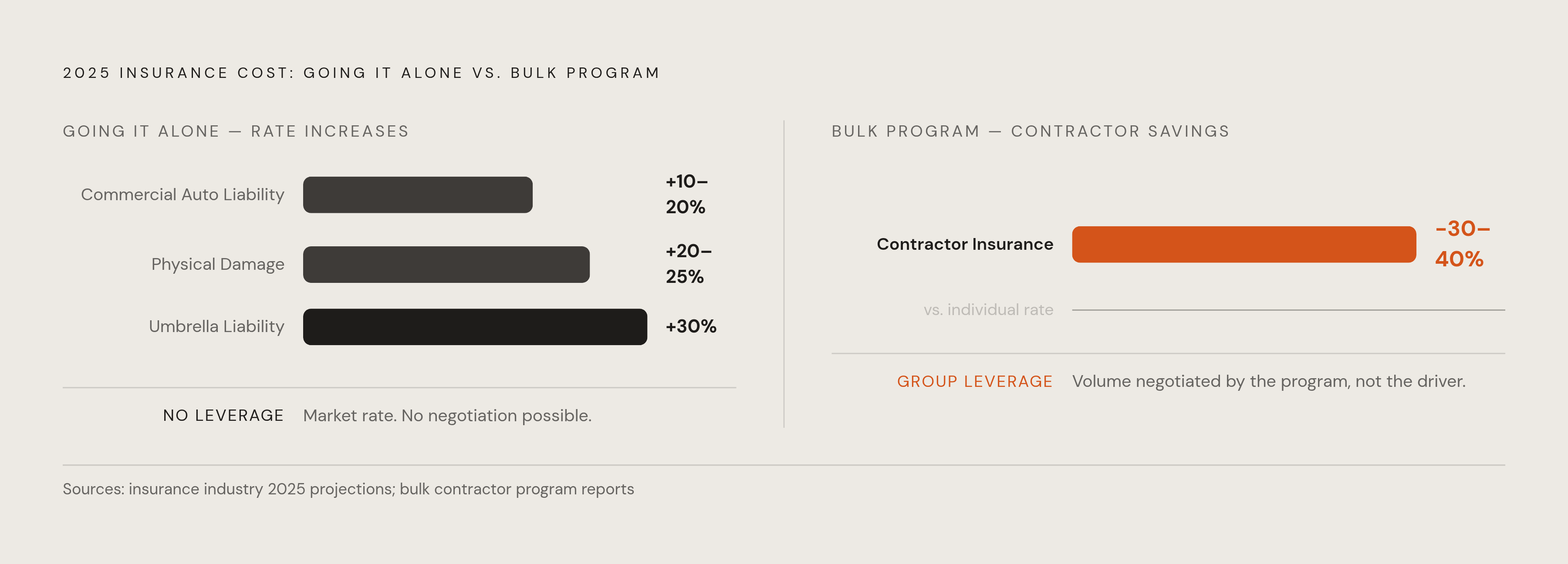
Commercial auto liability runs the same way. A carrier writing 500 drivers under one program has far more claims data to price against than one writing 500 separate policies, and better data buys sharper pricing and more room for credits. Bulk purchasing is one of the main levers behind the 30-40% savings operators report in contractor insurance programs, and that savings simply doesn't exist for a solo driver, or for an operator still buying coverage contractor by contractor.
Timing matters too. The commercial insurance market heading into Q4 2025 is calmer than it was in 2023 and 2024, per InsZone's commercial insurance outlook, and operators with clean loss histories and documented risk controls are the ones actually landing flat or lower renewals. That window won't stay open forever. Wait too long to build a bulk program and the underwriting conditions on offer get worse, not better.
The subcontractor default insurance market backs this up from a different angle: according to WTW, six carriers now offer SDI limits of $50 million or more per loss. Carrier appetite for pooled contractor risk is growing, and delivery networks sit right in the path of it.
Compare that to a driver going it alone. Commercial auto liability rates were projected to rise 10-20% in 2025, physical damage 20-25%, umbrella liability as much as 30%, driven by social inflation and nuclear jury verdicts pushing severity-driven lines up even as the rest of the market cools off. The Council of Insurance Agents & Brokers clocked Commercial Umbrella/Excess Liability up 8.6% in Q3 2024, against a 5.1% average across all lines. A solo driver has no leverage against any of that. They're a price-taker in a market that isn't in a negotiating mood, full stop.
Coverage advantages beyond price: what a bulk program covers that individual policies often don't
Price is half the argument. The other half is what actually gets covered, because plenty of drivers are running around with gaps they don't know exist until they're standing in an ER holding a bill.
Occupational accident insurance covers medical costs, disability, and death benefits for a 1099 contractor hurt on the job. Most solo drivers skip it, not out of carelessness but because they've never heard of it, or can't find an affordable standalone version to buy. Bake it into a bulk program and the gap closes for everyone automatically, no shopping required. Some OAI programs also include contingent liability coverage, which protects the operator if a driver's independent contractor classification gets challenged in court.
Cargo coverage and crime or employee dishonesty coverage matter as well, especially for networks moving high-value or sensitive goods, and individual drivers almost never buy either on their own. Specialized routes, medical deliveries, high-value freight, benefit from errors and omissions coverage, which protects against claims that a mistake or delay cost a client money. None of it shows up in a typical solo policy.
Then there's the platform coverage problem, arguably the biggest hole of all. Platform-provided coverage from gig apps is typically limited or absent between active deliveries, and some platforms only extend limited liability when the app is on but no delivery is active. Coverage switches off the moment a drop is complete, leaving a driver exposed during meaningful portions of the actual working day: driving to the next pickup, idling in a parking lot, walking back to the vehicle. A bulk OAI or commercial auto program built around the full working relationship, not just the active trip, closes that hole completely. Any operator still buying coverage piecemeal should treat that alone as reason to stop.
Carriers are also getting choosier about what they'll underwrite. Fleets submitting cleaner data, safety records, credentialing, telematics feeds, get better terms in 2025. Emerging platforms point at where this is heading: telematics, instant claims reporting, and automated compliance tracking feeding data to insurers and shaping underwriting outcomes. The coverage a bulk program can land is only as good as the operational data sitting behind it.
The compliance dimension: how bulk insurance intersects with contractor classification risk
Operators carry a legal obligation to confirm every 1099 contractor has proper coverage. That's not paperwork for its own sake, it's part of what keeps the independent contractor classification defensible in the first place. The Department of Labor closed out more than 17,000 wage and hour violation cases in 2024, and misclassification is the exposure that turns a missing certificate into a five- or six-figure regulatory problem. Last-mile delivery gets named specifically as a sector where drivers labeled contractors get reclassified as employees after the fact.
Individual purchasing makes this worse, not better. When each contractor buys a separate policy, the operator ends up chasing certificates, tracking renewal dates, and catching lapses after they've already happened, if it catches them at all. Every gap in that chase sits on the books as live exposure.
A bulk program run at the operator level cuts that chase out entirely. Coverage status is either on or off for every contractor in the system, tracked in real time instead of audited once a year when someone remembers to look. Contingent liability coverage inside the OAI program adds a further buffer if classification gets challenged, though it's worth being blunt about what that coverage does and doesn't do: it softens the financial hit from a dispute. It does not fix a classification that was wrong to begin with.
State law adds a layer individual purchasing handles badly. Requirements vary across all 50 states, and a bulk program built to meet federal and state rules across an operator's footprint is far easier to maintain than expecting each contractor to somehow get that right on their own. One more thing worth flagging: under the One Big Beautiful Bill Act, the federal 1099-NEC/1099-MISC reporting threshold jumps from $600 to $2,000 for payments made after December 31, 2025. That resets how platforms track contractor relationships and raises the stakes for platforms tracking contractor relationships under the new threshold.
The administrative load that bulk purchasing removes from day-to-day operations
Without a bulk program, someone in the back office is stuck collecting certificates, checking coverage types and limits, tracking expiration dates, and re-verifying everything after each renewal. Multiply that across a network running into the hundreds or thousands of contractors, and it stops being a task a person can do by hand. Every lapse that slips through unnoticed is a live liability sitting on the operator's books, waiting.
Bulk programs flip that process from reactive to proactive. Instead of chasing lapsed certificates after the fact, coverage status shows up in real time in one system. Build insurance into onboarding and a contractor's coverage gets confirmed before their first delivery, not verified retroactively after something's already gone wrong.
It removes friction for the contractor too. Instead of sourcing a policy before they can start earning, they're covered the moment they join, which means faster access to work and fewer people dropping out mid-onboarding because they got stuck trying to buy commercial auto coverage on a Tuesday afternoon. Compare that to what solo contractors deal with on the open market: separate applications, separate quotes from whichever carriers they can find, each disconnected from whatever compliance record the operator keeps. Platform-level administration collapses all of it into one renewal, one carrier relationship, one dashboard.
What operators should look for when structuring a bulk insurance program for their contractor network
A few things separate a program that actually works from one that just looks good in a pitch deck.
Coverage stack completeness comes first: commercial auto liability, occupational accident, cargo, general liability, and where the work calls for it, E&O and crime or dishonesty coverage. Skip one line to save on premium and the gap just moves somewhere else, usually somewhere more expensive. Classification alignment matters just as much: OAI has to be built specifically for 1099 workers, since employee drivers require different coverage, and blurring the two creates a coverage hole and a red flag for regulators at the same time.
Real-time monitoring beats periodic audits every time a program gets tested. A program that checks contractor coverage status continuously closes the gap between renewals that an annual spot-check never catches. Carriers reward operators who can show telematics data, MVR checks, and driver safety records, so a program plugged into that data lands better renewal terms than one that shows up with nothing but a spreadsheet.
Scalability is worth checking too, since a program that needs renegotiating every time the contractor count crosses some threshold defeats the point of building it. Look for carriers offering terms that can flex as the network grows, and insist that insurance administration live inside the same platform as onboarding, credentialing, and payments. A standalone insurance tracker nobody actually checks kills most of the administrative benefit the whole program was built to deliver in the first place.
Some workforce management platforms built specifically for 1099 contractor networks now run all of this as one integrated system: onboarding, real-time compliance monitoring, bulk insurance purchasing, automated payments, under one roof instead of five separate vendor logins. Worth asking, too, whether the program serves the contractor or just the operator's compliance checklist. A program that gives drivers visibility into their own coverage and a plain explanation of what's covered builds trust and cuts attrition. One that treats insurance purely as a box the operator needs checked is only doing half the job, and everyone involved usually knows it.