comprehensive workforce management solutions for gig delivery companies
Platforms need integrated systems to manage contractor compliance, insurance, and payments at scale.

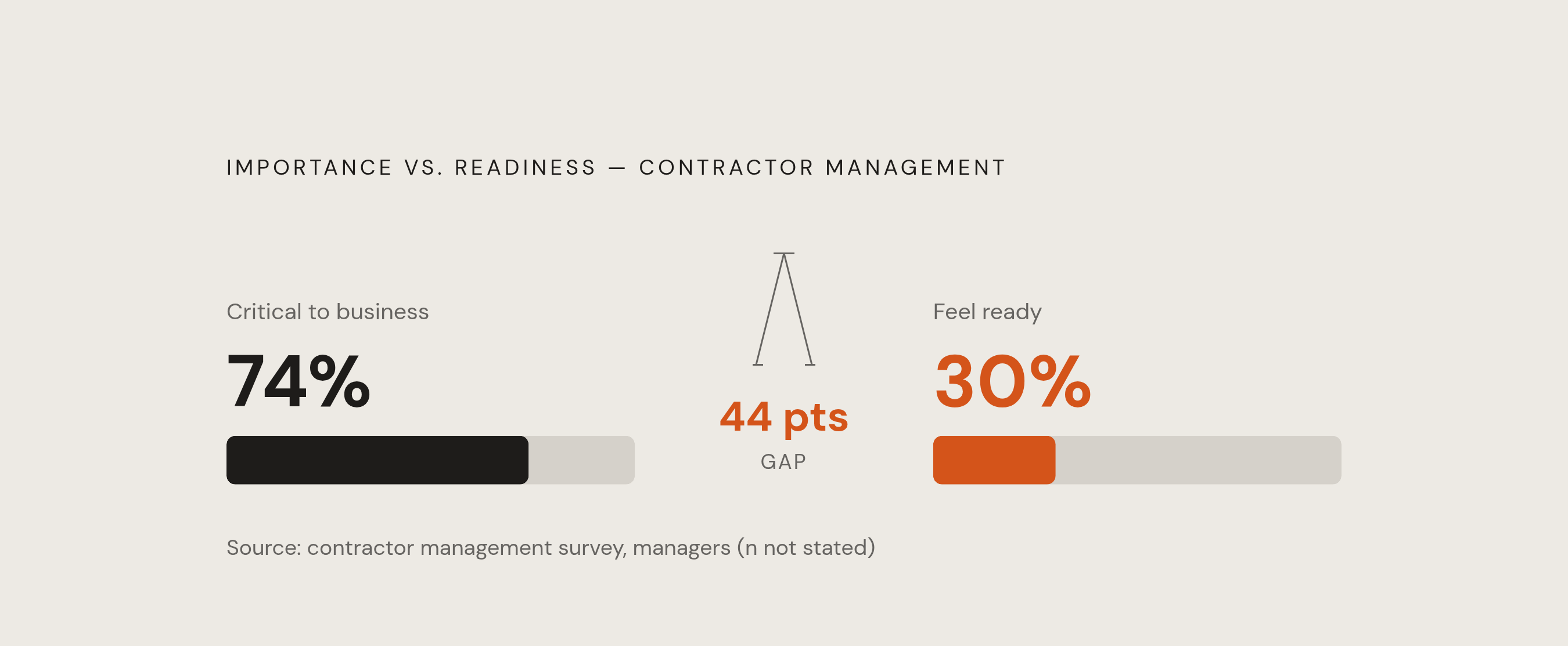
Independent contractor labor stopped being a side hustle for the American economy, and nobody sent out a memo. Full-time independent work went from 13.6 million people (8.2% of the workforce) in 2020 to 27.7 million (16.7%) in 2024. The trend line reflects a doubling. In logistics and delivery, 1099 networks aren't a workaround for avoiding payroll taxes anymore, they're the operating model, full stop. And yet 74% of managers say contractor management is critical to their business while only 30% feel ready to actually do it, which is the kind of gap that looks fine right up until it doesn't.
Here's the structural issue nobody wants to say out loud: W-2 onboarding happens once. IC onboarding never stops. Licenses expire, bank accounts change, insurance lapses, classification status shifts under a contractor's feet without them noticing. Most delivery operators handle this by duct-taping together four separate systems, one for onboarding, one for compliance, one for insurance, one for payments, each with its own login, its own data silo, and its own way of quietly failing. This piece walks through what a real, integrated system covers and why the four pieces stop working the moment they're split apart.
How the contractor onboarding process sets the compliance and operational baseline
Onboarding an independent contractor is an ongoing process without a clear start and end. It's a recurring administrative cycle: vehicle inspections need renewing, driver's licenses expire, insurance certificates lapse, banking details change when someone switches credit unions. A W-2 hire fills out paperwork on day one and that's mostly that. A 1099 driver needs re-verification on a schedule, and that schedule doesn't pause for the operator's convenience.
Front-loading W-9 and W-8 collection before the first payment goes out isn't just tidy bookkeeping, it's what keeps year-end 1099-NEC filing from turning into a scramble. And the population facing that filing burden just got a lot bigger: the IRS e-filing threshold now kicks in for any business filing 10 or more information returns, a rule that took effect for 2023 tax year filings (filed in 2024). Ten returns. A delivery operator with a modest regional fleet clears that in a slow month.
Contractors also vote with their feet, and they vote fast. A driver who can't finish onboarding and get to a first delivery within a few days goes and downloads a competitor's app instead. Paper forms and multi-day approval queues aren't a mild inconvenience, they're a leak in the top of the funnel. Once a contractor population climbs into the hundreds, manual onboarding stops being a staffing question and becomes a math problem: either the platform automates the credentialing, tax collection, vehicle verification, and insurance enrollment in one flow, or the operator hires more back-office staff to keep pace. A purpose-built system handles all of that in a single pass. A generic HR platform with a contractor module bolted on usually can't.
The compliance monitoring requirement that onboarding alone cannot satisfy
Getting a contractor cleared at signup tells an operator nothing about where that contractor stands six months later. And right now, the ground underneath classification rules is shifting in real time. The Department of Labor's six-factor economic realities test from 2024 is technically still in effect, but the Trump DOL announced on May 1, 2025 that it will no longer enforce it, with a new rule closer to the 2021 standard proposed but not finalized. Operators are left making staffing decisions against a standard that exists on paper and doesn't in practice.
State law piles on top of that federal fog. California runs a dual framework: AB 5, upheld by the Ninth Circuit on June 10, 2024, and Prop 22, upheld separately by the California Supreme Court on July 25, 2024 in Castellanos v. California. New York's Freelance Isn't Free Act requires written agreements for any contract worth at least $800, and it applies statewide. New York City sets its own minimum pay floor for app-based delivery drivers at $17.96 an hour, scheduled to climb to $19.96 by April 2025. None of these rules talk to each other, and an operator running contractors across state lines has to track all of them simultaneously.
The financial exposure here isn't hypothetical. The DOL's Wage and Hour Division recovered more than $273 million in back wages and damages for close to 152,000 workers in 2024 alone. A single misclassified worker can generate liability north of $135,000 once IRS penalties, state violations, and retroactive claims stack up. Classification audits should run every six months to catch drift before it becomes a lawsuit, and doing that manually across a network of hundreds of drivers simply isn't something a back-office team can execute. Real-time monitoring catches a lapsed license or an expired insurance certificate before a delivery goes out. A quarterly spreadsheet audit catches it after the incident, when the only thing left to do is call a lawyer.
What insurance coverage for IC delivery workforces actually requires
Independent contractors fall into a coverage gap that nobody designed on purpose but everyone has to live with. Workers' compensation, the standard W-2 protection, is generally not available to independent contractors. Personal auto insurance typically was not designed to cover commercial delivery use, which means a driver's own car insurance may not pay out if they get hurt on a delivery run. Occupational accident insurance, OAI, exists precisely to fill that hole: it covers medical costs, disability income during recovery, and accidental death and dismemberment for contractors hurt while under dispatch. It's not workers' comp. It's the closest thing available, and for delivery networks it's effectively mandatory infrastructure, not an optional add-on.
The economics favor it too: OAI typically runs about 30% cheaper than workers' comp, which makes it the right tool for the job rather than a discount substitute. Carriers have built pricing to match how gig work actually functions. Zurich, for one, prices OAI per mile, per delivery, per task, per hour, per day, per week, or per month, letting coverage track what a contractor actually does instead of guessing at a fixed payroll number. Disability benefit calculations can even fold in earnings from multiple platforms for drivers who run more than one app at once.
Most operators end up layering coverage: OAI paired with contingent liability, sitting alongside commercial auto rather than replacing it. Carriers like Crum & Forster, whose Occupational Accident Insurance division specifically serves motor carriers and independent owner-operators, and Great American Insurance Group both offer bundled products combining OAI and contingent liability with physical damage and non-trucking liability. Buying that coverage at the platform level, across an entire contractor network, unlocks group pricing that no individual driver could get shopping alone, which cuts per-contractor cost and simplifies enrollment considerably.
One catch worth flagging: platform-only OAI coverage ends the moment a contractor logs off that specific app. A driver running multiple platforms can end up with coverage gaps that go unnoticed until something goes wrong. States are starting to build their own floors underneath this. California's Prop 22 gives qualifying drivers a quarterly health stipend tied to hours worked, and Massachusetts rolled out a portable health fund in 2025. Operators need to track these state-level protections the same way they track federal rules, because the floor keeps moving.
How payment speed became a contractor retention and compliance function simultaneously
Money talks, but apparently speed talks louder. Pay speed has emerged as a major driver of contractor loyalty: a platform offering instant payout can be more attractive than one paying more per delivery on weekly ACH. Run the logic forward and the conclusion is almost funny: paying fast is cheaper than paying more.
Yet as of November 2025, only 36% of platforms actually offer instant payouts, according to PYMNTS. The other 64% running weekly or biweekly ACH are competing for drivers with one hand tied behind their back. The payment rails themselves matter here in specific, technical ways. Same Day ACH delivers funds on business days, and NACHA reported 1.4 billion Same Day ACH payments processed in 2025. Push-to-card through Visa Direct or Mastercard Send lands funds on a debit card in under 30 seconds, 24 hours a day, weekends and holidays included, no cash-out window required. Other instant payment rails offer round-the-clock transfers, which matters most for a contractor who needs today's earnings to buy tomorrow's gas.
Third-party infrastructure isn't free, either. Third-party instant payout products carry their own per-transaction fees and caps, numbers worth holding up against whatever an integrated platform quotes. And once monthly contractor payments cross into the hundreds, manual approval queues stop being a minor annoyance and start being an operational bottleneck; API-first infrastructure processes thousands of on-demand payout requests a week without adding a single person to the back office.
Payments and tax compliance are really the same system wearing two hats. Automated W-9 and W-8 collection at onboarding feeds directly into 1099-NEC and 1042-S filing at year-end, and a platform that handles the money but not the paperwork leaves the operator holding the compliance bag. That bag is also about to get heavier in a good way: the 1099-NEC reporting threshold rises to $2,000 for tax years beginning after 2025, up from $600, and a payment system needs to track that threshold automatically rather than relying on someone remembering to check.
Why each component breaks when it operates without the others
Split these four pieces apart and each one quietly stops doing its job.
Onboarding without ongoing compliance monitoring means a contractor cleared on day one can drift out of compliance by month six, a lapsed license here, an expired inspection there, and the operator finds out from an accident report instead of a dashboard alert. Compliance monitoring without insurance tied into the same system is just as useless: knowing a policy lapsed doesn't help if there's no automatic trigger to re-enroll the contractor before their next shift. Insurance priced per mile or per delivery depends on accurate payment data flowing in real time, so a payment system sitting in a separate silo produces coverage numbers nobody can actually audit, either the operator's paying for coverage that doesn't match activity, or the contractor's underinsured and doesn't know it.
And payments running ahead of onboarding create their own mess: pay a contractor before the W-9 is on file and there's a 1099-NEC filing problem waiting at year-end; pay without checking current classification status and there's a misclassification claim waiting behind it. Research from WorkMarket found that in about 40% of enterprises, one in four workers is already a contractor. At that ratio, the administrative surface of four disconnected tools grows faster than any back office can staff up to match.
The real danger isn't any one of these failures on its own, it's the cascade. A lapsed credential leads to an uninsured delivery incident. That incident triggers a misclassification investigation. The investigation surfaces a payment documentation gap that's been sitting there for months. Every seam between systems that wasn't stitched together becomes its own separate liability, and they tend to surface in the worst possible order.
What to look for in a platform built to handle all four components at once
Start with onboarding: does the platform handle credentialing, tax form collection, vehicle and license verification, and insurance enrollment inside one contractor flow, or does a driver bounce between four different logins to finish signing up? Does it re-verify on a recurring schedule, not just once at intake? And is the actual experience built for a mobile-first workforce that expects to start earning within days, not weeks?
On compliance, the test is whether monitoring runs continuously or in periodic batches. Does the system track state-specific rules, AB 5 exemptions, New York's written agreement requirement, NYC's minimum pay floor, alongside shifting federal standards, and update automatically when those standards change? Can it produce documentation that shows insurers and enterprise clients the operator's compliance posture on demand, rather than after a request comes in?
Insurance evaluation comes down to whether OAI and commercial auto are sold as one integrated product or something the operator has to source externally and manage by hand. Is bulk group pricing on the table, and is it structured around actual per-delivery or per-mile activity instead of a flat payroll estimate? Does the system flag a coverage gap before it becomes an incident report?
Payments follow the same logic: native support for instant debit and Same Day ACH, not a third-party plug-in charging its own fee on top. API-first infrastructure that clears large payment batches without a manual approval line. And 1099-NEC filing, W-9 management, and threshold tracking (that $2,000 figure for tax years after 2025) running automatically inside the same system that cuts the checks.
The single most telling question, though, is simpler than any of that: do all four components share one contractor record, or is someone on staff still copying data between four separate systems by hand? Platforms built originally for W-2 HR management and later retrofitted with a contractor module tend to miss the IC-specific logic, re-verification cycles, per-delivery insurance rating, automated 1099 handling, that delivery operators actually need once the network scales past a few dozen drivers. GigSafe is one platform built around that exact premise: compressing onboarding from weeks to days by running W-9 collection, credential checks, vehicle inspection, insurance enrollment, and banking setup through a single system instead of four disconnected ones. For an operator watching contractors choose between a fast platform and a slow one, that difference cuts to the core of the decision. It's the whole ballgame.
Sources
- Labor Law Compliance for Gig Workers: Employer Guide 2025
- Independent Contractor Compliance Regulations Guide | WorkMarket
- United States Independent Contractor Laws by Country | Rise
- Nelson Mullins - Department of Labor Plans to Rescind Biden’s Gig Worker Rule Making It Easier for Companies to Use Independent Contractors
- gigsafe.com
- Gig Insurance: Workers & Platform Companies | Zurich Insurance
- shiftnow.com
- Beyond the W‑2: I‑9 Compliance in the Contractor & Freelance Era