Onboarding Module Design for Multi-Client Delivery Operators
Modularity cuts contractor onboarding time by half through layered, client-specific requirements.

Onboarding Module Design for Multi-Client Delivery Operators
Why multi-client delivery operators face a compounding compliance problem
A delivery operator serving multiple clients, such as shippers, retailers, and DSP programs, must meet each client's distinct credentialing, insurance, and training requirements while managing a shared contractor pool. Every new client signed is, in effect, a new rulebook bolted onto an existing operation.
That leaves three paths gcheck.com. Rebuild onboarding from scratch for each client, patch the existing system with manual exceptions, or design the onboarding architecture from day one to absorb variation without rework. A contractor pool of a few hundred can survive spreadsheet triage. A pool in the thousands cannot.
The labor market makes the timing worse. More than 70 million Americans work in the gig economy in 2025, with projections putting freelancer counts near 86.5 million by 2027 demandsage.com oysterlink.com. Slow onboarding does not just cost administrative time. It costs the driver.
None of this is really a compliance story.
What clients vary on and share
Here is the useful part: clients don't vary on everything. Most of the onboarding stack is identical no matter which client a contractor ends up delivering for. The independent contractor agreement, W-9 and TIN collection, background check consent, motor vehicle record authorization, payment setup, and basic vehicle documentation look the same for a contractor delivering for a regional grocer or a national parcel client.
What actually changes are the thresholds sitting on top of that shared base. Insurance minimums differ by client, sometimes significantly, across commercial auto coverage and occupational accident requirements.
Looking outside pure delivery, the pattern holds. ModivCare, a non-emergency medical transportation broker, requires background checks through Checkr, OIG LEIE clearance, national sex offender registry (NSOPW) clearance, current CPR and First Aid certification, PASS training, and a clean MVR before it lets a contractor near its portal. That's five separate credentialing layers stacked onto a single client program gcheck.com.
The variation is bounded. It's configuration variation, different values plugged into the same fields, not different fields. That distinction is what makes this solvable with architecture rather than headcount.
The layered module architecture: shared base, configurable stack
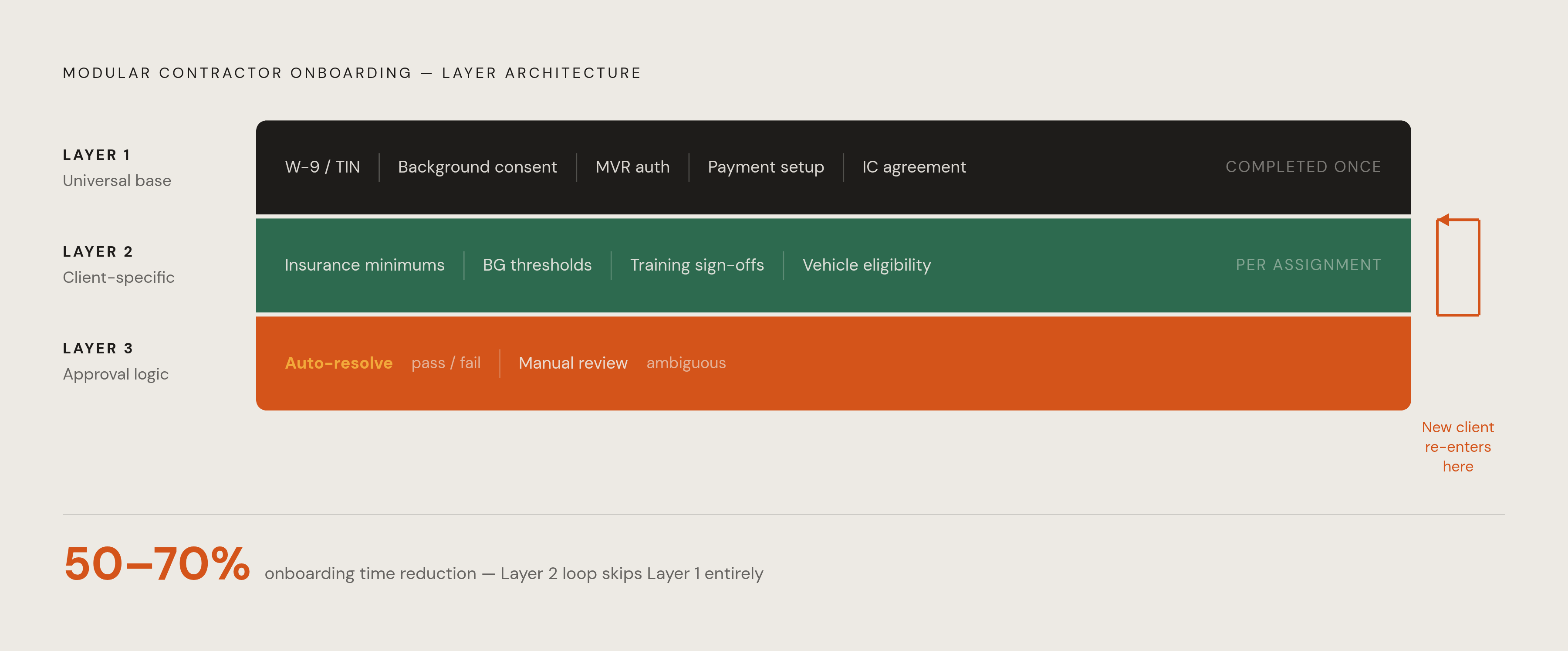
The fix follows directly from the diagnosis. Build one universal compliance base that every contractor completes exactly once, then stack client-specific requirement sets on top as modules that activate only when a contractor is assigned to that client's program.
Layer one is the base, completed once and applying across all clients: W-9 and TIN collection and verification, done at onboarding rather than retroactively. Every contractor touches this layer once, regardless of how many clients they eventually work for.
Layer two is where client identity enters the picture: insurance certificate minimums specific to that client, background check criteria tuned to that client's lookback period and disqualifying conditions, training modules and sign-offs that client requires, vehicle eligibility rules unique to that program. None of this activates until a contractor is actually assigned to that client.
Layer three is approval logic that decides who reviews what and what blocks activation. Verifiable criteria like MVR results or background check outcomes against a client's stated threshold get resolved automatically, pass or fail, no human needed. Anything ambiguous, like an old conviction that needs a fair-chance evaluation, routes to a manual review queue instead of an automatic reject.
The design target is simple to state and harder to build: a contractor qualifying for a second or third client program should complete only the incremental layer-two requirements for that program, never the entire stack again gcheck.com. Get that right and the platform-level payoff appears in the numbers. Research on contractor management platforms built this way cites onboarding time reductions in the 50 to 70 percent range demandsage.com accio.com oforce.com. That's not a rounding error; it can mean a contractor taking their first job this week instead of next month.
How classification risk shapes module content
Architecture solves the operational side. It does not solve the legal exposure that produces it: a question the module stack has to answer correctly every time, is this person a contractor or an employee, and does the paperwork agree with itself.
Classification status decides who owns the compliance burden. W-2 employees have their credentials managed by the operator directly. Independent contractors are generally responsible for maintaining their own credentials and submitting them straight into the broker portal. Get the module language wrong and that distinction erodes on paper even if it holds in practice.
The federal rule of the moment is the 2024 six-factor economic realities test, and it remains the operative standard even though the DOL has stopped applying it in its own enforcement investigations while a replacement is pending. In February 2026, the DOL proposed rescinding it altogether in favor of something closer to the 2021 standard, but that proposal isn't final, so the 2024 test still governs until it is. Module content written today needs to survive scrutiny under a rule that could change under it.
State law adds a second, messier layer. New York's Freelance Isn't Free Act imposes contract requirements with real enforcement teeth, and New York City mandates a minimum pay rate for app-based delivery drivers of $17.96 an hour, rising to $19.96 by April 2025. An operator running contractors in six states is running six different classification tests simultaneously, and the onboarding module has to survive every one of them, including every state beyond the one where headquarters sits.
Background check design tracks a parallel shift. Blanket disqualification is giving way to individualized, job-relevance assessment across the industry, so the manual review path in layer three is the mechanism that keeps a reject decision defensible gcheck.com. Module language carries classification exposure (onboarding materials that use employee-like language, such as health insurance, paid time off, workers' compensation benefits, can be used as evidence in DOL or court assessments of the actual working relationship).
Tax compliance modules: W-9 collection, TIN verification, and the 2026 threshold shift
Starting in 2026, the IRS reporting threshold for Form 1099-NEC and 1099-MISC jumps from $600 to $2,000, a change written into the One Big Beautiful Bill Act signed in July 2025, with backup withholding rules moving to match the new figure 1800accountant.com. Fewer forms get filed. That is the entire scope of the change.
It is not a compliance relaxation, whatever it might look like from a distance. The threshold increase is not a compliance relaxation, it reduces the number of forms required but does not change classification rules or the IRS's authority to audit worker relationships. Treating the higher threshold as a green light looks harmless for a year and expensive in the third.
The real risk is quieter than the headline change. Payments between $600 and $1,999 will no longer generate a 1099 at all, which removes a document trigger that used to make classification problems visible early 1800accountant.com. That blind spot scales with the contractor network: it gets worse exactly where operators can least afford it 1800accountant.com. Fewer forms also means fewer automatic checkpoints where a misclassified worker or a bad TIN gets caught before it becomes a bigger problem. And the fines for getting the old rule wrong haven't gone anywhere: omitted 1099-NEC forms for the 2025 tax year, filed under the old $600 threshold, can draw a $340 penalty per form 1800accountant.com kirschcpa.com.
The fix is sequencing. W-9 collection and TIN verification belong at onboarding, run through automated TIN matching against IRS records the moment a contractor signs up, not chased down in a year-end scramble. For an operator running hundreds or thousands of contractors, that single design choice, refusing to let anyone reach payment setup without a verified TIN on file, eliminates the single largest source of year-end tax cleanup. Operators moving money through third-party payment platforms should also keep the 1099-K threshold straight from the 1099-NEC threshold: 1099-K reporting was restored to more than $20,000 and over 200 transactions annually under the same legislation, and it is a separate rule governing a separate payment structure forbes.com.
Insurance modules: configuring coverage requirements by client program
Insurance is the layer-two field with the widest spread across clients, since commercial auto minimums, cargo coverage, and occupational accident requirements rarely match from one client program to the next gcheck.com. That variance is why insurance capture belongs as a conditional module triggered by client assignment, with each client's minimums hard-coded so the system flags a non-compliant certificate automatically instead of relying on someone to notice.
Certificates expire, which makes this a running obligation rather than a single checkbox at intake. The module needs to feed continuous monitoring that flags a lapsed certificate the moment it lapses.
Some operators go a step further and provide access to occupational accident and commercial auto coverage directly through the platform, giving contractors a path to a given client's minimums without shopping for a policy on their own, often at rates better than what an individual would find alone. It's a design choice that solves two problems in one motion: coverage compliance and contractor convenience gcheck.com.
The activation gate ties back to this directly. A contractor should not show up as deployable to a given client until the system confirms their coverage actually meets that client's specific minimum, not merely that a certificate exists somewhere in the file. Handled this way, the insurance module functions as a credibility signal to the client: proof that everyone deployed under their name actually meets the standard they set.
Credential and training modules: managing ongoing requirements without manual tracking
Some credentials don't end at onboarding, they renew. Driver's licenses expire, vehicle inspections lapse, drug screenings need repeating, certifications time out. Each of these is a recurring obligation, and the module architecture needs expiration tracking and automated re-verification prompts built in rather than bolted on after the fact.
Training requirements split by client the same way insurance does. Some clients want product-specific training, some want safety sign-offs, some want operational procedure acknowledgments before a contractor can take a single job under their program. The clean way to manage this is storing every completion at the contractor record level, tagged to whichever client program required it, so the operator can produce proof of compliance for any client on request without digging through folders.
The contractor-borne versus operator-managed split matters again here. Independent contractor arrangements generally put the burden of maintaining credentials on the contractor, who submits directly. The module's job is making that submission frictionless on the contractor's end while the verification and expiration monitoring happen automatically on the operator's end. Frictionless intake, automated backend, that's the split that actually holds up at scale.
The fair chance layer belongs here too. As background check practice moves away from blanket disqualification toward individualized review, the manual assessment path isn't a courtesy step, it's what keeps a disqualification decision defensible when someone asks how it was made. Of every layer in this stack, credential tracking is where manual work compounds fastest as contractor count rises, which also makes it the layer where automation pays back the most.
Payment modules: speed and structure as part of the onboarding experience
Payment setup sits in the universal base layer, but how fast a contractor gets paid, and how clearly that speed gets communicated during onboarding, decides whether they stick around to work.
Flexibility draws 70 percent of gig workers to the work in the first place, autonomy draws 49 percent, and access to varied projects draws 46 percent demandsage.com accio.com. Speed of access to earnings sits right alongside those motivations as a retention factor, particularly in a market where a contractor can simply open a different app if one platform is slower to pay demandsage.com accio.com. Instant debit and same-day ACH aren't a differentiator anymore, they're the floor. Operators who don't surface pay speed clearly during setup lose contractors to the ones who do.
That argues for putting payment setup early in the flow rather than treating it as the last box checked after every client-specific module is done. A contractor who sees confirmed payment configuration before wading through client-specific paperwork has a reason to finish the rest of onboarding. TIN verification and payment setup should be explicitly linked in the sequence too: the system should hold payment until a verified W-9 is on file, and it should tell the contractor why, rather than blocking payment with no explanation attached.
For an operator running multiple client programs, the payment profile itself should be built once per contractor and reused everywhere. Nobody should have to re-enter banking details or re-verify identity just because they picked up a second client program on the same platform.
Scaling to new clients without rebuilding the stack
The real test of this architecture isn't how it handles the first client, it's how it handles the tenth. Adding a new client should mean configuring one new layer-two set, insurance minimums, background check thresholds, training requirements, activation criteria, without touching the universal base or any existing client's configuration gcheck.com.
Every time a new client instead triggers a manual exception or a custom onboarding flow built outside the platform, the operator eats the cost three times over: back-office time spent building it, inconsistency risk introduced by a one-off process, and slower activation for contractors trying to work that client's jobs gcheck.com.
A practical checklist for bringing a new client onto the platform runs short: document that client's background check criteria and lookback period, capture their insurance minimums by coverage type, identify whether their training requirements are client-proprietary or already standard on the platform, define the exact activation gate that marks a contractor deployable, and confirm the jurisdiction-specific rules for every state where that client's jobs actually run. Five items, and none of them touch the base layer other contractors already completed gcheck.com.
The payoff lands on the contractor side as much as the operator's. A contractor already onboarded to the base layer should be able to add a new client program by clearing only the incremental requirements, not repeating the whole process from the agreement page forward. In a labor market where contractors compare onboarding friction across platforms the way shoppers compare checkout speed, that difference is not cosmetic, it's the whole competitive argument. Real-time monitoring across all these layers keeps the architecture actually holding once the client roster stops being small enough to track by memory.