Contractor Training and Certification Requirements for Delivery Networks
Delivery networks must track four separate credential categories with independent expiration cycles.

Delivery networks built on independent contractors carry a training and certification burden that generic gig platforms simply don't. A rideshare driver needs a license and an inspection sticker. A delivery contractor moving freight for a shipper needs that, plus DOT medical eligibility, cargo insurance, background clearance, platform-specific onboarding modules, and often shipper-mandated certifications layered on top, each with its own expiration clock running independently of the others. The gig workforce feeding this system is enormous: U.S. freelancers hit 76.4 million in 2025, roughly 36% of the workforce. Scaled across a delivery network with thousands of active contractors, the credentialing gap becomes an operational risk with a dollar figure attached. Everyone knows the rules exist. It's building a system that tracks them without accidentally turning contractors into employees in the eyes of a regulator.
The credential categories every IC delivery network must track
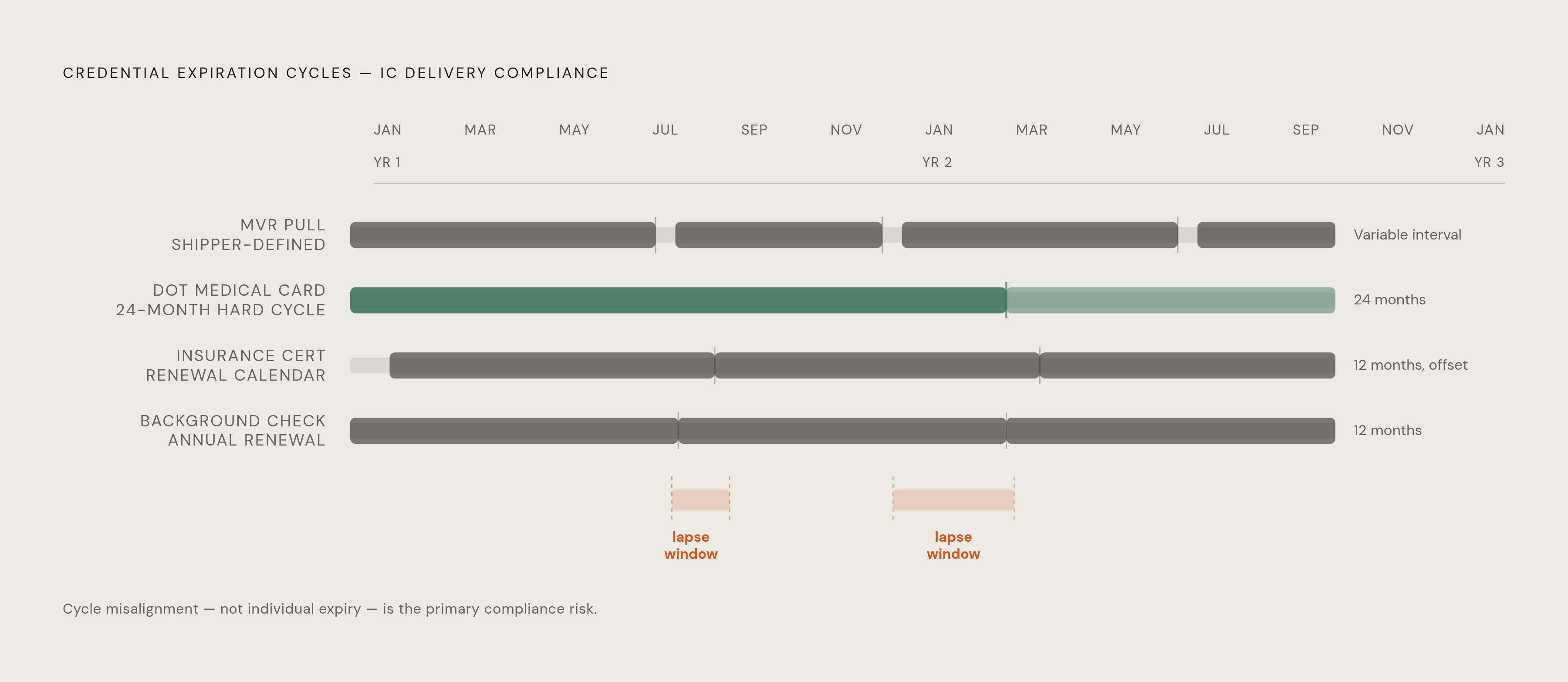
Four categories, four different owners, four different expiration logics. None of them run on the same clock. A single onboarding checklist falls apart the moment a network scales past a few dozen drivers.
Driver licensing and eligibility comes first: a valid state license at the right class for the vehicle, plus a motor vehicle record pulled at onboarding and, for many shippers, re-pulled periodically after that. CDL holders get their medical certification transmitted electronically through the Commercial Driver's License Information System, which sounds like a solved problem until you notice that most last-mile delivery associates don't hold a CDL at all. Non-CDL drivers sit outside that electronic system entirely, running on a standard DOT medical certificate that's valid for up to 24 months and expires as a hard compliance event, not a soft one.
Vehicle credentials form the second bucket: registration current and under the correct name or entity, annual inspection records where state or shipper rules require them, and vehicle weight class that can quietly trigger federal Hours of Service and ELD requirements a smaller operator never expected to deal with.
Insurance documentation is the third, and probably the messiest. Personal auto policies typically exclude commercial delivery use outright, so commercial auto liability isn't optional, it's foundational. Add cargo coverage, add occupational accident insurance standing in for workers' comp (since IC status usually means standard workers' comp doesn't apply), and add certificates of insurance that need the correct named insureds and a tracked expiration date. Whether a driver counts as a gig driver, a DSP contract carrier, or an owner-operator determines which coverage layer actually applies to them.
The fourth category covers platform and shipper-mandated training: background checks renewed on an annual cycle, safety modules with actual proof of completion, shipper-specific certifications for fragile or temperature-sensitive freight, and basic proficiency with the routing software and telematics devices drivers are expected to use every shift. Four categories, four expiration cadences, and not one of them syncs up with the others.
How the Amazon DSP program defines the industry benchmark for structured driver training
A large e-commerce company's last-mile contractor training program is the largest of its kind in the country, and it's worth studying regardless of whether an operator ever competes with it directly. As of October 2025, the program supports 4,500 small business owner partners and has trained more than 140,000 drivers across 65 immersive training sites. Amazon has put $16.7 billion behind DSPs and their drivers over the program's seven-year run, showing that training at this scale isn't a compliance afterthought, it's infrastructure.
The iLMDA structure runs a deliberate sequence. The program sequences virtual instruction first, covering business standards, safety protocols, and the routing software and delivery tools drivers will use daily, before moving into hands-on training at a live delivery station and then actual on-road experience, so road time follows structured preparation rather than preceding it. The technology layer mixes traditional classroom instruction with VR headsets, and driving simulators are already live at select sites, with wider rollout planned. Mock-town environments, the kind of built-out practice neighborhoods some driver training programs use, remain a planned expansion rather than a current feature. Amazon projects iLMDA will grow past 95 delivery stations across North America by December 2026.
A separate track called EVOLVE handles virtual training, and it's already pulled in more than 6,000 newly onboarded drivers with a behind-the-wheel participation rate above 90%. Amazon expects 40 iLMDA sites to offer EVOLVE by the end of 2026. Whatever else you think about the DSP model, the sequencing (virtual first, hands-on second, road time third) is a structure other programs can borrow even at a fraction of the scale.
Where the regulatory floor sits and who sets it
Federal contractor classification is a moving target. A federal labor agency's current governing standard is the 2024 six-factor economic realities test, and a replacement was already proposed in 2026. The pace of change means any training program built around today's rules may need to adapt quickly. Any training program built around today's rules needs enough flexibility to survive tomorrow's rewrite.
Training itself can become evidence against an operator. Mandatory attendance windows, set schedules, and prescribed methods of doing the job are exactly the kind of behavioral control regulators look for when deciding whether a "contractor" is actually an employee. So the content and structure of training requirements has to be calibrated against that risk from the start, not bolted on after a state labor board comes asking questions.
States complicate the picture further. California runs the ABC test under AB5, though Prop 22 survived a challenge at the California Supreme Court in 2024 and still carves out app-based transportation and delivery specifically. New York's Freelance Isn't Free Act imposes its own contract requirements. Other states keep legislating independently, and an operator running contractors across a dozen states is tracking a dozen different rulebooks simultaneously, not one federal standard with local flavor.
None of that touches DOT and FMCSA rules, which don't care about classification arguments at all. Vehicle weight and route type can trigger federal Hours of Service, ELD, and drug and alcohol testing requirements regardless of whether the driver is a salaried employee or a 1099 contractor. Those requirements don't bend, and they don't negotiate.
Why credentials lapse and its downstream cost
Lapses aren't a discipline problem, they're a math problem. A driver's medical card expires on a 24-month cycle, the insurance certificate on its own renewal cycle, the MVR pull on a periodic re-check schedule, and the background check on whatever re-check schedule the shipper requires. Four dates, four calendars, and at any real volume, manual tracking simply cannot keep up.
Compounding this: delivery drivers are mobile and shift-based, and something like 83% of non-desk workers lack regular access to company email. Building a compliance alert system around inbox notifications for a workforce that's rarely near an inbox is a mechanism mismatched to the population it's meant to serve.
Then the classification trap resurfaces at the worst possible moment. If a credential lapses and an operator responds by pausing or cutting off the contractor's access, that's the operator exercising exactly the kind of behavioral control regulators use to argue employment status. The operator ends up squeezed between two risks pointing in opposite directions: let the lapsed credential ride and absorb the compliance and insurance exposure, or act on it and hand a regulator a data point for reclassification.
And the insurance exposure isn't theoretical or delayed. A driver operating on a lapsed commercial auto certificate or an expired occupational accident policy is running an uninsured gap in real time. One at-fault incident inside that window and the operator is looking at direct liability, no buffer, no grace period.
What a compliant credentialing system needs to do
Onboarding is where the credential baseline gets set, and getting it wrong is expensive twice over. Structured onboarding programs see roughly 82% better retention and upward of 70% improvement in productivity, while poor onboarding can cost the equivalent of six to eight months of a contractor's expected earnings in lost productivity and rehiring. That's a budget line.
A system built to hold up needs a handful of specific capabilities beyond a vague promise to "manage compliance."" Credential capture at onboarding has to produce an actual stored document with an expiration date attached to it. Expiration tracking needs to run automatically and push alerts by SMS and email, because inbox-only notification doesn't reach a workforce that's rarely at a desk. Monitoring needs to be continuous, so credential status reflects reality at any given moment rather than only at the last quarterly audit. Onboarding flows need to flex per shipper, since shippers routinely layer requirements on top of the regulatory floor. And every contract, credential, insurance certificate, and training completion needs to live in one exportable record that can survive an audit request without three days of file hunting. Background checks and MVR pulls need defined re-pull schedules built in so they don't age silently.
Ownership matters here too. A workable governance model splits responsibility cleanly across functions, so that process ownership, deliverables, payment readiness, legal exceptions, and access controls each have a defined owner rather than defaulting to whoever notices a gap. Training and certification proofs get stored against the contractor record inside that structure, not scattered across five departments' separate spreadsheets.
The insurance layer that sits underneath every training and credential requirement
Last-mile delivery insurance isn't one policy, it's a stack: commercial auto liability, cargo coverage, general liability, and occupational accident insurance sitting on top of each other. Pulling one layer out exposes the whole structure.
Occupational accident insurance fills the gap that arises because 1099 contractors generally fall outside traditional workers' compensation coverage. Coverage needs to be confirmed as part of the credentialing process, not treated as an afterthought. Carriers that write OA coverage for platform companies typically structure it around mileage, completed tasks, or hours engaged rather than a flat premium.
Platform OA coverage is typically tied to active engagement on that platform. A driver running multiple apps, or working hours off any platform at all, has a coverage gap the instant they log off. A personal accident plan that follows the driver across platforms and off-platform hours can help close that gap.
And here's the detail that gets missed: a certificate of insurance is itself a credential, with its own expiration date, and it belongs in the exact same monitoring system as the driver's license and the medical card. Filing it separately just recreates the tracking gap the rest of the system was built to solve.
Building a training and credentialing program that holds up at scale
Every layer covered here, driver credentials, vehicle records, insurance certificates, training completions, shares one vulnerability. Everything expires, and expiration at scale becomes a liability event unless a system is built specifically to track it before it happens.
Two principles follow from that. Treat onboarding as the starting line: what a contractor submits on day one is the opening entry in a continuous record that stays open and gets updated. Second, match the notification channel to the actual workforce. SMS and in-app alerts reach mobile, shift-based drivers where they actually are. Email doesn't, not when 83% of non-desk workers lack regular access to company email. A credentialing system that ignores that fact isn't a system, it's a filing cabinet with a deadline problem nobody's watching.