Background Check Requirements for Independent Delivery Contractors
Skipping background check steps exposes delivery operators to negligent-hiring liability.

Delivery contractors don't sit in a cubicle. Delivery contractors knock on doors, hand off packages worth real money, and drive vehicles on public roads for a living, which means the background check governing their onboarding is a legal safeguard with real consequences. A business that handles this correctly can defend itself in court, while one that doesn't finds out the hard way what "negligent hiring" means. Courts have applied vicarious liability to independent contractor networks regardless of how the worker is classified on a 1099, so the operator's legal exposure doesn't disappear just because the org chart says "contractor" instead of "employee." The last-mile delivery market, valued at $167.3 billion in 2025 and projected to hit $348.8 billion by 2033 per Grand View Research, has every dollar of that growth riding on a driver who was screened, or wasn't. This piece covers what operators actually need to check, which federal and state rules apply, and how to build a process that doesn't stall the fleet waiting on paperwork.
How FCRA rules apply to independent contractor screening, and where operators commonly misread the coverage
The Fair Credit Reporting Act kicks in the moment an operator orders a background report from a third-party Consumer Reporting Agency (CRA). A lot of operators assume FCRA only covers employees, treating contractors as some kind of screening-lite category. Wrong. The FTC has said that independent contractors fall under the employment-purpose category and get the same FCRA protections as traditionally classified employees. The trigger isn't the worker's tax classification, it's the CRA relationship: run a report through a screening vendor, and the FCRA clock starts, 1099 or not.
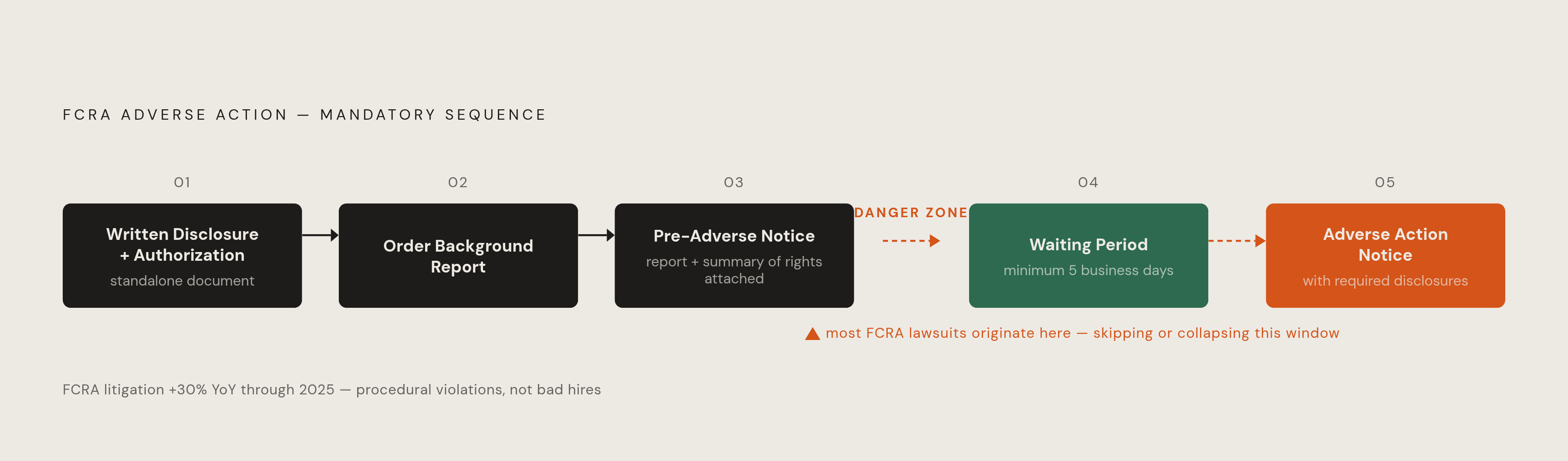
The requirements are specific and not optional. Operators need a standalone written disclosure: the notice that a background check is coming can't be buried inside a contractor agreement or an onboarding packet full of other paperwork. They need written authorization from the contractor before ordering anything. The contractor gets a copy of the report. If the operator is leaning toward a negative decision, a pre-adverse action notice goes out first, with the report attached and a summary of rights included, before that decision is finalized. Then, after the decision, an adverse action notice follows with its own required disclosures.
Lift HCM's playbook puts the year-over-year rise in FCRA litigation through 2025 compared to 2024 at more than 30%, with private plaintiffs filling the enforcement gap left by reduced CFPB activity. Worth sitting with that for a second: the lawsuits aren't mostly about operators hiring someone dangerous. They're about skipping a disclosure step or sending the adverse action notice out of order. The process itself is the exposure. Operators should treat the FCRA sequence as a repeatable step in the onboarding workflow.
What a compliant delivery contractor background check covers
Screening standards across the industry have tightened. Gcheck.com's data shows major delivery networks, including Amazon DSP, FedEx Ground, and USPS contractor programs, now examine records going back 3 to 7 years. A compliant check for a delivery contractor covers five areas, and skipping any one of them leaves a gap that's hard to explain later.
Criminal history comes first. The standard lookback runs 7 years for felony convictions, and most carriers automatically disqualify for violent crimes, theft, and drug trafficking offenses. Some, like UPS, extend the felony lookback further, so operators need to set their own threshold in writing rather than borrowing someone else's policy by assumption. Misdemeanors involving theft or violence get screened too, for the obvious reason that contractors are walking into customers' homes and handling their stuff.
Motor Vehicle Records matter just as much. Most networks want a clean record, capping violations at 2 to 3 moving infractions over the past 3 years. DUI or DWI convictions typically trigger disqualification for 5 to 10 years, and license suspensions or restrictions get reviewed as part of the same pull. For CDL holders, FMCSA requires an annual MVR review from every state where the driver holds or has held a license, and that review needs to be documented with a clear record of who conducted it and when. Not a checkbox. An actual paper trail.
Employment verification confirms prior work history, including relevant delivery, driving, or logistics roles. Identity verification, meaning Social Security number checks and address history, exists to make sure the criminal record and the MVR are actually tied to the person sitting across the table and not someone who shares a name. Drug screening is standard pre-engagement across major carrier networks, with ongoing testing requirements that vary by operator and regulatory tier; DOT-regulated operators follow a separate, stricter framework covered in the next section. Round it out with a national sex offender registry check, which matters given the home-delivery context, and a terrorist watch-list check, which many CRAs include as part of a bundled screening package.
Independent contractor roles sometimes carry slightly looser thresholds than employee roles at the same company. That's not license to cut corners: negligent-hiring liability doesn't check the employment classification box before deciding whether it applies. Operators should lock in a written disqualification policy before ordering a single report, because consistency is the thing that protects against a discrimination claim later.
DOT drug testing and MVR requirements for operators running CDL or commercial vehicle fleets
49 CFR Part 40 governs DOT drug and alcohol testing, and it spells out every step from specimen collection to return-to-duty. If the fleet runs commercial motor vehicles requiring a CDL, Part 382 applies with zero exceptions for size. Foley Services notes that a single-truck owner-operator carries the same testing obligations as a thousand-truck carrier, which is either reassuring or terrifying depending on which side of the compliance gap someone's standing on.
Foley Services notes that an update to Part 40 now allows oral fluid testing as an alternative to urine collection, though broad rollout is waiting on HHS laboratory certification. Clearinghouse II brought a harder deadline: as of the November 18, 2024 state compliance date (the rule itself took effect November 8, 2021), state licensing agencies must downgrade CDLs for drivers carrying unresolved drug or alcohol violations in the FMCSA Drug and Alcohol Clearinghouse. No more quietly sitting on a violation.
Marijuana's rescheduling from Schedule I to Schedule III, directed by a December 2025 executive order, changes nothing about DOT testing. DOT confirmed as much in guidance, most recently a May 2026 Q&A, so operators tempted to soften marijuana policy for DOT-regulated contractors should drop that idea immediately. Annual MVR review stays mandatory: pull an updated record from every state the driver holds or has held a license in, review violations and suspensions, confirm the driver still meets FMCSA qualification standards, and get the reviewing official to sign and date the record. Operators running non-CDL fleets should still treat MVR pulls and drug screening as baseline practice, but they need to know precisely which regulatory tier applies to them so they're not either leaving gaps or burning time on compliance steps that don't apply.
How ban-the-box laws, Clean Slate statutes, and 2026 state-level changes limit what operators can use
Ban-the-box started in public-sector hiring and has since spread across a wide range of states, counties, and cities into private employment. For an operator running contractors across multiple states, that means tracking rules jurisdiction by jurisdiction instead of assuming one policy covers everywhere. The core mechanic: criminal history questions can't come up until after an interview or a conditional offer goes out. The sequence of the process is what's regulated.
Clean Slate laws cut even deeper into what a report can show. In Philadelphia, for instance, background reports have to ignore misdemeanor convictions older than 4 years. Fair-chance protections in some jurisdictions have expanded to explicitly cover gig workers and independent contractors, bringing with them stronger adverse-action procedures, including updated notice requirements and individualized assessments.
That individualized assessment piece deserves its own paragraph, because it's where operators tend to slip. Blanket disqualification for any criminal record, without weighing the nature of the offense, how much time has passed, and whether it's actually relevant to the delivery role, isn't legally defensible anymore in a growing number of jurisdictions. Illinois is a useful example of how fast this is moving: 2026 brought new obligations under the Clean Slate Act (HB 1836), plus a separate requirement under HB 3773, an amendment to the Illinois Human Rights Act, governing AI-assisted screening tools. Operators using an automated platform to run or score background checks need to confirm that platform complies with rules governing algorithm-driven screening tools wherever it operates. Pay transparency laws are rolling out in a lot of the same states leading on ban-the-box, so 2026 compliance for a multi-state IC network is an ongoing process to manage continuously. It's an ongoing moving target, and a screening policy that clears the bar in one state may not clear it in another.
The negligent-hiring exposure operators face when screening is absent, incomplete, or inconsistently applied
Negligent hiring liability doesn't ask what box the worker checked on a tax form. Courts can and do hold hiring companies responsible for harm a contractor causes, and IC status offers no shield if the operator skipped the screening step that would have caught the problem. The legal theory is straightforward: if a reasonable background check would have surfaced a disqualifying history and the operator didn't run one, the operator owns the resulting harm. The check itself is the standard of care, and failing to run it is the negligence, regardless of what the worker's classification says on paper.
Misclassification turns this into a bigger problem fast. If an operator's contractors get reclassified as employees down the line, every assumption built around reduced IC screening obligations collapses at once. Misclassification penalties can include back wages, liquidated damages, and civil penalties that can reach significant sums per violation, with some state fines running into the tens of thousands per worker. That's not a rounding error in a budget spreadsheet.
Inconsistency creates its own separate exposure. Screening one contractor more rigorously than another, without a documented reason, hands a plaintiff's attorney exactly what they need: proof that similarly situated workers were treated differently. And FCRA process failures sit apart from all of this as their own litigation risk, independent of whether the screening result itself was accurate. Given that Lift HCM's playbook puts FCRA litigation growth through 2025 at more than 30% year-over-year, driven largely by private plaintiffs chasing procedural violations rather than bad hires, the goal for an operator is a screening program that is documented, applied the same way every time, aware of jurisdiction, and procedurally clean under FCRA from step one. It's one that's documented, applied the same way every time, aware of jurisdiction, and procedurally clean under FCRA from step one.
Building a structured screening workflow that moves contractors to active status without creating bottlenecks
Comprehensive screening is required and it reduces liability. It also takes time, and time is the one thing an operator trying to fill delivery routes doesn't have to spare. Gcheck.com's data puts background check turnaround typically at 2 to 10 business days depending on which components get ordered and which jurisdictions are involved. Conditional active status, where a contractor starts limited work while results are pending, is standard practice across the industry for managing that gap without losing capacity.
A workflow that actually holds up looks something like this. Deliver the standalone FCRA disclosure and collect written authorization before ordering anything. Order the background report as a bundle: criminal history, MVR, identity verification, employment verification, and drug screening where applicable. For CDL operators, kick off the FMCSA Clearinghouse query at the same time, not after. Review results against a written disqualification policy, applying individualized assessment rather than a blanket rule, and document that assessment. If the results support activation, move to onboarding; if adverse action looks likely, follow the FCRA sequence exactly: pre-adverse notice, waiting period, then adverse action notice. For contractors activated conditionally while results are pending, define in writing exactly what work they're permitted to do during that window.
The onboarding intake form should capture where the contractor operates, because ban-the-box timing rules and Clean Slate reporting limits vary enough by state that guessing isn't an option. Screening also can't be a one-time event: a contractor who passes at onboarding can pick up a new violation, a suspension, or a fresh criminal record while active. Ongoing MVR and criminal record monitoring is the day-to-day equivalent of the annual MVR review FMCSA already requires for CDL holders, just running continuously instead of once a year.
Every disclosure, every consent form, every report delivery, every adverse action notice needs a timestamp and a place to live where it can be pulled up later. That record is what defends against both an FCRA suit and a negligent-hiring claim, and reconstructing it after the fact from memory is not a plan. For an operator running hundreds or thousands of contractors, none of this survives as a manual process handled off to the side. It has to sit inside the contractor management platform itself, not bolted on as an extra task somebody remembers to do eventually. Built correctly, the background check moves from being the bottleneck between application and active route to just another scheduled step, and in a market where driver supply is already tight, that difference can mean filling a route this week instead of losing the contractor to whoever onboarded faster.