Digital Document Collection for Contractor Onboarding
Sequencing document collection prevents costly onboarding failures and compliance gaps.

The contractor workforce doubled in four years. Onboarding systems built for a few hundred drivers now process thousands, most of them still running on the same tool they used at the start of that stretch: a shared inbox and someone's memory. That gap is where the trouble lives. A company that collects the right documents in the right order moves fast because it never has to double back. A company that doesn't ends up onboarding the same contractor twice: once quickly and wrong, then slowly and right. Manual, fragmented collection is where this breaks; the fix is sequence. It's sequence.
The contractor workforce is growing faster than most onboarding systems can handle
MBO Partners tracked full-time independents going from 13.6 million in 2020 to 27.7 million in 2024. MBO Partners tracked full-time independents going from 13.6 million in 2020 to 27.7 million in 2024, a structural shift in how work gets staffed, and delivery is one of the industries feeling it first, since the entire model runs on contractor labor at scale. It's a structural shift in how work gets staffed, and delivery is one of the industries feeling it first, since the entire model runs on contractor labor at scale.
The gap between contractor volume and onboarding capacity doesn't close on its own. The gap between contractor volume and onboarding capacity doesn't close on its own; it widens. Every hire that goes through a manual system adds a little slack: one more form that might land in the wrong inbox, one contractor file that's almost complete with nobody noticing which piece is missing. Delivery companies building their intake process now are deciding what kind of company they'll be running in three years, when the contractor pool has doubled once more, and the manual system, if it's still standing, is held together with sticky notes.
What compliance requires delivery companies to collect at intake
Three categories of documents matter here, and they don't carry equal weight.
Tax documentation starts with the W-9. It captures the tax ID, legal name, address, and business classification needed to file a 1099 correctly, and it has to be collected before the first payment goes out, not after. Missing that window means the company owes backup withholding at 24% on the payment, because no valid TIN was on file when it should have been. The One Big Beautiful Bill Act, signed in July 2025, raises the 1099-NEC and 1099-MISC reporting threshold from $600 to $2,000 for payments made on or after January 1, 2026. Fewer forms get filed as a result. That does not make the W-9 optional. Every contractor still needs one on file regardless of expected earnings, and a lower filing count is not the same thing as lighter IRS scrutiny.
Identity and right-to-work documentation comes second: government-issued ID and proof of work authorization, collected at intake to confirm the contractor is who they say they are. For delivery specifically, a valid driver's license in the correct class for the vehicle being driven is its own credentialing requirement, not just a face-matching exercise.
Third is insurance. Personal auto policies almost always exclude commercial delivery use; a contractor's existing coverage can be worthless the moment they pick up a paid delivery. Collecting proof of insurance at intake, a certificate of insurance where the contractor runs under a commercial policy, and occupational accident enrollment where the company offers it, makes the coverage gap visible before an accident does. Then come contracts and acknowledgments: the independent contractor agreement signed before work begins, plus NDAs, platform policies, and safety acknowledgments. Audits regularly turn up missing or post-dated contracts, and a digital timestamp on the signature is the cheapest fix available for a problem that gets expensive fast.
Tracking is where this falls apart in practice. Teams lose track of which W-9s are on file, whether the contract was signed before the first shift or after it, and whether the NDA got executed. Without an audit trail, none of that is provable later, and for compliance purposes, unprovable might as well mean it never happened.
Credentialing documents specific to delivery contractors and their higher stakes
General contractor management advice tends to undersell what delivery actually requires. The list runs longer here and the stakes cut sharper, because the contractor is operating a vehicle, often carrying goods, and driving straight into someone else's insurance exposure the moment something goes wrong.
The Motor Vehicle Report, or MVR, is the single most important document on this list, full stop. A driver with a disqualifying record who slips through intake without an MVR pull is a liability from the first mile driven. Lookback periods run 3 to 10 years depending on the state, and most delivery companies set their own bar around no more than 2 to 3 moving violations in the past 3 years, no DUI or DWI within 5 to 10 years. DeliverThat runs its checks through Checkr and reviews up to 5 years of driving history, which reflects where serious delivery operators have landed on this: the MVR is a standard gate, not a nice-to-have. Delay the pull and the risk stays in place, unaddressed, until something happens. It just sits there, unaddressed, until something happens.
Background check authorization works the same way, with a sequencing wrinkle attached. Criminal background checks in delivery typically cover 3 to 7 years of history, and violent crime, theft, and drug trafficking are common automatic disqualifiers. The check can't run until the contractor signs authorization, so the consent form has to exist before the screening process even starts. Get that order wrong and the whole check is invalid, no matter how clean the result looks.
Drug screening applies to operators touching regulated transport: non-emergency medical transport (NEMT), healthcare-adjacent routes, anything under DOT authority. DOT-regulated carriers carry one more requirement on top of the test itself: enrollment in the FMCSA Clearinghouse and consent to query it.
NEMT and DOT-covered routes carry the heaviest document load of all, organized into what's called a Driver Qualification File, or DQF: valid license (CDL where the route requires it), MVR, background check, drug screening, OIG exclusion clearance, DOT medical card, plus certifications like CPR, First Aid, and HIPAA training where relevant. Medicaid audit rules require these files be kept for a minimum of 7 years, so the file has to get built into the system from day one of intake, not bolted on later when an auditor requests it.
Each missing document is its own separate exposure. A background check without an MVR doesn't cover the MVR's gap. An MVR without a drug screen doesn't cover the drug screen's gap. Partial completion is a different shape of exposure. It's just a different shape of exposure.
The order documents are collected in shapes the risk profile
Not every document carries equal urgency, but the order they're collected in decides whether a problem gets caught at intake, when it's cheap to fix, or becomes visible six months later as a lawsuit.
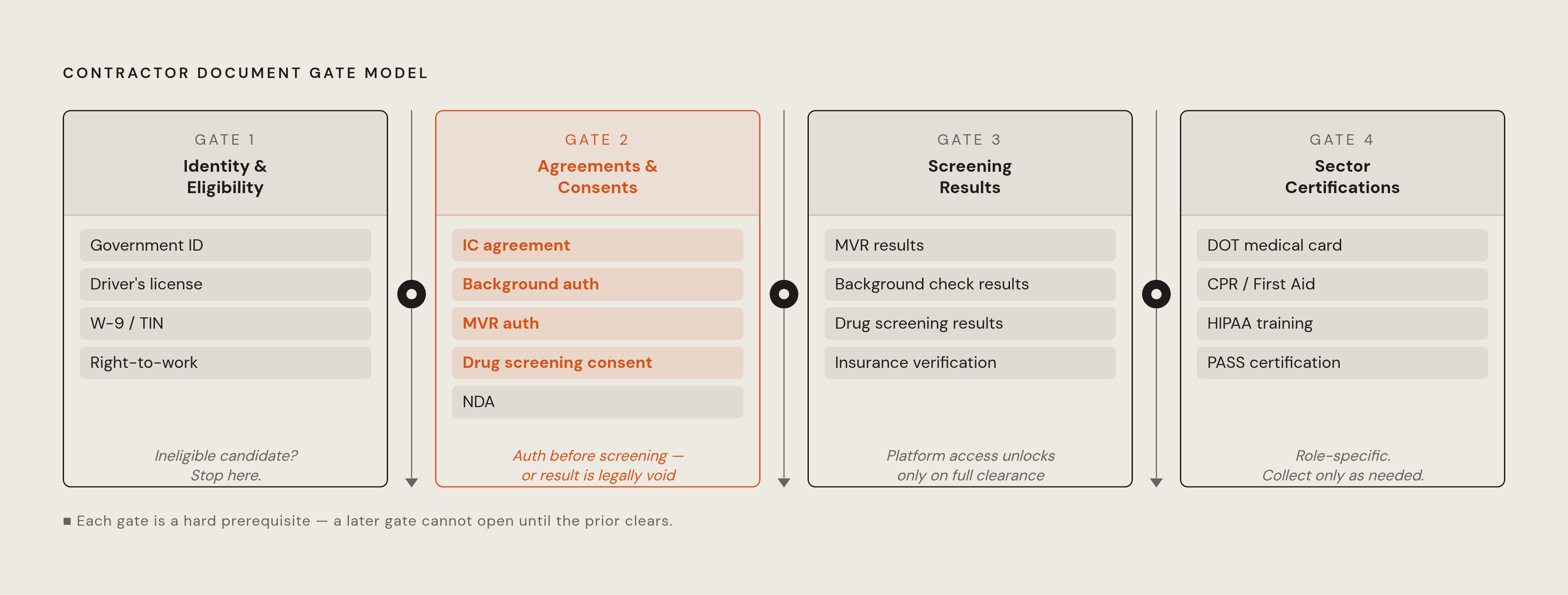
Think of it as four gates, each one a dependency for the next.
Gate one covers identity and eligibility: government ID, driver's license verification, W-9 and TIN confirmation, right-to-work acknowledgment. If anything here is missing or invalid, nothing downstream should move. This is the cheapest place in the process to stop a bad hire, before any money gets spent on background checks or MVR pulls for someone who was never eligible.
Gate two covers the contractor agreement and consents: the IC agreement signed and timestamped, background check and MVR authorization signed (legally required before those checks can run), drug screening consent where applicable, NDA and platform acknowledgments.
Gate three is where screening results land: MVR results measured against company standards, background check results, drug screening results, insurance verification. Platform access, dispatch credentials, the actual ability to accept a delivery, should be conditional on clearing gate three. Not provisional. Not running in parallel while checks are still pending.
Gate four is sector-specific certification: DOT medical card, PASS certification, CPR and First Aid for NEMT or other regulated routes, plus platform-specific safety training.
Skipping a gate, or running them out of order, doesn't make the cost disappear. It moves later, to the point where the company has already paid for a background check on someone who turns out ineligible, or a contractor has already worked a shift nobody can legally defend. Sequencing usually breaks down not from malice or laziness but from structure: operations, legal, finance, and IT each own a slice of the document flow and run on separate clocks. The idle time between one department finishing its piece and the next department picking it up is where onboarding actually stalls out.
How digital workflows close the gaps manual collection leaves open
Manual collection fails for a mechanical reason. Documents arrive out of order, through different channels, in different formats, with no single record of what's been collected and what's still missing. Nothing in the process enforces the gates. There's a person, hopefully remembering to check.
A digital intake process replaces that person's memory with structure. A contractor self-service portal has the contractor upload documents and sign agreements in a fixed sequence, so gate two literally cannot start before gate one clears, because the system won't unlock the next step. Digital signatures carry a timestamp, so there's proof a document was signed on time instead of just a claim that it was. W-9s get collected automatically at intake, stored, and linked to the contractor's record, which is what keeps the whole thing from turning into a scramble every January. Expiration tracking flags a license, insurance certificate, or certification before it lapses, and locks the contractor out of work on an expired credential instead of relying on someone checking a spreadsheet. A centralized audit trail keeps every document, every signature, every timestamp in one place, ready to hand over during an IRS audit, a state labor review, or an insurance claim.
BNP Paribas cut onboarding time in half by moving multi-stakeholder workflows into one centralized digital hub. That wasn't a faster form. It eliminated the back-and-forth between disconnected teams, the same fragmentation described above, where operations, legal, finance, and IT each run their own clock without checking anyone else's. Software that blocks a contractor from getting platform access until every gate clears is the thing that keeps an uncleared driver off the road, not a policy that says they should be blocked.
The downstream compliance failures that bad intake documents cause
Misclassification risk starts at the document level. If the independent contractor agreement doesn't spell out the relationship correctly, or the company's actual behavior (how much control it exerts over schedule, methods, tools) contradicts what the contract says on paper, the classification is vulnerable from day one. The IRS can claw back 41.5% of earnings in back taxes on misclassified workers, and state penalties can run as high as $25,000 per violation in states like California.
A missing or wrong W-9 triggers backup withholding at 24%, a cash flow problem that's entirely preventable and entirely self-inflicted. Stack that on top of penalty exposure for 1099 filing errors, roughly $660 per form, inflation-adjusted, with no cap on the total, and run that math across a delivery network with a few thousand contractors and a systemic documentation gap. A paperwork problem turns into a liability large enough to threaten the business.
The 2026 threshold change raising 1099 reporting to $2,000 doesn't soften any of this. A higher filing threshold doesn't mean relaxed enforcement, and misclassification exposure hasn't moved an inch. Better IRS data matching means discrepancies get flagged faster than before, not slower.
Credentialing gaps create a different flavor of failure. An MVR that was never pulled doesn't protect the company when a driver with a suspended license causes an at-fault accident. An insurance certificate that expired two months before a claim can void coverage entirely, right when the company needs it most. Without a digital record proving when each document was collected and verified, a company can't prove compliance even when it actually complied, because the audit trail gap undermines everything else in the file. Absence of evidence, in an audit, reads exactly like evidence of absence.
Building a document collection process that scales with contractor volume
Standardize the document list before building any workflow around it, not after. A standard delivery IC, an NEMT driver, and a DOT-regulated route driver need different document sets, and the workflow has to know the difference before it can enforce anything. Build the gate logic into the system itself, not into a coordinator's judgment call, so a contractor physically cannot move from gate one to gate two without clearing what's required there. Collect the W-9 and the IC agreement first, every time. Those two documents are what protect the company if everything else downstream goes sideways.
Build expiration monitoring in from day one instead of bolting it on later. A license or certification collected at intake and never checked again is useful only for the day it was collected; six months on, it might be worthless and nobody would know it. Retain records in a format built to survive an audit: 7 years for DQF files under Medicaid rules, structured and searchable storage for everything else.
A digital onboarding platform built for delivery IC networks needs a few things running at once: a contractor self-service portal with structured upload and e-signature, automated W-9 and tax form collection with secure storage, credential tracking with expiration alerts and access locks, and MVR and background check integration through a direct vendor connection rather than a manual upload step. It also needs one unified audit trail covering every document, every gate, every timestamp, in a single place. That last piece is what turns "we think we're compliant" into a record that actually proves it.