Software That Monitors IC Classification Rules in Real Time Across Every State Your Delivery Fleet Operates In
Real-time monitoring flags classification changes across state lines before audits discover gaps.
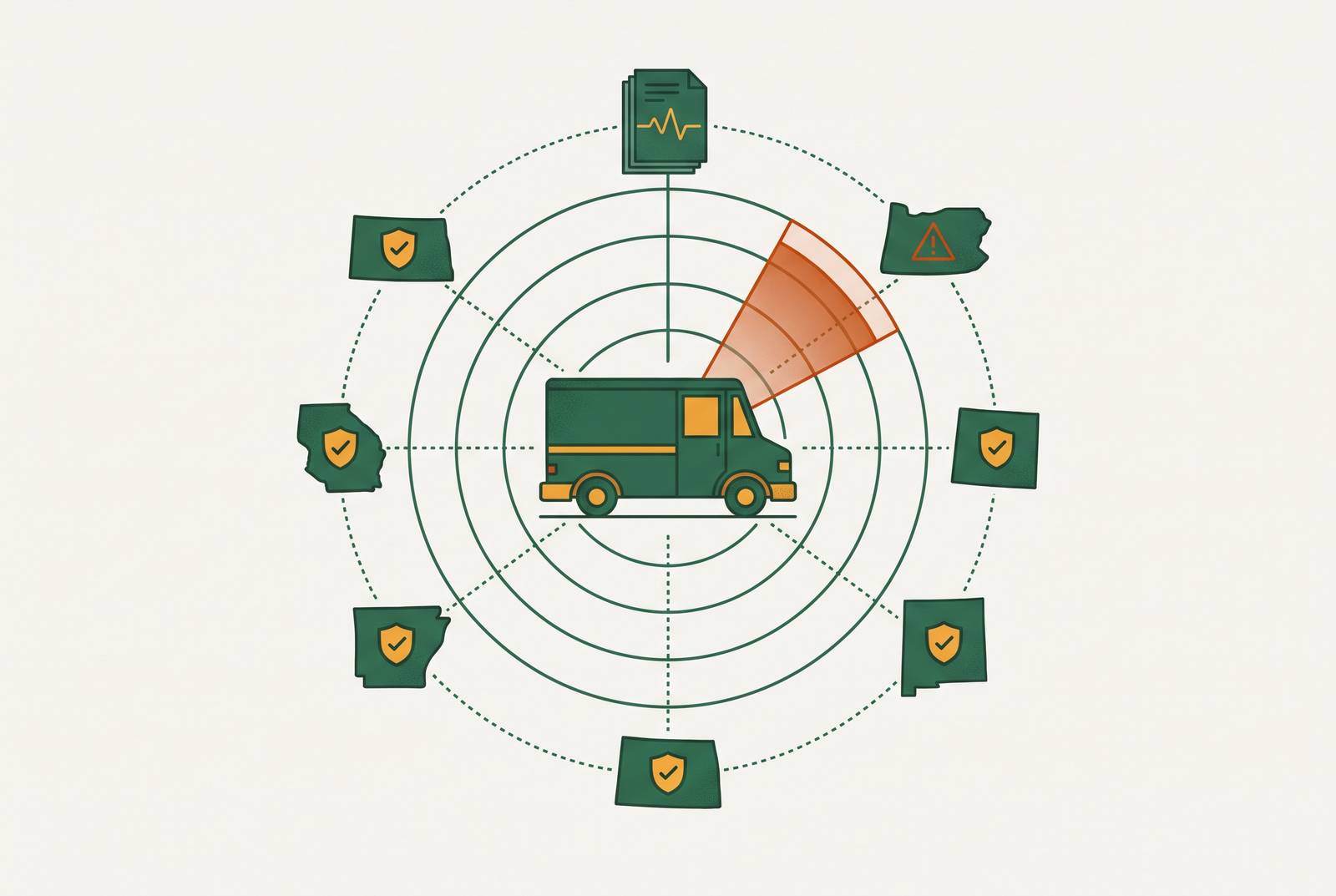
Delivery fleets that work across states need to monitor independent contractor classification in real-time, tracking state rules, federal standards, and changes in how each person works. When audits happen only from time to time, gaps remain between a change in the law and the fleet’s response. The right software closes those gaps without imposing the day-to-day control that can itself become evidence of employment.
Why delivery fleets operating across multiple states face a structurally different compliance problem than single-state operators
The same driver doing the same work can receive different classification verdicts under different jurisdictions’ rules. Nothing about the delivery has to change. A company operating across state lines therefore faces more than a larger version of single-state compliance. It must assess one working relationship against overlapping standards that can reach different conclusions at the same time.
At the federal level, three overlapping frameworks guide how that relationship is assessed. The IRS examines behavioral control through instructions, their degree of detail, evaluation systems, and training. Its broader common law test groups factors into behavioral control, financial control, and the type of relationship. The Department of Labor applies an economic reality test under the FLSA, examining the totality of circumstances, including control. These are distinct but related inquiries.
ABC Prong B requires work “outside the usual course of the hiring entity's business,” which creates an obvious problem when the business is delivery and the workers deliver. The label on the contract cannot change that. California, New Jersey, and Massachusetts hold or tighten strict tests, while Florida and Texas use more flexible common-law control tests, without recent loosening legislation. New Hampshire retains a strict ABC test, despite a narrower change to benefit-plan treatment.
How the federal classification floor keeps moving, and why that creates a permanent monitoring problem
The Department of Labor’s Wage and Hour Division changed its enforcement posture on May 1, 2025. Its Field Assistance Bulletin instructed staff to stop applying the 2024 rule’s analysis and enforce the FLSA using the July 2008 Fact Sheet #13 framework. A monitoring process watching only for final regulations would miss an administrative instruction with immediate operational significance.
The DOL then proposed another change in late February 2026. The proposal would rescind the 2024 rule and place greater emphasis on two core factors, namely the worker’s opportunity for profit or loss and the degree of control exercised by the putative employer. The comment period closed April 28, 2026. The rule remains proposed in the timeline covered here, so its anticipated approach must not be treated as an operative replacement.
For operators, the distinction determines what needs attention now and what needs preparation. An assessment made under the 2024 rule may look different under the enforcement framework adopted in 2025, and it would need reconsideration if the 2026 proposal became final. A notification that says only “DOL classification rule changed” is not enough to distinguish a future possibility from a present enforcement instruction. The permanent obligation is to keep the fleet’s assumptions aligned with the federal standard actually being applied.
What recent state-level shifts look like in practice, using New Jersey and New Hampshire as opposing cases
The New Jersey Department of Labor and Workforce Development finalized revised ABC-test rules on May 5, 2026, effective October 1, 2026. The final rule treats locations where an enterprise conducts an integral part of its business as its “places of business.” For delivery companies, that narrows the route through Prong B’s “outside all places of business” alternative. The wording deserves close attention. Trucks, airplanes, and transportation vehicles appeared as explicit examples in the proposed rule, but those examples were removed from the adopted text.
New Hampshire moved in a different, narrower direction. Governor Kelly Ayotte signed HB 1245 on July 2, 2026, effective August 31, 2026, allowing companies to offer portable benefit plans to contractors without the offer being used as evidence of employment. Its strict ABC test remains unchanged. Monitoring that reports simply “New Hampshire loosens contractor rules” would obscure the boundary of the change.
California’s AB 1340, effective January 1, 2026, makes a third kind of change. Gig drivers keep their independent contractor classification and gain collective bargaining rights. The classification answer stays put. The obligations do not. Software that watches only for movement between employee and contractor status would miss that distinction. A fleet operating in all three states must account for each applicable obligation, because a benefit-plan change in New Hampshire does not offset a classification barrier in New Jersey.
Why the penalties attached to misclassification make monitoring a financial priority, not just a legal one
Federal misclassification exposure includes the full employer share of FICA taxes and a portion of the employee share not withheld. It also includes penalties associated with unfiled wage and tax statements, a percentage of total wages paid, and a further percentage of FICA taxes not withheld from workers. These obligations can accumulate by worker and filing period. They are not a single admission charge. As a contractor network grows, the financial consequences of an incorrect classification can grow with it.
The named platforms that have faced ABC-state class actions include FedEx Ground, Uber, Lyft, DoorDash, Grubhub, and Amazon Flex. For fleet operators, that history puts the legal framework close to the core business model rather than at the edge of an occasional hiring decision. Insurance status adds a separate financial concern. Fleet operators should identify gaps in occupational accident coverage or commercial auto liability before a claim.
Some operators still think a legal review each quarter or each year is enough. The dates make that assumption difficult to defend. New Jersey’s May 2026 adoption and October 2026 effective date gave fleets time to prepare, while the DOL’s May 2025 bulletin changed enforcement right away. A quarterly review cycle could leave up to three months between the New Jersey rules taking effect and the next scheduled audit if no other monitoring intervened.
What must real-time multi-state IC compliance monitoring actually track?
Partial coverage is the central failure mode. A system that watches state ABC tests but misses federal enforcement guidance can miss changes in how federal law is enforced. Operationally useful monitoring must cover amendments in every state where the fleet operates, DOL rulemaking and administrative guidance, and IRS updates. It must distinguish proposed changes from effective requirements. Field bulletins belong in that coverage because enforcement can change without a completed notice-and-comment rulemaking.
The system must also detect changes in working arrangements. A contractor may spend more and more of their work hours with one client, dispatch instructions may become more controlling, or financial dependence may change even while the law stands still. Monitoring should flag these classification signals for review while keeping any one signal from standing in for the whole legal test. Otherwise, software replaces a contextual inquiry with an overconfident checkbox.
That requirement creates a genuine design paradox. The IRS evaluates behavioral control through the type and degree of instructions, evaluation systems, and training. Software that mandates work hours, reviews idle-time reports, or requires fixed-schedule logins may itself create evidence of control. More observation is not automatically safer compliance. A system must distinguish detecting an employment-like relationship from directing contractors in ways that help produce one.
FMCSA requires driver qualification files to be retained throughout the driver relationship and for three years after departure. Monitoring must track MVR status, expiring credentials, and commercial auto insurance verification, with alerts before a lapse. Monitoring must also track the status of each contractor’s occupational accident coverage policy. Finally, entry into a new state must trigger a classification review, because geographic expansion changes the applicable legal questions even when the delivery workflow looks familiar.
How delivery companies building contractor networks across state lines should evaluate compliance monitoring platforms
Before comparing vendors, delivery operators should separate tools for workforce and legal compliance from tools that cover the day-to-day needs of delivery work. A platform may support classification assessment and localized contracts without supplying driver qualification file tracking or granular state ABC-test monitoring. The useful comparison is therefore between documented capabilities and the fleet’s requirements. The supplied product descriptions do not establish a defensible ranking for real-time, multi-state delivery compliance.
Deel offers AI-powered worker classification that flags engagements resembling employment under local law, localized compliant contracts, and coverage across 150+ countries. Its Contractor of Record model absorbs classification liability. Remote offers localized contractor agreements and a Contractor Management Plus tier with misclassification protection. These are relevant legal-risk features, but they answer different questions from live state-rule tracking.
Worksuite supports large contingent workforces through automated onboarding with custom compliance checkpoints by role, location, and entity. It also offers indemnification-backed contractor classification across all 50 U.S. states, with custom pricing and partial global contractor payments. Multiplier is aimed at companies that want to hire contractors quickly across countries. WorkMotion provides a built-in pathway to Employer of Record employment when a contractor arrangement is no longer legally appropriate. That option helps when the test that applies rules out continued contractor classification and better documentation alone will not meet it.
For a delivery fleet, evaluation should start with state-by-state ABC-test coverage and extend to DOL enforcement guidance and IRS updates. FMCSA qualification files and MVR monitoring should be built into the credential layer. Insurance verification should sit in the same workflow. Onboarding speed also counts, with self-serve smartphone intake capable of reducing the process from weeks to under two days through the right platform design. Built-in payments, including instant debit or same-day ACH options, can close the gap between identity verification and fund release, while addressing payout speed as a retention factor.
Building a monitoring posture that keeps pace with classification rules without creating the behavioral control that triggers them
The behavioral control paradox is resolved by focusing monitoring on deliverables and outcomes. Packages delivered, routes completed, and current credentials support a different relationship from mandated login times, idle-time scrutiny, and screen-activity monitoring. Renaming an activity-control feature as compliance does not change what it does. Outcome-focused monitoring is consistent with contractor status under the IRS behavioral control analysis, though it does not remove the need to satisfy the other applicable tests.
Monitoring classification rules and checking driver credentials should also stay separate. One asks whether a jurisdiction’s requirements have changed. The other asks whether a particular driver’s documents remain current. Both are necessary for the fleet. Conflating them with activity-level oversight in one undifferentiated system can create the appearance of integrated employer control. The compliance workflow should be connected, with care taken over which forms of worker surveillance are useful to it.
The changes in 2025–2026 show why that workflow needs to keep getting updates. The DOL bulletin changed enforcement in May 2025, its proposed replacement arrived in February 2026, and the New Hampshire and New Jersey measures became effective in August and October 2026. Real-time monitoring turns each into a detected event with a response measured in days. Scheduled legal review can then address the implications.
At hundreds or thousands of contractors, manually tracking rules, credentials, insurance, and classification signals requires proportional headcount growth. Automation becomes infrastructure. A fleet with these functions in place can make new-state entry an operational decision supported by a classification review, rather than rebuilding its compliance process each time. Expansion still triggers scrutiny, but it need not trigger a manual reset. That is the growth advantage of monitoring designed to follow the law without directing every minute of the driver’s work.