How Delivery Companies Audit AB5 Exposure Across Independent Contractor Populations
California's AB5 makes delivery driver independence legally impossible under the law.
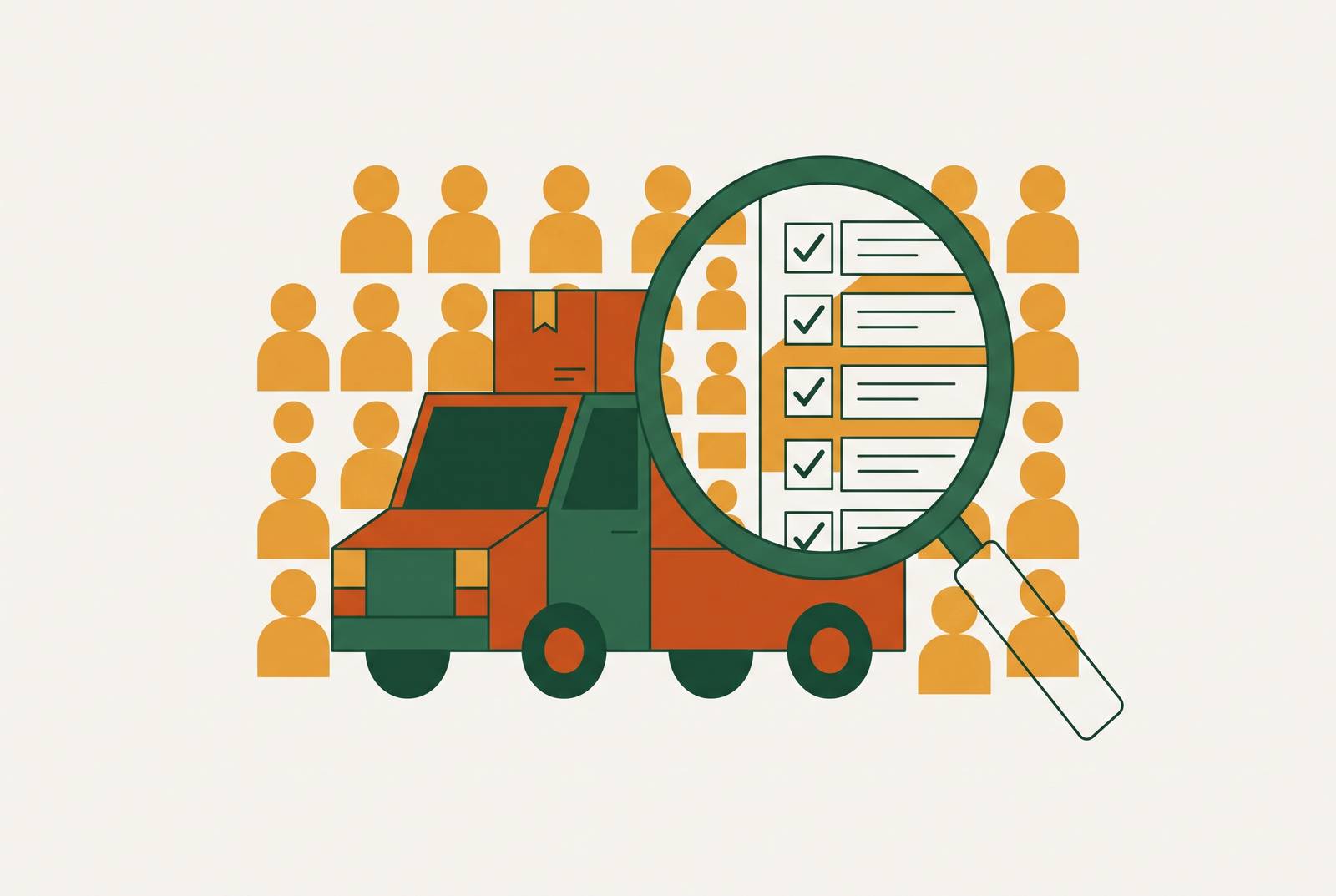
Delivery companies audit AB5 exposure by reviewing every contractor’s working relationship. Because drivers who do a delivery company’s core work generally fail Prong B and cannot have independent contractor status, the audit must show the company’s exposure before it decides on reclassification or restructuring. Compliance software can support that review through credential tracking, insurance verification, and monitoring, but it cannot make a failing arrangement lawful.
Why Prong B makes delivery drivers structurally impossible to classify as independent contractors
AB5’s ABC test starts with a presumption of employment. Where the test applies, the hiring company must prove all three prongs to classify a worker as an independent contractor. Failure on any one means employee status, regardless of what the agreement calls the relationship.
Prong B requires the worker’s services to fall outside the hiring company’s usual course of business. A driver delivering goods for a delivery company performs the company’s core function, so the arrangement fails that requirement on its face. Owning a vehicle or negotiating terms does not change what the business sells. No improvement to the contractor agreement can turn delivery into an activity outside a delivery company’s usual business.
Prong C can compound that failure when the driver lacks a genuinely independent business. A driver working exclusively for one carrier, without other clients, market presence, or business infrastructure, also has a weak claim under that prong. An LLC and a website do not establish independence by themselves. Even if drivers are free from operational control under Prong A, they still fail the test if they fail another prong.
What active AB5 enforcement actually looks like for delivery operators in 2025–2026
The California Labor Commissioner’s Office announced citations against Costco, Ryder Last Mile Inc., and Mega Nice Trucking LLC in October 2025 for misclassifying 58 delivery drivers. The action included substantial penalties and back wages. The office found that Costco and Ryder exercised direct and indirect control over the drivers, establishing a joint-employer relationship with the carrier. Liability reached beyond the company contracting with the drivers. The carrier of record was not a firewall.
That action shows that retailers, shippers, and 3PLs can face enforcement over their control of the supply chain. Scheduling, routing, and load assignment can expose companies above the carrier when those practices amount to operational control. Complaints from drivers, insurance audits, and court proceedings can lead to a closer look at these arrangements. Subcontracting layers do not erase the underlying relationship.
The Employment Development Department’s audit horizon also makes historical records consequential. Its standard statute of limitations reaches three years, extending to eight years where returns were not filed without good cause, with no limit in fraud cases. An audit typically takes six to nine months to reach a final assessment. An appeal to an administrative judge adds one to two years.
Meanwhile, the California Trucking Association dropped its AB5 challenge in August 2024 after four and a half years of litigation. The California Supreme Court’s July 2024 decision in Castellanos v. State of California upheld Proposition 22’s carve-out for app-based transportation and delivery platforms. That exception does not extend to traditional carriers operating outside that model. Waiting for those avenues to provide relief is not an exposure-management strategy.
Why mapping exposure across the whole contractor population must come before any remediation decision
EDD auditors begin with accounts payable detail, payroll registers, emails, scheduling exports, and communication archives rather than treating contractor agreements as the decisive evidence. Those records show how money moved and who directed work. Contracts describe the intended arrangement. Operations reveal the one that actually existed, including changes nobody recorded in an amendment.
For that reason, the audit must cover the whole contractor population before the company chooses a remedy. Dispatch authority, route control, equipment arrangements, pricing autonomy, and business identity may differ across drivers or groups. Stronger Prong A and Prong C evidence can distinguish those groups, but cannot rescue a shared Prong B failure. The review needs findings across all three prongs.
Relationships also drift after onboarding as drivers lose outside clients or carriers introduce fixed schedules and assigned equipment. A contract-only review misses that movement. Treat classification as an operational finding before deciding on reclassification, restructuring, an employee model, or a B2B arrangement. Otherwise, the company risks paying for changes that do not address the problem, or leaving severe exposure untouched because the paperwork looks orderly.
How to build the contractor population list and pull the source records an audit requires
For the internal review, start with accounts payable. The company should list every individual or sole-proprietor LLC it paid during the prior three years and check that list against its filings. That establishes who belongs in the review. A list limited to contractors currently active in dispatch would miss historical relationships within the standard audit horizon.
Each contractor’s file needs the agreement and amendments, dispatch history, records of routes and schedules, and messages that show who gave day-to-day instructions. Dispatch records should establish who assigned loads and whether acceptance or refusal was meaningful. Equipment records need ownership, lease or rental terms, and any requirements concerning type, age, or branding. Compensation records should show who set rates, whether negotiation occurred, and whether payment was piece-rate, mileage-based, or hourly.
The same file needs insurance certificates that show coverage dates and lapses, along with proof that the contractor runs an independent business. Relevant records include a business license, general liability coverage in the contractor’s name, business registration or website, and other-client confirmation. The review should establish whether each contractor has at least one other active paying client. That fact has a shelf life. An onboarding confirmation cannot establish that outside work remained active throughout the engagement.
Reviewing dispatch and operational control records against the Prong A standard
Once those records are gathered, the Prong A review compares the freedom the contract gives with how much control the company has in practice. Load acceptance is an early fault line. Can the contractor really choose whether to take work, or does turning it down lead to fewer assignments later? A contractual right to decline provides little support if dispatch practices make exercising it costly.
Records of routes and schedules then show whether contractors chose where and when to drive or followed fixed instructions. Who owns the equipment is only part of the review. The review also needs to establish who leased and maintained the vehicle, and whether carrier requirements concerning type, age, condition, or branding went beyond legitimate safety or regulatory needs. Pricing records provide another distinction between negotiated terms and fixed rates offered on a take-it-or-leave-it basis.
Business presentation completes this part of the review by asking whether drivers appeared to customers as independent businesses or carrier representatives. Legitimate DOT and safety requirements are permitted without automatically constituting employment-style control. The file should show which rules meet those requirements and which give the carrier control over day-to-day work. Each contractor should receive a supported, unsupported, or indeterminate Prong A finding, with the specific records supporting it.
Documenting independent business identity for each contractor as the Prong C review
Prong C asks whether the contractor operates a business that would exist if the carrier engagement ended. A W-9 cannot answer that question. Neither can the contractor agreement, because a contractor can have both documents without having customers of their own or a business that is doing work. The audit file needs evidence of the business itself.
That evidence should include current business licensing or entity registration and general liability insurance in the contractor’s own name. The review should check coverage dates to see whether the onboarding certificate is still current. The file should also contain confirmation of another active paying client in the same line of work. A carrier-directory listing or records of soliciting work from multiple shippers or brokers can document independent market presence.
A contractor who gets all their revenue from one carrier has a weak claim under Prong C, especially if they have no independent market presence. A former employee returning on a 1099 to perform the same work is an especially direct warning pattern in accounts payable. The company needs to recheck this from time to time because contractors can lose outside clients while every document in the original onboarding folder stays the same.
How insurance verification fits into the audit and where coverage gaps create compounded exposure
Misclassification and insurance gaps can compound one another. A driver treated as a contractor but later deemed an employee may face a coverage dispute while the company faces retroactive premium adjustments and regulatory penalties. The company should thus review the classification file and insurance file together. Separating them administratively does not separate the exposure.
For each contractor, the audit should check whether occupational accident coverage is in force and covers the work they do, including time between deliveries. Platform policies may cover drivers while they make deliveries but leave gaps between deliveries, between apps, or after logoff. The coverage terms and dates show whether the policy covers the work and periods under review.
Workers’ compensation is for employees, while occupational accident insurance covers injuries to independent contractors without itself establishing their employment status. Neither policy makes a failing ABC arrangement pass. Bulk purchasing of occupational accident and commercial auto coverage can nevertheless simplify administration by consolidating lapse management for scattered individual renewal dates under a network policy. As more insurers ask for records that show lawful employment or classification models before they provide or renew coverage, the audit also helps show whether the company can still get coverage.
How can delivery companies keep AB5 compliance monitoring current?
An audit file that was accurate six months ago may not describe the current relationship. Changes in how much work a contractor gets can lead to sole-client dependency, while new schedules, assigned equipment, or required check-ins can change the finding on control. Compensation changes can alter the same analysis. A new California lane or service area can also bring previously out-of-state contractors into AB5 scope.
Those changes should prompt a new review before the next broad audit. Insurance lapses and the loss of outside clients require the same response. Periodic confirmation of other clients, current coverage, and active business registration should also sit on the operational calendar.
At hundreds or thousands of contractors, spreadsheets become slow and error-prone. The infrastructure needs automated credential tracking, expiration alerts, and dashboards that surface status changes while preserving a contemporaneous review record. GigSafe is one purpose-built option offering real-time compliance visibility, insurance verification, and credential monitoring across the independent contractor lifecycle. That visibility supports the audit, but dispatch, scheduling, and communication evidence still require systematic review.
What the audit findings require at the onboarding stage to prevent future exposure from accumulating
The audit’s findings also diagnose the intake process. Missing credentials, unverified outside clients, and unclear equipment arrangements will recur with new contractors unless onboarding changes. That is where historical review becomes operating design. The company should use the findings to determine what information must be established before a new engagement starts, without confusing complete intake with proof that Prong B is satisfied.
The workflow shaped by the audit should check the license and driving record, include a background check, gather vehicle documents, and confirm who owns the equipment. It also needs business registration, current general liability coverage, occupational accident enrollment or confirmation, and another active client relationship. Tax intake should collect the applicable W-9 or W-8 digitally during onboarding. A risk questionnaire should capture the facts relevant to Prong A and Prong C at the outset.
Speed need not mean skipping these steps. Parallel credentialing, digital intake that avoids re-keying, and automated status visibility can shorten onboarding while improving the audit trail. Same-day ACH and instant debit options activated only after full compliance verification can make payment speed an incentive for complete intake. The contractor’s interest in getting paid then supports, rather than competes with, the verification process.
The audit should produce both a current exposure map and a corrected onboarding process. The first supports decisions about existing liabilities, including arrangements that cannot lawfully remain contractor relationships. The second lets a compliant contractor operation grow without making the same mistakes each time.