Behavioral Control Boundaries in Delivery Contractor Program Design
Design delivery programs around results, not methods, to defend contractor status.

Delivery contractor program design succeeds when operators specify results and verify eligibility without directing how contractors work. Compliance software can support that boundary through credentialing, insurance monitoring, outcome tracking, and payment records, but it cannot make a delivery business satisfy a worker classification law when the legal test rules out contractor status. The defensible program joins operational independence with records that prove it.
Why behavioral control is the classification factor delivery operators most often misread
A dispatcher assigns stops in a prescribed order. The app locks that sequence in place. A manager reserves the power to redirect the driver mid-route, even if that power is rarely used. These are familiar delivery practices, but each creates evidence that the operator controls how work gets done. A contract that promises independence does not erase that evidence.
The IRS evaluates behavioral control through the instructions a business gives, their detail, training on methods, and evaluation systems that measure how work is performed. The distinction is between results and methods. Requiring a completed delivery is different from prescribing each step toward completion, and retaining the right to direct those steps can be enough to establish control.
Operators often concentrate instead on contract language and financial arrangements because those are easier to isolate and review. Behavioral control is embedded in routing, timing, and daily communication, where operational convenience can obscure its significance. It can establish an employment relationship, although it is not the sole factor across classification tests. Economic dependence also enters the analysis, and different laws weigh the relationship differently.
How the federal classification standard currently works and where it is headed
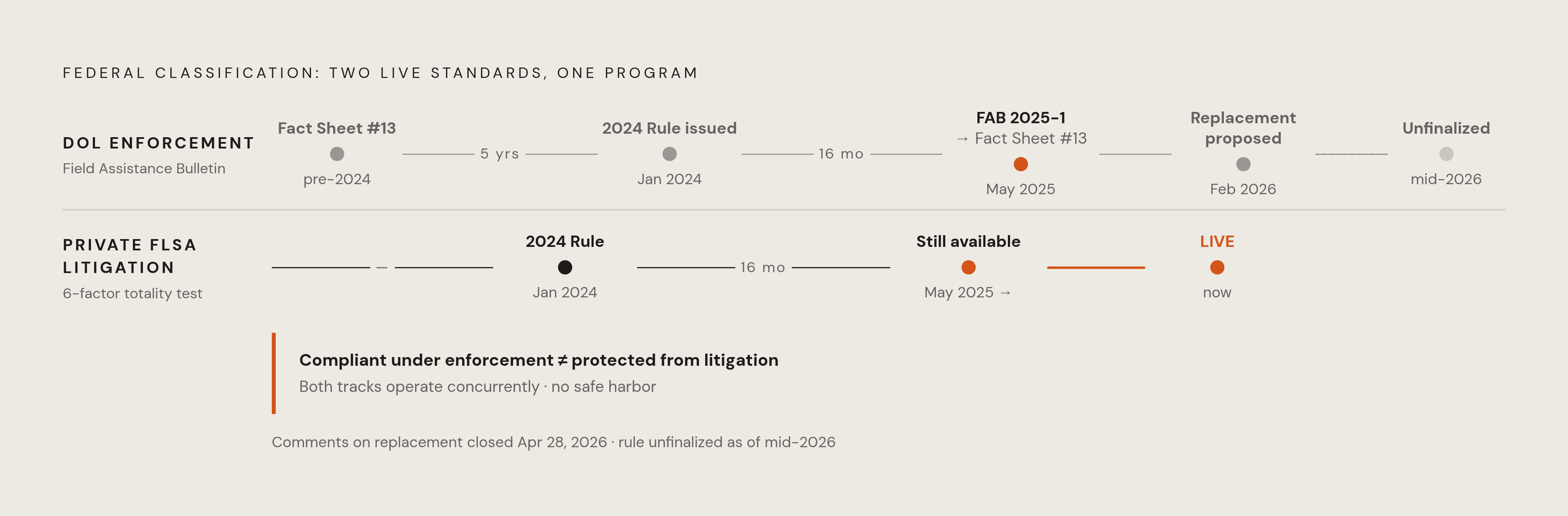
The federal position has two tracks. The Department of Labor’s 2024 rule introduced a six-factor totality-of-circumstances test, with factors weighted equally, that made contractor status harder to defend. Its May 2025 Field Assistance Bulletin 2025-1 then directed the Wage and Hour Division to stop applying that rule in investigations and return to the older Fact Sheet #13 framework. The 2024 rule nevertheless remains available in private litigation.
The department announced a replacement proposal on February 26, 2026, published it on February 27, and closed comments on April 28. As of mid-2026, it is not finalized. The proposal elevates control and opportunity for profit or loss, while giving less weight to skill, permanence, and integration unless the core factors conflict. When workers choose their schedules, tasks, and methods, that weighs in favor of contractor status. The proposal uses a delivery driver with their own vehicle and chosen hours as an illustration of initiative or investment.
For operators, the practical consequence is dual-track exposure. A program aligned with current agency enforcement can still face a private FLSA collective action invoking the 2024 rule. Programs therefore need to hold up under both standards, since an enforcement bulletin does not shield them from suit. Separately, the NLRB withdrew its vacated October 2023 joint employer rule in February 2026. The narrower 2020 standard requires substantial direct and immediate control, which eases the burden on subcontractor networks but leaves independent contractor classification unresolved.
Why state law remains the sharpest risk for delivery operators regardless of federal direction
California’s ABC test creates a barrier that federal changes do not remove. Prong B requires work outside the hiring entity’s usual course of business. For a delivery company engaging drivers to deliver, the work is the business, so reducing supervision does not solve that prong where the test applies. Massachusetts and New Jersey also use strict ABC standards, while Illinois uses its strict ABC test only for construction and generally uses the common-law test for other work.
The New York City Council introduced the Delivery Protection Act, Int 0518-2026, which would require last-mile facility operators to directly employ delivery workers. It would also require a business license from the Department of Consumer and Worker Protection, with safety, training, and employment conditions. This remains proposed legislation. Operators need state-specific program assessments.
New Jersey’s Attorney General sued Amazon over Amazon Flex despite the program’s documented flexibility. Drivers can decide whether, when, and how often to work and can accept or decline delivery blocks. That autonomy did not prevent a misclassification challenge. Defensible onboarding begins only after the applicable law leaves room for a contractor relationship.
Where onboarding and credentialing create behavioral control exposure without operators realizing it
Onboarding concentrates the tension between qualification and instruction. A valid license, clean MVR, background check, insurance, and competence with delivery technology are eligibility requirements. “You must attend our orientation and follow our delivery sequence” instead combines access with direction over methods. The compliant alternative is “you must hold a valid license and demonstrate you can use the platform.”
Training makes that distinction especially easy to lose. The IRS treats training on work methods as an employee indicator because an independent contractor ordinarily brings the ability to perform the work. “Contractors must use the three-point turn technique when reversing” prescribes a method. “Contractors must deliver without damage to goods or recipients” specifies an outcome. The recommended structure places safety standards in the contract and uses credentialed third-party training providers rather than internal instruction on how to do the job.
Platform onboarding should preserve the same separation. Letting contractors choose when they are available and accept or decline assignments supports independence, while requiring a set order of stops or barring them from declining loads can show control. Technology competence is not obedience to a route plan. Likewise, on-time delivery and damage rates assess results, whereas route adherence and required check-in frequency assess methods.
Credentialing also has a shelf life. Shared badges and informal route swaps can mean the person making a delivery is not the person originally vetted. An onboarding record from months ago may fall short when an underwriter asks for proof of who the driver is. Continuous license and MVR monitoring addresses eligibility without telling an eligible driver how to perform the work.
How to structure day-to-day operational direction without crossing into behavioral control
A delivery commitment can specify the address, time window, undamaged condition, and proof of delivery. It can require a valid license, current insurance, a clean driving record, and compliance with traffic law and carrier safety regulations. Requiring the app to record completion captures a result. Requiring the app’s prescribed route controls the means. That distinction has to hold up under day-to-day dispatch pressure as well as appear in onboarding materials.
The contractor retains route selection and sequencing, vehicle maintenance schedules and methods, and decisions about breaks. Acceptance of particular loads or time windows also remains the contractor’s choice. So does work for other platforms or clients. Exclusivity is an employee indicator under both IRS and DOL frameworks, although preferred status or priority load access can reward performance without requiring it. Multiple-client work must remain genuinely available.
The lesson for operators is to audit control mechanisms regularly, including between annual contract reviews. The 2026 proposal gives actual practices more weight than contractual or theoretical possibilities. A nominal right to choose a route offers little protection if the platform penalizes every departure from it. Records of day-to-day work need to show which choices contractors make.
The sharpest version of this problem is algorithmic direction. Mandatory acceptance rates, prescribed sequences, and automated deactivation for violating method requirements can create control without a manager issuing an order. Operators should check the rules built into their platforms just as they check their written policies. If a human dispatcher giving the same instruction would create behavioral control, automating the instruction does not remove it.
Insurance architecture that protects the contractor network without creating employment signals
Workers’ compensation is the wrong default for a properly classified 1099 delivery network. It is generally neither required nor appropriate for independent contractors, and coverage choices can create employment signals that conflict with the intended relationship. Classification comes before the coverage label.
Occupational accident insurance, or OAI, is the standard contractor injury tool. It covers medical expenses, disability income, and accidental death and dismemberment up to the limits set in the policy. It is materially cheaper than equivalent workers’ compensation coverage, and bulk purchasing can extend that advantage across a network. Its exclusions require plain explanation. Most policies cover acute injury and exclude occupational disease unless specifically scheduled, a consequential distinction for cumulative repetitive-stress injuries.
Commercial auto liability covers delivery driving because personal auto policies leave out commercial delivery use. Cargo insurance covers goods while they are in transit, while general liability covers third-party claims at places where deliveries are made. These protections are additive.
California’s Prop 22, upheld by the California Supreme Court in Castellanos in July 2024, requires app-based delivery companies to provide OAI for contractors. Classification analysis remains necessary alongside that legal obligation. Platform exposure also survives independent contractor status. When a contractor or customer is injured during delivery, contingent, or vicarious, liability backed by commercial general liability addresses the platform’s exposure.
What compliant IC program documentation actually needs to contain
The independent contractor agreement needs to say what must be delivered for each load or project rather than list ongoing duties as it would for an employee. It should expressly reserve control over methods to the contractor and assign responsibility for equipment, vehicle, insurance, and taxes. Unrestricted work for other clients belongs in it. The agreement should also state that employee benefits are not provided and define the relationship through specific engagements. Those provisions need to describe the actual working arrangement.
Payment records provide a separate business record. Contractor-submitted invoices show services rendered, while the tax file needs a W-9 before first payment and a 1099-NEC by January 31 for payments above the reporting threshold. Autonomy needs its own evidence. Logs showing declined loads, contractor-set schedules, or work for other clients support the contractual promise of independence. Credentialing records should show the standards for eligibility and the checks made at onboarding and on an ongoing basis.
Under New York State’s freelance worker protection law, a hiring party that fails to maintain adequate records or provide a written contract bears the burden of proving that the worker was paid in accordance with the law. Missing paperwork changes the evidentiary position. That makes contract and payment records more than administrative housekeeping.
The audit should assess whether those records show independence in practice. The 2026 DOL proposal prioritizes actual practices but does not expressly instruct businesses to document them. Documentation is the operational response to that distinction. A defensible file shows that behavioral control indicators are absent from daily work.
What software helps delivery companies monitor IC compliance without adding control?
Useful independent contractor compliance software monitors eligibility and results. For delivery companies evaluating worker classification compliance support, the concrete criteria are credentialing, insurance verification, outcome measurement, payment infrastructure, and attributable records. Those capabilities support a legally viable program. They do not overcome an ABC test that excludes the relationship in the first place, or eliminate the need to assess each state separately.
A license can lapse, an MVR can deteriorate, or insurance can expire before the next scheduled review. Automated monitoring detects eligibility changes without requiring a manager to redirect the contractor’s work. Automated background checks, MVR pulls, insurance verification, and document collection likewise check that contractors qualify to do the work. Faster onboarding also lets qualified contractors start earning sooner without telling them how to make deliveries.
Performance monitoring should then remain focused on on-time delivery, damage, and customer confirmation. Those measures describe what was delivered, which serves operational quality without prescribing the route or break schedule. Payment speed offers another classification-neutral tool. Instant debit or same-day ACH can support retention and the contractor’s ability to operate an independent business without requiring exclusivity or closer supervision.
One system can link credentialing, monitoring, insurance, and payments while staying within that boundary. Its strongest contribution is the documentation trail. Timestamped, attributable eligibility checks, credential verifications, and payments establish what the program actually did.