Downstream Liability When a DSP Subcontracts Drivers
Subcontracting drivers does not shield DSPs from liability for crashes and compliance failures.
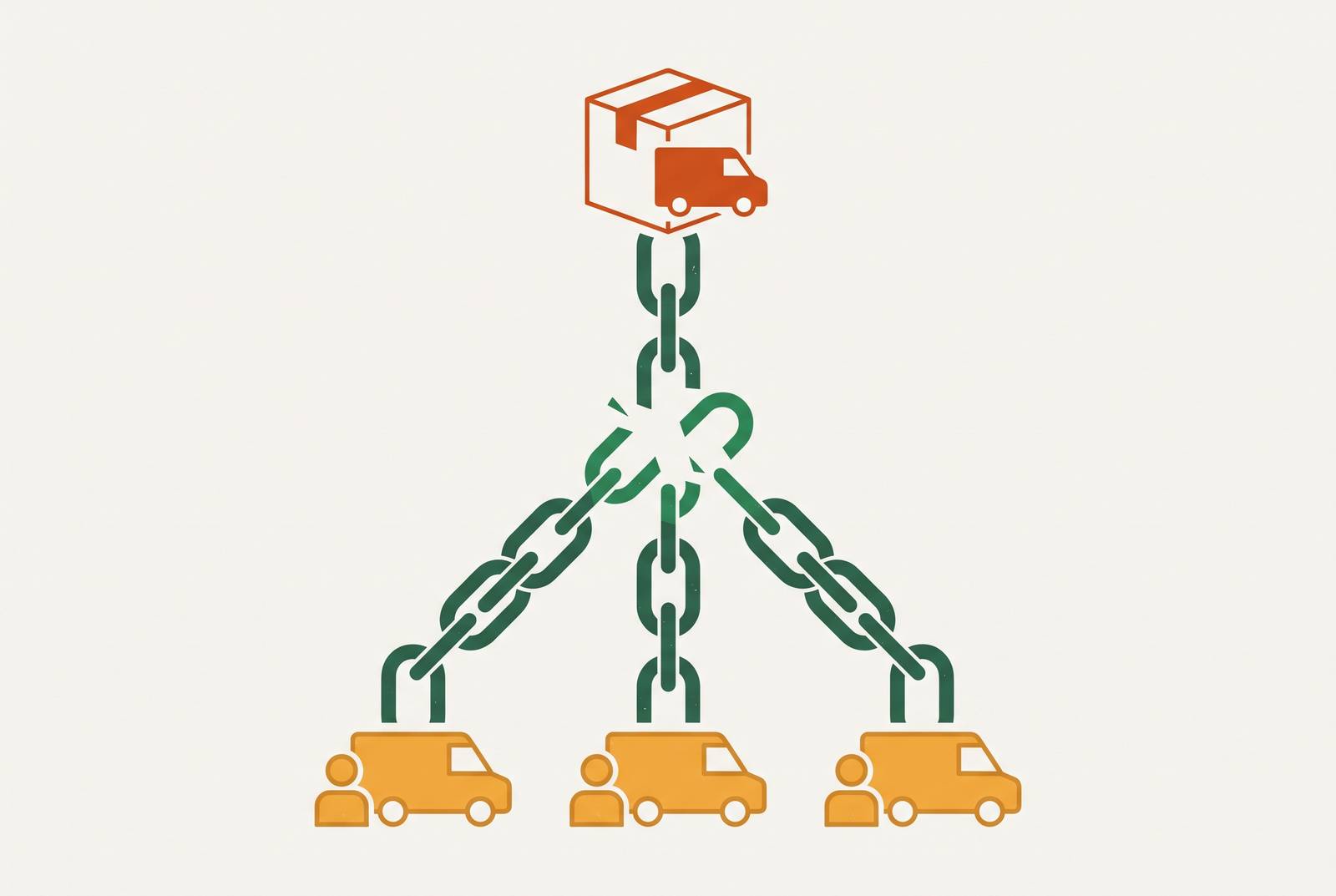
Subcontracting drivers changes who does a DSP’s work, but it does not reliably change who answers for it. Liability for crashes, coverage failures, and worker misclassification can move up the contracting chain. The practical defense is visibility into the drivers actually doing the work, supported by continuous credential monitoring, network-level insurance management, and documentation that matches the working relationship.
How the DSP subcontracting model distributes legal responsibility across the chain
Amazon’s delivery service partner model puts a separate business between the platform and the driver. Amazon contracts with DSPs, which hire drivers or engage them through subcontractors. Amazon reports that its DSP program has grown to thousands of small business owners since its 2018 launch, with billions invested in it. At that scale, who bears responsibility is part of how the delivery system works, with disputes reaching beyond the small contractors involved.
Amazon sets delivery routes, package volume, driver training modules, vehicle branding, uniforms, and delivery windows, while its apps monitor performance in real time. A DSP can therefore sit between instructions from above and workers supplied from below. Adding a subcontractor puts another business in that chain but may leave the same company in charge of how deliveries happen.
A DSP may have an onboarding file for its employees but lack equivalent records for a subcontractor’s drivers. Without those records, it cannot attest to the credentials, insurance status, or work authorization of people operating under its name. When one of those drivers causes a crash or a compliance failure, the separate contracts become the starting point for questions about responsibility.
The two legal pathways by which liability climbs above the DSP level
Vicarious liability makes an employer answer for a worker’s negligence while the worker is doing the job. Under respondeat superior, a driver’s conduct on a company route can expose the DSP, while a joint-employer finding can reach the platform above it. Courts examine the right to control the work, including routes, schedules, equipment, and performance monitoring.
The court in Edmonds v. Amazon.com, Inc. declined to dismiss a joint-employer claim because the allegations about Amazon’s control supported a plausible inference of that status. A federal judge in Gibbs v. MLK Express Services also let a joint-employer theory against Amazon go forward. That case concerned an FLSA wage claim. Neither ruling was a final finding of liability, but both show why contractual separation alone may fail to end a lawsuit.
Jury verdicts have gone further than those preliminary rulings. A South Carolina jury returned a $44.6 million verdict in December 2023, and a Georgia jury returned a substantial verdict in 2024, finding Amazon responsible despite the DSP structure. Direct negligence gives a second way to hold a company responsible. A claim of negligent hiring, training, or supervision rests on the company’s own failures, so, unlike vicarious liability, it can succeed without proof that the company employed the driver.
The evidence makes that distinction concrete in both verdicts. In Georgia, the plaintiff’s lawyers argued that Amazon controlled onboarding, training, and driver technology, and the jury assigned it the bulk of responsibility for failing to train the driver properly. In South Carolina, the driver had recorded more than 90 distracted-driving events in Amazon’s required Mentor app during his five months of employment before the crash. Monitoring data became evidence of knowledge and inaction. A system that sees a problem does not, merely by seeing it, solve it.
How the negligent-hiring trap catches DSPs that cannot verify subcontractor credentials
Negligent hiring turns on what a reasonable investigation would have revealed about a driver’s qualifications, training, and record before deployment. Actual knowledge is not the only issue. A DSP that did not know a driver was unqualified may still face questions about why it did not know. Subcontracting sharpens that problem when the DSP relies on another business’s assurances without holding the underlying documentation.
The U.S. Department of Transportation moved in early 2026 to remove roughly 550 commercial driver-training schools from the national training registry. It had found schools where instructors were unqualified and students earned commercial driver’s licenses without being tested well enough. The action reaches back into existing hiring files. A driver trained at a school later shuttered by enforcement presents a fresh question about the adequacy of training and the operator’s screening, even though the driver was already deployed.
The Supreme Court’s ruling in May 2026 in Montgomery v. Caribe Transport II, LLC also put intermediaries’ selection decisions in focus. The Court ruled that freight brokers can be sued under state law for negligently hiring unsafe motor carriers. The ruling’s scope is limited to freight brokers. Its relevance is that an intermediary’s responsibility for choosing qualified operators can survive the contractual distance between it and the people performing the work.
For a DSP, the operational weakness is often more basic than a disputed legal theory. It may have no license, training, or background documentation for a subcontractor’s drivers, and no way to learn that a credential has lapsed. Requiring credentials can raise questions about control if those requirements become management of how the service is performed. But abandoning verification is no safe workaround. Setting access standards differs from directing performance.
Why credential gaps that exist only briefly still create liability
An onboarding file records a driver’s status at a particular time. It does not establish that status indefinitely. A contractor whose license expired three months ago has a credential gap now, even if every document was current on day one. After an incident, the relevant inquiry concerns the driver’s status when it happened and whether the operator reasonably maintained its checks, rather than simply whether the original file was complete.
Quarterly or annual reviews can miss a license lapse, a disqualifying background event, or an insurance cancellation until the next scheduled review. The calendar is not a legal defense. A short gap can still coincide with a crash, and a longer review interval gives an unnoticed problem more time to remain in service.
A subcontractor’s commercial auto or occupational accident policy may lapse between renewal reviews while the DSP still thinks the coverage is in place. Continuous monitoring addresses that interval by flagging changes as they occur. The goal is less time spent operating on information that has stopped being true.
The insurance stack DSPs operating with subcontractors actually need
Amazon’s required commercial auto liability coverage addresses drivers on active routes, but it does not resolve every layer of subcontracting exposure. Other coverage may also apply while a driver is making deliveries. The trigger is important. A driver operating outside it, or under a subcontractor’s lapsed policy, may fall into a gap between the protection the DSP expects and the protection actually available.
Workforce injuries require a separate insurance decision from auto liability. Occupational accident insurance, or OAI, is the standard choice for platforms using gig delivery workers classified as independent contractors. Workers’ compensation is state-mandated and built for employees, and extending it to contractors can constitute or confirm an employment relationship. Policy choice therefore interacts with classification risk. It is not simply a comparison of premiums.
OAI covers medical expenses, disability income, and accidental death and dismemberment up to the limits set by the policy. It is meaningfully cheaper than equivalent workers’ compensation coverage and avoids that coverage’s employment-status signal. The trade-off is the absence of workers’ compensation’s exclusive-remedy shield. Contractors may, in some circumstances, still sue the platform despite having OAI, so buying the policy does not close every route to a claim.
For DSPs using subcontractors, network-level purchasing addresses a different weakness. Buying occupational accident and commercial auto coverage in bulk lets the DSP see whether coverage is in place without having to rely on each subcontractor’s separate policy. This can save money and remove the delay in spotting a lapse in coverage held further down the chain. It does not erase policy limits or coverage triggers. The loss must fall within those policy limits and meet the coverage triggers for the available insurance to apply.
How misclassification exposure accumulates when subcontracting adds distance from the work
Subcontracting can obscure how drivers are managed without removing the consequences of that management. A DSP that specifies routes, equipment, performance standards, and delivery windows supplies facts relevant to an employment finding, even when another business engages the driver. Ignorance of the subcontractor’s practices can leave the DSP unable to show that its independent-contractor documentation matches the work.
Proficient Auto Logistics’ disclosure describes a putative class action alleging that Tribeca Automotive misclassified contracted truck drivers under New Jersey Wage and Hour Law and New Jersey Wage Payment Law. Filed in 2016 and amended in 2022, the case was in mediation as of 2025 and sought overtime and recovery of unlawful deductions. The claim involves a business within a publicly traded logistics consolidator. It shows how a larger business can still face claims over worker status, though the allegations do not show a failure to verify credentials.
Instacart / Maplebear’s 2026 SEC 10-Q describes ongoing litigation, government audits, administrative claims, and inquiries over classification in California and several other jurisdictions. Allegations include unpaid wages, overtime, and expense reimbursement for people providing delivery and other fulfillment services as non-employee contractors. Those legal matters remain unresolved.
New Jersey Attorney General Jennifer Davenport announced an antitrust lawsuit alleging that Amazon maintains dominant power over DSP drivers by preventing unionization, restricting hiring between delivery-network companies, and limiting labor-market competition. A separate New Jersey lawsuit alleged that Amazon and Amazon Logistics misclassified Flex drivers and deprived them of wages, benefits, and legal protections. Flex is a different arrangement, but it tests the same reliance on an independent-contractor label.
Judicial rulings have also rejected that label for specific purposes. The Wisconsin Supreme Court in 2024 let stand an appeals court ruling that Flex drivers are employees for unemployment insurance purposes. The Supreme Court of Virginia affirmed in 2025 that Flex drivers are employees for unemployment compensation purposes. For DSPs, the operational lesson is to extend documented access standards, credential requirements, and structured contractor onboarding to subcontracted drivers, without substituting performance management or training mandates that undermine the claimed relationship.
What compliance infrastructure DSPs need to manage subcontractor visibility in practice
The practical response begins with records that follow the actual workforce. DSPs need continuous tracking of license status, motor vehicle record updates, background changes, and training certifications for subcontracted drivers as well as direct hires. Subcontractor assurances are not a substitute for visibility. The DOT school action makes the purpose concrete, because learning promptly about a credential problem gives an operator the opportunity to remove a driver from service before it becomes part of an incident.
Holding or administering occupational accident and commercial auto coverage across the contractor network gives the DSP a record of coverage for active drivers without relying on subcontractors to self-certify. OAI runs roughly 30% cheaper than equivalent workers’ compensation coverage, although that comparison does not make the protections interchangeable or settle which classification is legally correct.
Contractor agreements, credential submissions, insurance confirmation, and work-authorization documentation create a contemporaneous record, while the operating process must preserve the distinction between access standards and management of the service. These requirements need to reach every subcontractor supplying drivers under the DSP’s name. Otherwise, consistent paperwork at the top can coexist with inconsistent practices below.
Automation connects these functions into an operating system for compliance. Onboarding modules, real-time credential monitoring, insurance administration, and payment records can compress the interval between a change and its detection to near zero. That information still requires an operational response. The decisive improvement is that the DSP can act on a driver’s current status, rather than discover after a crash that its confidence rested on an old file.