Real-Time Compliance Monitoring vs. Periodic Audits
Continuous monitoring catches compliance lapses the day they happen, not months later at audit.
A 1099 contractor passes a January audit clean: insurance current, license valid, background check on file. Six weeks later his commercial auto policy lapses because he switched carriers and missed a payment, and nobody finds out until he rear-ends someone on a delivery route in March. That gap between "verified" and "true" is the subject here: periodic audits check a moment in time, and the moment closes the second the auditor logs off. Audits still have a job to do in a compliance program, but on their own they leave too much unwatched, and the operator still treating the annual review as the whole program, rather than one piece of it, is running on borrowed time.
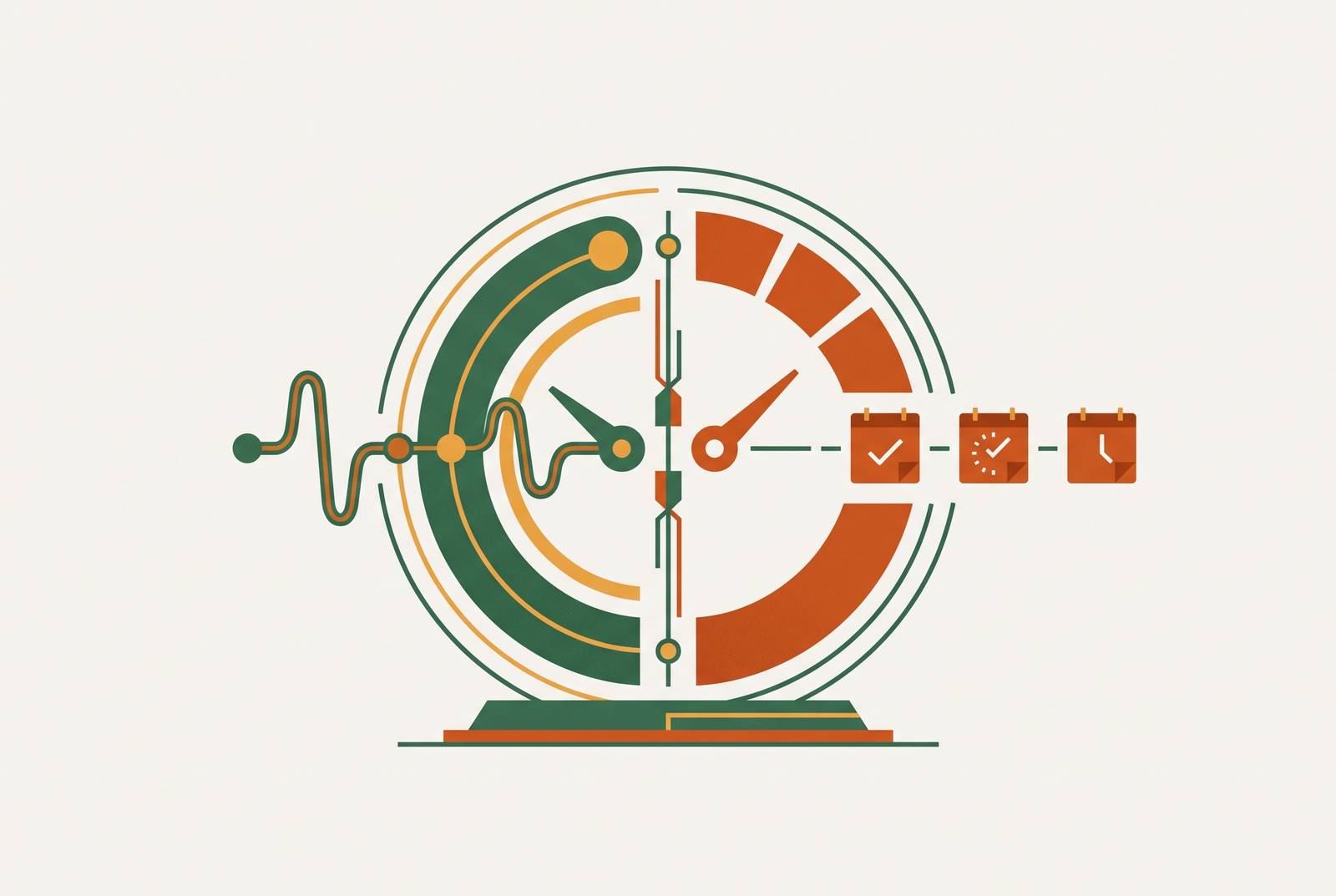
When a contractor's insurance lapses between quarterly reviews, a periodic audit simply does not see it. The audit checked a moment in time, that moment closed the second the auditor logged off, and the lapsed policy runs unchecked until the next scheduled pull finds it months later. A real-time monitoring system checks insurance policy status as the underlying data changes, so a lapse gets flagged the day it happens rather than the quarter someone gets around to looking. That difference is the exposure window: a lapse caught the same day gets fixed before the contractor goes on-route, while a lapse caught at the next quarterly audit has already generated claim risk, incident liability, or a regulator's attention for weeks or months before anyone on staff knew there was a problem.
How periodic audits work and where they genuinely hold up
An audit is a structured look backward. Someone pulls records at a fixed interval (quarterly, semi-annually, once a year) and checks them against a standard. That's the whole model: retrospective review at a fixed cadence, then done.
Audits still earn their keep in a few places. They produce a paper trail that shows regulators a good-faith effort was made, which matters if a case ever lands in front of the Department of Labor or a state agency. They catch systemic failures, like an entire onboarding cohort that never got asked for a certificate of insurance because someone changed the intake form and nobody noticed. And they satisfy contracts: plenty of enterprise clients and insurers write periodic attestation into the agreement, so the audit stays a required part of the program even alongside other tools.
Most audits also rely on sampling: someone reviews a subset of files and infers the state of the rest. That's standard practice, and defensible for a stable population, but it means whatever sits outside the sample stays invisible until the next cycle. For a small roster that barely changes month to month, that's a tolerable risk. Delivery and IC networks are rarely that roster.
Why do periodic audits miss a 1099 contractor's insurance lapse between reviews?
Insurance is the clearest failure point. Commercial auto and occupational accident policies lapse, get cancelled, or change coverage limits on their own schedule, and none of that syncs to an audit calendar. An operator can run an uninsured contractor for weeks and only find out when a vehicle incident forces the question.
Credentials work the same way. Driver's licenses expire, CDLs change status, vehicle registrations lapse, background check refresh windows come due, and every one of those runs on its own clock. None of them wait for the audit team.
Churn makes it worse. In a high-turnover network, a meaningful chunk of the active roster on any given day was onboarded after the last audit closed, which means those contractors haven't been reviewed at all. They're not overdue; they're simply outside the process.
Then there's classification drift, which is quieter and more expensive. A contractor's working pattern can shift toward something that looks like employment (concentrated hours, one exclusive route, company-provided equipment) without a single document changing. Nobody's tracking a trend line during a document pull. That's the gap that costs the most, because nobody's assigned to watch for it.
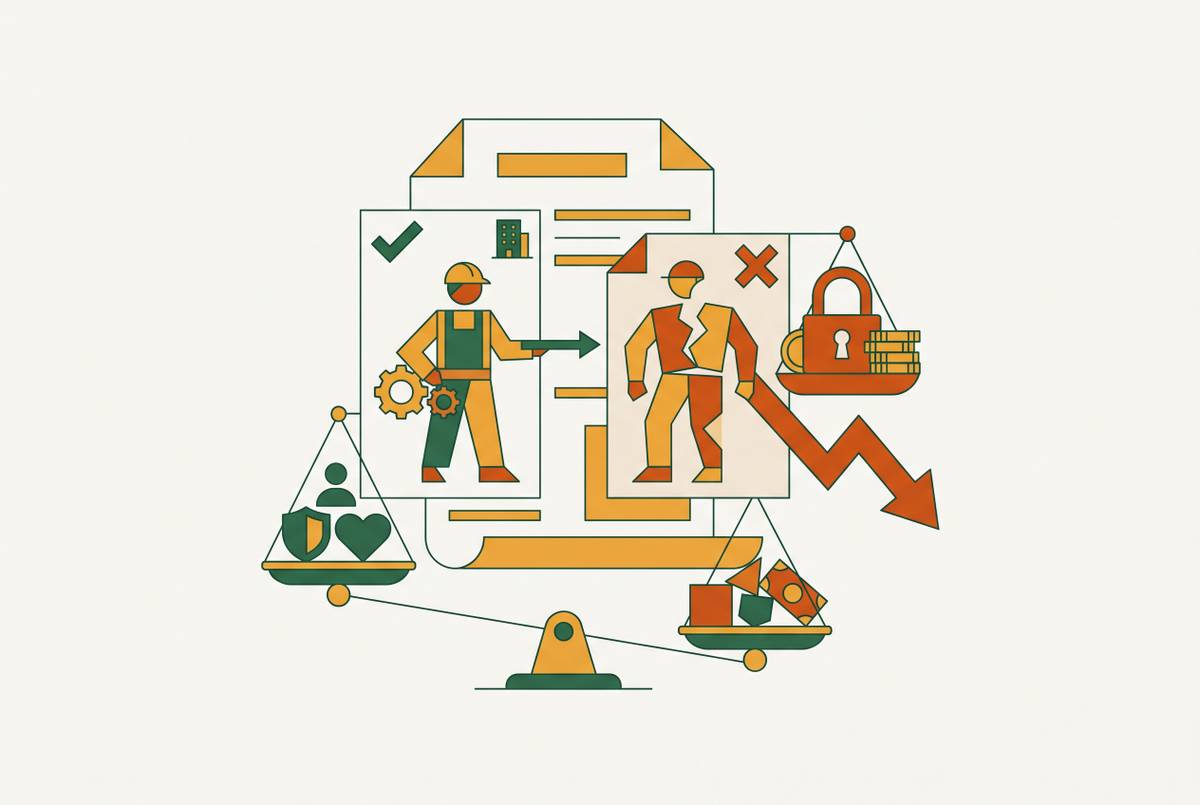
That drift lands in a regulatory environment with no single standard to satisfy. Federal DOL investigators currently apply the 2008 Fact Sheet #13 test, private litigation runs on the 2024 economic realities test, and state enforcement uses its own tests, often stricter than either federal standard. An audit calibrated to one of these misses exposure under the other two, by design, not by oversight. California alone allows penalties up to $25,000 per misclassified worker, and total exposure per worker, once federal back taxes, FLSA damages, and state penalties stack up, commonly lands between $15,000 and $100,000. A missed credential lapse or an unnoticed classification shift between audit cycles doesn't sit still. It compounds.
The audit cannot catch what changes the day after it closes. That's a structural limit built into the model, and closing it takes a different kind of tool.
Why the scale of today's contractor workforce makes the gap worse
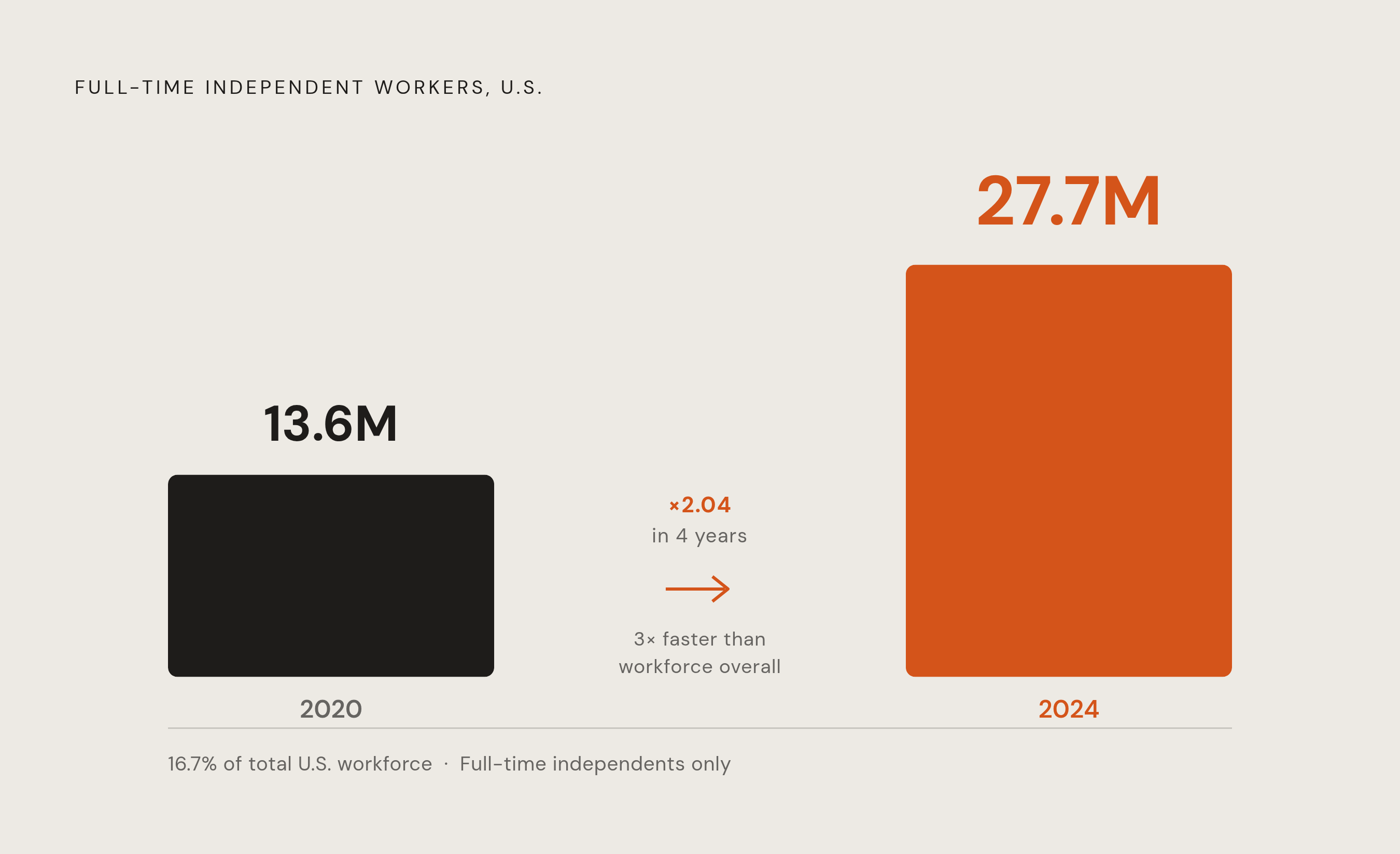
Full-time independent work in the U.S. went from 13.6 million people in 2020 to 27.7 million in 2024, now 16.7% of the entire workforce and growing three times faster than the workforce overall. Every one of those workers carries a credential clock and an insurance renewal date, and none of them are synced up.
Run the math on an audit built for a roster of 200 that's now 400. The audit didn't get twice as good at catching problems; it's reviewing a company that no longer looks like the one it was built to review. Last-mile delivery adds its own pressure here too: last-mile work accounts for 53% of total delivery costs, and operators managing that cost line lean on contractor pools that expand and contract with seasonal demand. The roster at peak season and the roster in a slow month aren't the same group of people, and an annual audit built around one snapshot can't represent both.
The labor math gets worse from here, not better. As headcount grows, the manual effort needed to run a real audit grows right alongside it. Operators end up choosing between auditing a shrinking sample of a growing population, or throwing back-office headcount at the problem in a way that doesn't scale and doesn't pay for itself. Neither option holds up on its own. That's exactly why the fix here is a different tool, not a bigger version of the same one.
What real-time compliance monitoring actually does — and doesn't do
Real-time monitoring runs continuously instead of on a schedule. It checks contractor status against compliance requirements as the underlying data changes: insurance policy status, license and credential expiration, background check refresh triggers, classification signals like hours concentration or route exclusivity. It flags exceptions the moment they appear, not the moment someone remembers to look.
Mechanically, it's a pipeline problem more than a review problem. Records get checked as they update instead of pulled in a batch at a fixed interval, so a lapse gets caught the day it happens, not the quarter someone gets around to checking.
It doesn't replace the audit function, and it shouldn't try to. Formal audits still serve documentation and attestation purposes that contracts and regulators expect. The point here is pairing continuous monitoring with periodic review, not treating either one alone as sufficient.
Worth flagging: not every monitoring platform actually does this. Some track a narrow slice of data. Some generate reports on a schedule that just recreates the audit lag in a different wrapper. Some don't talk to onboarding or payments at all. "Real-time monitoring" covers a wide range of actual capability, and operators evaluating vendors need to check what's underneath the label rather than take the term at face value.
The measurable difference between monitoring and auditing in compliance outcomes
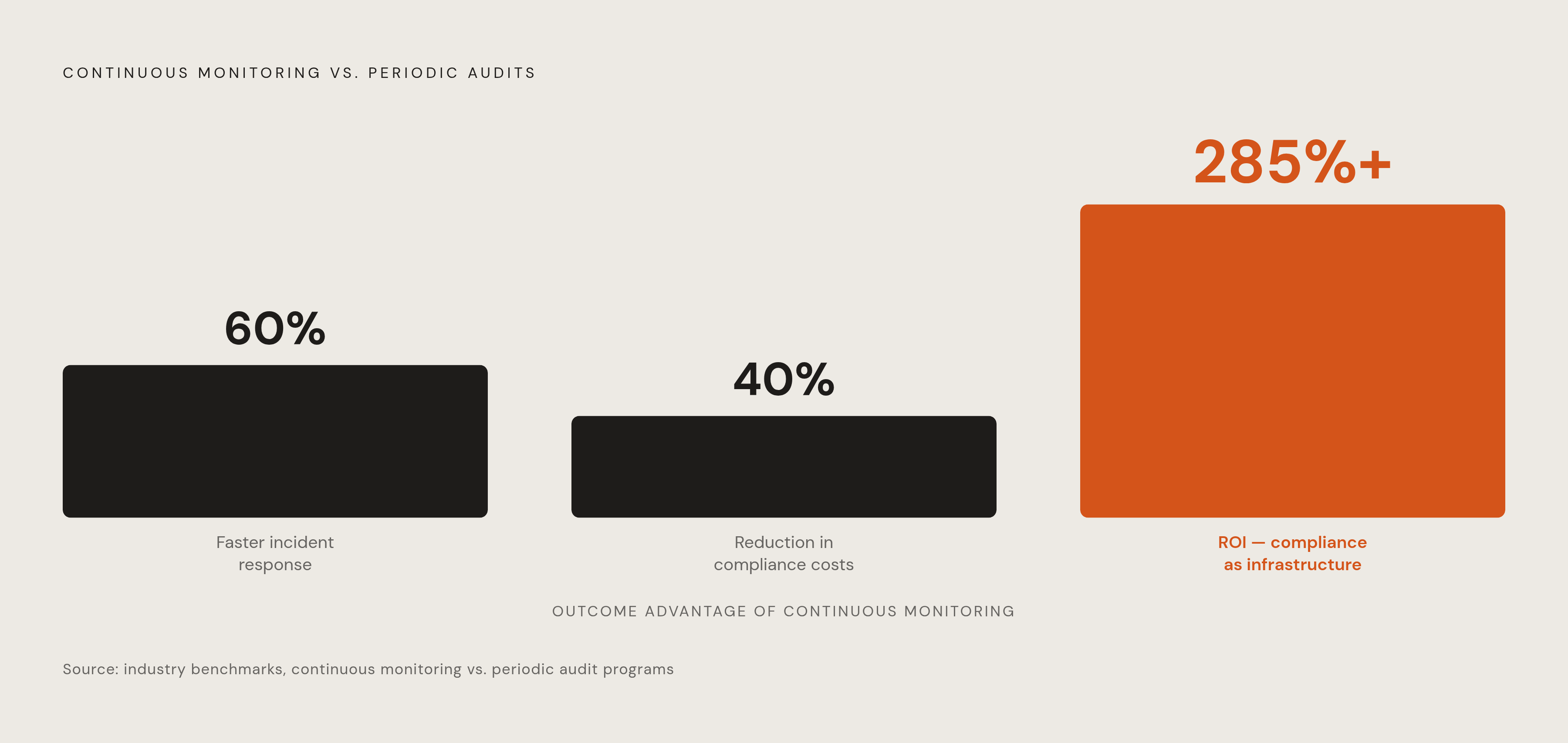
Organizations running continuous monitoring report 60% faster incident response and a 40% cut in compliance-related costs compared to the traditional audit approach. Sit with what "faster" actually buys: a lapse caught the same day it happens gets fixed before a contractor goes on-route, while a lapse caught at the next quarterly audit has already generated exposure (a claim, an incident, a regulator's attention) months before anyone on staff even knew there was a problem.
The cost reduction isn't just avoided penalties either. It's fewer people running full-population document pulls every quarter, because the system is already watching. A separate ROI analysis put continuous compliance monitoring at 285%+ return versus periodic audits, the kind of number that turns this from a compliance line item into something operators budget for as infrastructure.
Regulators are landing on the same conclusion from a different direction. PCI DSS 4.0, effective March 2024, now requires continuous vulnerability monitoring instead of annual assessments. That's an explicit statement from a major compliance standard that annual review is no longer enough on its own. The direction across industries points the same way: continuous verification is becoming the baseline, not the upgrade.
How the regulatory environment in 2025 raises the cost of monitoring gaps
The 2025 landscape is a genuinely awkward one to comply with. Federal DOL has pulled back from the 2024 IC Rule and told investigators to apply the older 2008 Fact Sheet #13 standard, but the 2024 rule hasn't gone away; it's still live in private litigation. State enforcement, meanwhile, runs on its own tests, frequently stricter than either federal option. Operators aren't choosing among standards. They're subject to all three at once, with no single compliant position that satisfies every one of them at the same time.
The only sane response is to stay defensible against the strictest applicable standard at all times, since there's no way to know in advance which standard applies to which case.
With federal enforcement stepping back, state attorneys general and state labor agencies have filled the space, and several recent multimillion-dollar misclassification settlements have named app-based delivery drivers specifically. The National Employment Law Project estimates 10 to 30 percent of employers misclassify at least some portion of their workforce. Apply that range to a delivery network running thousands of contractors, and even the low end produces meaningful exposure in aggregate.
Cross-border operators have another deadline coming. The EU Platform Work Directive takes effect in December 2026 and introduces a presumption-of-employment standard for platform workers, meaning the burden shifts to the operator to prove independent status rather than the other way around. An operator with expansion plans needs infrastructure that adapts to standards as they shift, not a compliance posture calibrated to rules that were current last year. In a multi-standard, multi-jurisdiction environment, a periodic audit built around one point in time under one standard covers only part of the job. Continuous monitoring is the model built to track status against requirements that keep moving.
Choosing a monitoring approach: what delivery and IC-network operators should evaluate
Generic compliance software built for enterprise IT or financial services watches different data than a contractor workforce needs watched, and dropping one into a delivery network leaves obvious blind spots. A handful of questions separate a monitoring platform that actually closes the drift window from one that just relabels the audit report.
Coverage is the first test: does it track insurance status, license expiration, background check refresh, and classification signals, or just store documents and call it done? Integration is the second: does a compliance hold actually stop a contractor from getting dispatched or paid, or does the flag sit in a dashboard nobody checks until Friday? Alert design matters too, since a system that batches exceptions into a weekly report has just rebuilt the audit delay with better branding. Scale is non-negotiable: can the platform track thousands of contractors without a human running manual queries, and does it produce the audit trail operators need if a regulator, insurer, or enterprise client asks for proof?
Platforms built specifically for delivery and IC networks, ones that combine onboarding, monitoring, insurance, and payments in one system, close that drift window in a way that stitching together three separate vendors rarely manages. Stitched-together stacks fail quietly, at the seam between systems, which is exactly where a lapsed policy or an expired license likes to hide. The audit stays in the picture as the supplementary layer, run for contractual attestation and legal documentation, while continuous monitoring carries the daily weight. For operators scaling headcount under real cost pressure, that division of labor is the only version of the equation that doesn't require adding compliance staff at the same rate the roster grows.
What continuous compliance looks like as an operational standard
Compliance monitoring belongs next to dispatch and route planning as core operational infrastructure. A contractor with a lapsed policy is an operational problem before it's a legal one.
In practice, that means no contractor goes on-route with an expired license, a lapsed policy, or an open credential gap, because the system blocks it automatically instead of catching it on the next audit date. It means classification signals get tracked as they build, not reconstructed after someone files a complaint. It means the compliance record is current on any random Tuesday, not just accurate for the three weeks following the last review.
The payoff shows up the moment someone asks for proof. When a regulator, an insurer, or an enterprise client wants to see contractor compliance, the answer is a live record instead of a report generated four months ago that was already stale the week it printed. That turns compliance into something closer to a growth lever: operators who can show continuous verification can take on bigger contracts and expand into new markets without the compliance risk that usually comes bundled with moving fast.
The periodic audit made sense when contractor rosters were small, stable, and barely moved year to year. The 1099 workforce in 2025 fits none of those descriptions, and building a compliance program as if it still does is a bet against the data, one that gets more expensive to lose every quarter the roster keeps growing. Continuous monitoring has moved from optional upgrade to baseline requirement in the current environment.