SOC 2 Compliance for Gig Economy Platforms
Gig platforms need SOC 2 Type 2 compliance to land enterprise deals.
A gig platform's SOC 2 audit covers three things at once: contractor Social Security numbers, same-day payment rails, and live dispatch data. Most SaaS companies only have to worry about one of those. So this piece exists to answer three questions: what SOC 2 actually checks, why enterprise buyers now demand it before they sign anything, and how to sequence the work so it doesn't eat six months of engineering time. Scope isn't something a gig platform gets to pick off a menu. It's dictated by what the platform already does every day, audit or no audit.
Scoping a gig platform's SOC 2 audit starts with what the platform already touches, not what it wishes it could exclude. Security is mandatory for every report; Availability and Confidentiality belong in scope the moment a platform runs live dispatch and holds contractor Social Security numbers; Processing Integrity turns close to mandatory once same-day ACH or instant debit payouts run at real volume. On sequencing: map every system that holds contractor PII, payment data, and operational data first, including Slack threads and Jira tickets that accumulated during fast hiring periods, then build the vendor inventory and remediate policy and technical gaps before the observation period starts, because anything fixed mid-period doesn't count for the full window. The six-to-twelve-month observation period is the structural reason to start before an enterprise deal is on the table, and compliance automation platforms that pull audit evidence continuously, rather than in a pre-audit scramble, are what make the difference between a six-month engineering drain and a manageable background process.
What SOC 2 actually evaluates and what the report proves
SOC 2 comes from the AICPA and runs on five Trust Services Criteria: Security, Availability, Processing Integrity, Confidentiality, and Privacy. Security is the only one you can't skip; the rest get added depending on what the business actually touches. There's no badge or seal here, nothing to slap on a homepage. SOC 2 is an auditor's written opinion on whether a company's controls are built right and, in the harder version, whether they held up over time.
That's the split between Type 1 and Type 2. A Type 1 report checks whether controls were designed right on a given day, the way a home inspector confirms the wiring meets code the moment they walk through the house. A Type 2 report checks whether those same controls held up over six to twelve months of real operation: real transactions, real people clicking real buttons. Enterprise shippers and insurance carriers know the difference and almost always ask for Type 2. A one-day snapshot tells them nothing about whether the platform stayed disciplined during a payment spike.
The report itself doesn't live in some public registry you can search. It goes to whoever asks for it: a procurement team, an insurance partner's risk desk, a logistics firm doing vendor due diligence. It's a private document you hand over, not a public credential you flash, and that distinction is exactly why so many platforms get caught flat-footed when a prospect finally asks for one. The criteria also got a refresh in 2022, mostly to catch up with how cloud infrastructure, and now AI tools, moved risk around.
Which Trust Services Criteria belong in a gig platform's scope and why
Security is non-negotiable. Nine control categories, from governance and risk management to access control and monitoring, appear in every SOC 2 report. The real decisions start with the other four.
Confidentiality maps straight onto contractor data. The AICPA splits it into data classification and protection: encryption, access limits, secure deletion once a contractor account closes. That spans from the moment a driver uploads a license scan to the day their record is deleted after offboarding.
Processing Integrity gets skipped in most SOC 2 explainers, but it's the one that matters most for a platform running same-day ACH or instant debit payouts. The criteria check that processing is complete, accurate, timely, and authorized. Auditors test this by tracing a transaction end to end and reconciling what went in against what came out, which is a heavier lift than pulling a database log. It means proving the payment math holds, transaction by transaction, not just on paper.
Availability matters anywhere dispatch uptime is the actual product. A delivery platform whose dispatcher goes dark for twenty minutes isn't having a minor outage; it's stranding drivers and orders at the same time. Enterprise logistics clients want documented SLAs proving that risk gets managed, not just hoped away. Privacy applies more narrowly, mostly to platforms handling contractor health data or operating under GDPR or CCPA.
For most gig and delivery platforms, the sensible baseline is Security, Availability, and Confidentiality. Adding those two to a Security-only audit costs roughly 20% more, a modest premium for what it buys in a vendor risk review. Processing Integrity turns close to mandatory the moment a platform moves contractor payouts at real volume and speed.
Where gig platform data actually lives, and why that creates audit exposure
Here's a finding that shows up constantly in real audits under the CC6 control family: customer PII sitting in systems that were never built to hold it. Social Security numbers pasted into Slack. A driver's license number sitting in a Jira ticket from eighteen months ago. Bank routing digits buried in a support email thread nobody archived.
For a gig platform, that's not hypothetical. It's just how contractor onboarding runs at a lot of companies. W-9 collection goes through email, license scans get shared over whatever messaging tool is fastest during a busy hiring week, routing numbers get typed into forms that dump into storage nobody's watching. None of it is malicious. It's just how growing operations move before anyone stops to ask where the sensitive fields actually landed.
Now add the 2025 wrinkle: staff pasting contractor PII into ChatGPT or Copilot to speed up a task, with no policy anywhere telling them not to. Auditors now ask whether a company has an AI use policy and technical controls to prevent that kind of leak, not just a Security section that mentions AI in passing.
There's a vendor layer stacked on top of all this. A 2023 Ponemon Institute survey found 59% of data breaches traced back to third parties, and a gig platform's vendor list fits that profile exactly: background check providers, insurance carriers, payment processors, fleet telematics companies. Each one is a door the platform doesn't fully control. Auditors have caught up to this; they check whether a company runs a real vendor assessment program now, not just whether it locked its own front door. Readiness gets decided as much by the integration stack as by the core app.
Why enterprise partnerships specifically hinge on SOC 2 Type 2
Large shippers, third-party logistics firms, and insurance carriers run formal vendor risk assessments before they let a platform near their supply chain or customer data, and those assessments are built around Type 2 reports specifically. A Type 1 report, or a filled-out security questionnaire, won't clear that bar with a procurement team that's done this before.
The part operators miss until it's too late is the observation period: six to twelve months, minimum. Start today and there's no Type 2 report available for at least half a year. That's why the smart move is starting before an enterprise deal is on the table, not after a prospect asks for the report and the sales cycle stalls.
Insurance carriers evaluating a platform as a distribution partner run the same math. They need proof of operational discipline before routing policyholder data or premium flows through someone else's systems. And the market keeps growing under all of this: platform-based labor is headed toward $2.5 trillion by 2035, so the buyers demanding audited vendors aren't some shrinking niche. They're where the labor market is going.
The cost of skipping Type 2 isn't abstract. It shows up as deals that stall in procurement and partnerships that never survive vendor review.
What the traditional audit process costs and why most platforms underestimate it
A traditional SOC 2 audit runs $50,000 to $100,000 in consulting and auditor fees. That number surprises people less than the time does: three to six months of internal prep before the auditor even shows up to do anything.
The prep is the actual grind. Evidence collection, control documentation, policy writing, gap remediation, all of it has to happen before fieldwork starts. For a gig platform, the list of in-scope systems runs longer than what most SaaS companies deal with: contractor onboarding modules, payment integrations, telematics feeds, background check connections, each one needing its own documented controls.
Somebody has to own this, and at most lean platforms that person is an engineering lead or head of ops who's also running production systems day to day, with no dedicated compliance team to hand off to. And Type 2 isn't a box you check once. The observation period renews every cycle, and controls have to stay in force continuously, not just look good the week before the audit. That ongoing weight is the real argument for building monitoring into daily operations instead of treating each audit like a fire drill.
How compliance automation tools change the preparation timeline
Compliance automation platforms connect directly into a company's existing systems and pull audit evidence continuously, instead of forcing a scramble before the auditor arrives. Evidence accumulates throughout the observation period.
The core feature worth understanding is control mapping. The platform matches existing technical controls against SOC 2 requirements and flags gaps automatically, before an auditor finds them. Done well, this cuts time to audit-readiness by up to 90% compared to manual preparation. Vanta, Drata, Secureframe, and Sprinto show up most often here, and each one plugs into the cloud and SaaS infrastructure most gig platforms already run on.
For a gig platform, the payoff goes past speeding up one audit cycle. Real-time alerts catch a control drifting, like an access permission nobody reviewed in months or a vendor assessment that quietly lapsed. Processing Integrity evidence for payment systems builds up continuously instead of existing as one snapshot from audit week, and vendor risk monitoring covers the exact exposure the Ponemon number points to: the third-party integrations behind 59% of breaches.
This is the same shift delivery platforms already made with contractor compliance, moving from periodic manual checks to always-on monitoring. A workforce management platform running real-time credential checks on its drivers is, structurally, doing the same thing a SOC 2-ready company does with its data controls. Same idea, different data.
How contractor compliance infrastructure and SOC 2 controls reinforce each other
Every onboarding module that collects contractor PII sits inside SOC 2 Confidentiality scope: how the data comes in, where it sits, who can touch it, when it gets deleted. Every payment disbursement system, same-day ACH included, sits inside Processing Integrity scope, and auditors will trace transactions and expect reconciliation records behind them.
Credential and license monitoring builds its own long-running data trail, and questions about retention, query access, and security on that trail feed straight into both Confidentiality and Security. None of this sits apart from the compliance work gig platforms already do to keep drivers licensed and insured. It's the same data, just read through an auditor's checklist instead of an ops dashboard.
There's a real structural payoff here. A platform built on one integrated system, rather than five disconnected tools stitched together over time, ends up with a smaller, cleaner SOC 2 scope almost by accident. Fewer vendor integrations means fewer third-party assessments to chase, and access controls living in one place are far easier to document than controls scattered across a half-dozen systems that don't talk to each other. One payment rail is a much simpler thing to test for Processing Integrity than three or four disbursement paths running in parallel.
Platforms that already built real-time monitoring for contractor credentials are, without quite realizing it, partway to the continuous control monitoring Type 2 demands. The overlap runs deeper than most people expect, and it cuts both ways: a vendor that handles contractor Social Security numbers and payment data but can't produce its own Type 2 report is itself a third-party risk sitting inside your stack.
How do you scope and sequence a SOC 2 audit when contractor SSNs, payment rails, and live dispatch data are all in play?
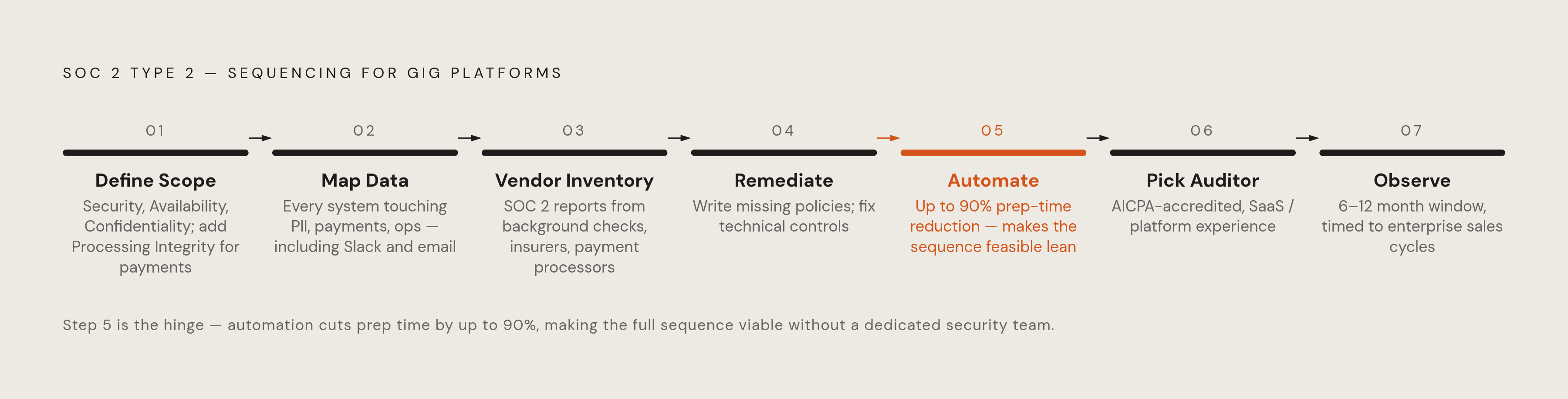
Start with scope. Decide which Trust Services Criteria actually apply based on what the platform processes. For most gig and delivery operations, that's Security, Availability, and Confidentiality, with Processing Integrity added once payment volume justifies it.
Then map the data. Find every system touching contractor PII, payment data, and operational data, including the chat tools and email threads nobody thinks to check. This is where the Slack-and-Jira problem surfaces, ideally before the auditor finds it.
Build a vendor inventory next. Document every third-party integration and obtain SOC 2 reports, or equivalent proof, from each one; background check providers, insurance carriers, and payment processors go at the top of the list. Then remediate: write the missing policies (AI use, data classification, secure deletion) and fix the missing technical controls (access management, encryption, logging) before the observation period starts. Anything fixed mid-period doesn't count for the full window.
Decide on automation tooling around this point. For a platform without a dedicated security team, cutting prep time by something close to 90% isn't a nice-to-have. It's the difference between hitting a sales deadline and missing one. Pick an auditor next, specifically an AICPA-accredited CPA firm that's worked with SaaS and platform businesses before. Familiarity with contractor data environments changes how smoothly fieldwork actually goes.
Last step is patience. Plan the six-to-twelve-month observation period around the business calendar, ideally lined up with enterprise sales cycles, since a Type 2 report landing right before a big procurement push has obvious commercial value. After that, the job doesn't end. SOC 2 runs alongside the business: continuous monitoring, annual renewal, and ongoing vendor reassessment belong in daily operations, not in a folder dusted off once a year.