Contractor Agreement Clauses That Reduce Misclassification Risk
Multiple federal tests govern contractor status, and the agreement is your first line of defense.

Misclassification does not turn on what a company meant to do. It turns on what a regulator, a plaintiff's attorney, or an auditor can point to in the record: the contract, the pay stub, the dispatch log, the app that told a driver which route to run. The written agreement is usually the first document anyone pulls, and it either backs up the independent contractor relationship or hands the other side its opening exhibit. For operators running large contractor networks, delivery fleets, last-mile carriers, 3PLs, the math is not abstract. Federal penalties run above $2,300 per violation, back-wage claims can reach two to three years into the past, and that's before liquidated damages or IRS payroll-tax exposure. A good contract does not solve the problem by itself, and the gap between what an agreement says and what actually happens on the ground is where most of this exposure lives. Even so, the agreement is the lever operators actually control, so it's the right place to start.
The classification tests that give every clause its meaning
Two federal frameworks currently apply at the same time, which is exactly as annoying as it sounds. The Department of Labor's economic realities test, laid out in Fact Sheet #13 and the reinstated Opinion Letter FLSA 2019-6, is the enforcement standard the Wage and Hour Division has used since May 2025. Meanwhile, the 2024 DOL Final Rule's six-factor test is still on the books and still gets cited by federal courts in private lawsuits, even though the agency itself said it won't apply that rule in enforcement actions. A proposed return to a five-factor test also sits in DOL's rulemaking pipeline, with no confirmed timeline. Anyone drafting agreements as if today's enforcement posture is permanent is drafting for a moment that will pass.
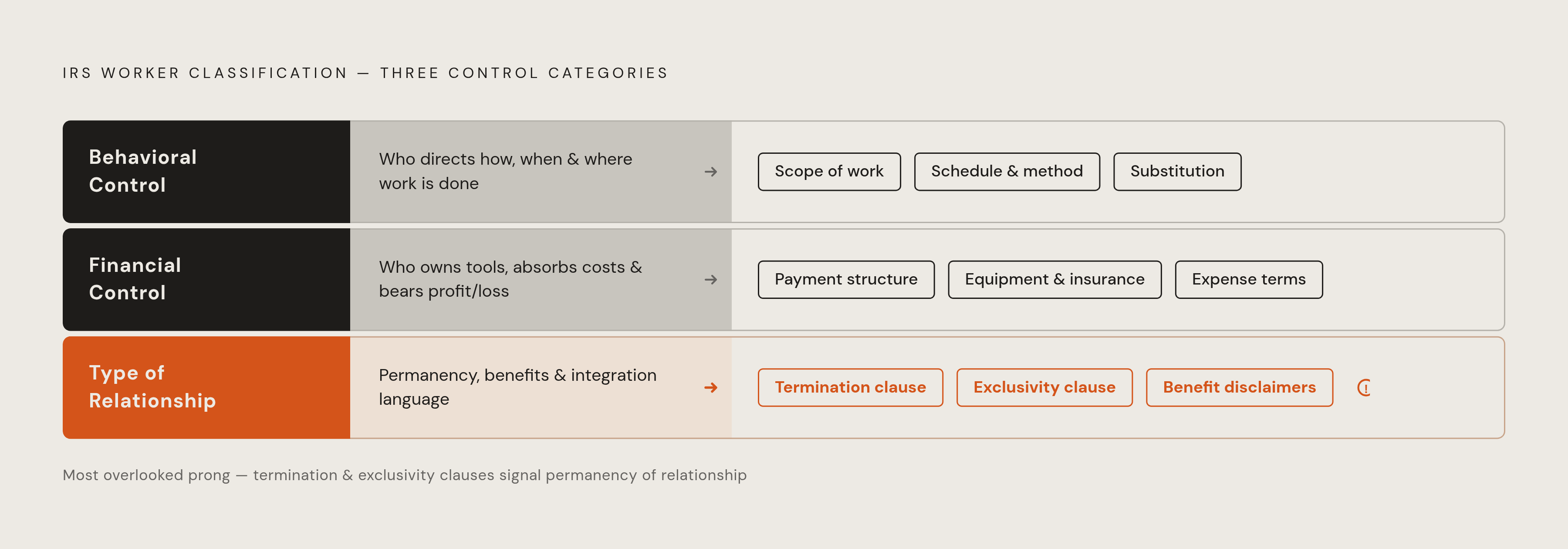
Layer the IRS's three-category framework on top: behavioral control, financial control, and type of relationship. Each one maps to a specific kind of clause, which is the organizing logic for the rest of this piece. Behavioral control asks who directs how, when, and where the work gets done. Financial control asks who supplies the tools, who eats the costs, who actually stands to profit or lose. Type of relationship looks at the paper itself: how permanent the arrangement is, whether benefits exist, whether the worker reads as integrated into the business.
Then there are state ABC tests, and California's AB 5 is the one that keeps compliance officers up at night. Upheld by the Ninth Circuit in June 2024, it requires that the contractor work free from control, perform tasks outside the hiring company's usual business, and run an independently established trade of their own. That middle prong, the "B prong," is brutal for delivery companies: a courier is no more outside a delivery company's usual course of business than a chef is outside a restaurant's. Running one national agreement across every state is a common shortcut and a documented risk. Treat the base contract as a template, not a finished product, and adjust it state by state.
Every one of these tests, federal or state, comes back to the same governing idea: what matters is the reality of the relationship, not the label on the contract. Keep that in mind for every clause discussed below, because it's the lens the courts actually use.
How to write the scope-of-work clause without prescribing method
Behavioral control problems usually start right here, in the section everyone assumes is boilerplate. A scope clause that describes how work gets done, rather than what result is required, reads as an instruction manual, not a contract for services. Instructions are what employers give employees.
Good scope language defines the deliverable, spells out what "done" looks like, sets revision limits where relevant, and flags dependencies, all pointed at outcomes. What it should not do: dictate hours, prescribe a sequence of tasks, mandate a specific method, or require check-ins and approval gates for routine decisions. Each of those is a behavioral control flag with a name and a case history behind it.
Vague scope clauses show up constantly in real-world contractor agreements, and they cause a second problem beyond classification risk: disputes over when payment triggers and how much revision is owed. For delivery operators, the fix is concrete. Define the service by route completion, delivery windows, and service-level metrics, rather than by vehicle speed, loading order, or a scripted greeting at the customer's door. A vague scope clause creates a vague payment condition, and a vague payment condition starts looking like a salary, which undercuts what anyone drafting this document is trying to achieve.
Control over schedule, method, and location — where agreements most often create exposure
Behavioral control gets tested more than any other prong, in DOL investigations and in private lawsuits alike, and language that sounds perfectly reasonable in a meeting can read as a smoking gun in a deposition. "Must be available Monday through Friday." "Must use the company app for route updates." "Must attend the weekly team call." Each of those phrases, taken individually, sounds like normal business coordination. Taken together, in front of an investigator, they sound like a shift schedule.
The fix isn't complicated: let the contractor set availability windows, use company systems for delivery confirmation rather than turn-by-turn direction, and make coordination channels optional rather than mandatory.
The single strongest tool against a behavioral control finding is the right-to-substitute clause. If a contractor can send a qualified replacement to run the route, the company is paying for a route to get run rather than for one specific person's labor, and that distinction is close to the whole ballgame under every version of the economic realities test. Draft it so the contractor can engage subcontractors or substitutes at their own expense, with the company allowed to ask for proof of qualification but not allowed to reject a substitute without cause. A prior-approval requirement that functions as a veto defeats the clause entirely; it's a substitution clause in name only.
Training is its own trap. Mandatory, company-run training sessions read as direction. Making training available, without dictating when or how a contractor completes it, reads as a resource. Same goes for route optimization software and dispatch tools: framed as tools the contractor chooses to use, they're fine. Framed as instructions the contractor must follow, they're evidence.
Why exclusivity clauses are a documented misclassification trap
Exclusivity clauses are legal. They are also, depending on how they're written, a documented piece of evidence for the other side, sitting right there in black and white for an investigator to circle in red pen. Economic dependence on a single client is a core factor in the DOL's test, and an exclusivity clause is the company admitting, in its own contract, that the dependence exists.
The counter is a non-exclusivity clause: an affirmative statement that the contractor can work for other clients, with no obligation to disclose who they are and no non-compete running during the engagement. Watch for clauses that reconstruct exclusivity without using the word: a right of first refusal, a minimum-hours commitment that eats up all available time, a geographic carve-out that boxes the contractor into one territory. Each of these rebuilds economic dependence under a different name.
None of this holds if the operational facts contradict it. A contractor logging 50-plus hours a week for a single operator is economically dependent whether or not the contract says otherwise, and courts read past the language to the pattern. For a network running hundreds or thousands of contractors, keeping the non-exclusivity language consistent, and making sure dispatch practices don't quietly punish contractors who take outside work, is as much a management discipline as a drafting exercise.
Payment structure and financial control — how compensation terms signal independence or dependence
Financial control comes down to three questions: how the worker gets paid, who owns the tools, who absorbs the losses. The payment clause touches all three at once.
Per-delivery or per-project pay supports contractor status. A fixed weekly amount that resembles a salary draws exactly the scrutiny a company doesn't want. Tie payment to completion of a defined unit of work rather than to hours logged; hours logged is the currency of employment.
Tax language needs to be unambiguous: the contractor is solely responsible for self-employment tax, quarterly estimated payments, and their own compliance, and the company withholds nothing. Reimbursing routine operating costs, fuel, vehicle upkeep, a phone plan, pushes the analysis toward employment; requiring the contractor to own their equipment and absorb their own operating costs pushes it the other way. A contractor who can pick up more routes, bring on a subcontractor, or decline a low-margin job has genuine profit-and-loss exposure, the kind that defines a business owner rather than an employee on a schedule. The agreement should reflect that instead of fixing rates the company alone controls.
One more detail with a hard deadline attached: the 1099-NEC reporting threshold rises from $600 to $2,000 for payments made after December 31, 2025. Payment systems that miss the new threshold create filing gaps, and filing gaps are exactly the kind of paperwork inconsistency that turns a routine audit into a classification review.
Equipment, insurance, and expense clauses — putting contractor independence in writing
Under the IRS's financial control test, a contractor who owns or leases their own equipment looks like an independent business. A contractor using company-supplied gear looks like an employee with a badge. The agreement should say plainly that the contractor provides, maintains, and insures their own tools and vehicle, and the company should avoid any setup where equipment shows up free, or as a quiet condition of getting work.
Insurance works the same way. Requiring proof of insurance is one of the clearest signals available that the company is contracting with a real business rather than hiring a worker under a different name. For delivery contractors, commercial auto liability is the floor: bodily injury, property damage, legal defense. General liability covers damage or injury tied to the work itself. State workers' comp, where required, is the contractor's obligation, not the company's, and the agreement should say that too. Requiring a current certificate of insurance, and actually checking it, is both a compliance step and an operational one.
Indemnification and hold-harmless language only means something if the insurance behind it is real; draft the two together, because an indemnification clause backed by nothing is just a sentence. Add a waiver of subrogation, standard in a well-built IC agreement, so the contractor's insurer can't turn around and come after the hiring company after paying a claim. None of it matters if certificates lapse between renewals and nobody notices. A lapsed certificate turns a strong clause into a decorative one.
Termination clauses and relationship permanency — the often-overlooked classification signal
Permanency shows up in every major test, and an open-ended contract with a single client, renewing forever with no defined end, is a red flag under all of them. Project-based agreements with a defined end date or a defined set of deliverables support contractor status. Arrangements that simply continue indefinitely, indistinguishable from employment, do not.
Termination clauses need to run both directions: either party can end the relationship without cause on reasonable notice. At-will termination that only the company can invoke, with no notice period, is a control mechanism dressed as a contract term. Watch for termination-for-convenience clauses that force the contractor through a company-controlled wind-down period or restrict them from picking up other work while it happens; that reflects direction over the worker, not the end of a business deal.
Auto-renewal is its own quiet risk. A contract that renews indefinitely functions as an ongoing relationship no matter what it's titled. Structure the work as discrete projects, or build in explicit re-engagement terms that require both sides to affirmatively choose to continue. And say, in plain words, that the contractor gets no health insurance, no retirement contribution, no paid leave, nothing that looks like an employment benefit, because the relationship-type prong of the IRS test looks for exactly that.
Tone matters here too. A contract that calls the contractor "part of the team," references company culture, or uses employment-flavored language hands the other side an integration argument built entirely from the company's own words.
Why a correctly drafted agreement still fails without operational alignment
The governing principle bears repeating: what matters is the reality of the relationship, not what the contract calls the worker.
The disconnect patterns repeat across delivery operators with striking consistency. The agreement says non-exclusive, and a dispatcher calls daily expecting priority access. The agreement says the contractor supplies their own equipment, and the company hands out branded gear as a condition of getting shifts. The agreement says project-based, and the same contractor hasn't gone a week without an assignment in three years. The agreement requires proof of insurance, and a certificate lapses quietly until a claim forces the question.
Retroactive reclassification doesn't care how clean the paper looked at signing. Liability reaches back years, covering wages, taxes, and benefits, even when the written agreement would have passed a law school exam. The only real defense is auditing the agreement against actual practice on a set schedule, not just at onboarding and then never again.
Scale makes the stakes bigger, not smaller. With 27.7 million full-time independent workers in the U.S. as of 2024, and a last-mile delivery market valued at $167.3 billion in 2025 and still growing, the sheer number of contractor relationships in this one sector makes manual, spot-check monitoring structurally inadequate. Operators need agreements that are sound on paper, and they need systems that continuously check the facts those agreements depend on: insurance still current, credentials still valid, other clients actually being served.
How delivery operators maintain clause-level compliance across large contractor networks
Contractor compliance at scale is a monitoring problem and a workflow problem as much as a drafting one, and even a genuinely well-built agreement degrades the moment nobody's watching whether reality still matches the paper. Certificates lapse. Dispatchers slide back into old habits and start assigning routes like a shift schedule. A contractor quietly stops taking outside work because the volume from one operator became too good to turn down, and nobody flags it because nobody was looking.
The clauses most exposed to this kind of drift are the ones that depend on an outside fact staying true over time, insurance status, multi-client activity, substitute qualification, rather than a fact fixed at signing. A scope-of-work clause doesn't expire. An insurance certificate does, on a specific date, whether or not anyone's tracking it. That difference is why clause-level compliance must function as an ongoing operational discipline, not a filing cabinet exercise revisited only when a regulator comes knocking.