Federal Contractor Misclassification Penalties
Contractors face $15,000 to $100,000 in penalties per misclassified worker.

Federal contractor misclassification now sits at the intersection of three unstable regulatory tracks, and every delivery or IC-network operator running 1099 drivers is exposed on all three at once. The Department of Labor has changed its enforcement standard three times in five years, federal courts are applying a different standard than the agency currently enforces, and state regulators are moving faster than either one. The DOL has also identified transportation and delivery companies as elevated enforcement concerns, with vehicle provision and fixed route assignment treated as red flags in classification reviews. Waiting for the dust to settle carries its own cost; the dust hasn't settled in five years. What follows maps what a misclassification finding actually costs, then walks through how operators structure around that exposure before a finding ever happens.
Under federal law, a misclassification finding typically costs between $15,000 and $100,000 per worker once every layer stacks: the FLSA requires back wages reaching two or three years depending on willfulness, liquidated damages equal to the wages owed that double the bill outright, and civil penalties up to $2,300 per violation; the IRS adds unpaid employer-side FICA at 7.65% of wages, income tax withholding liability, and employee-side FICA at 20% to 40% depending on whether a 1099 was filed, rising to 100% of unpaid FICA if the misclassification was intentional. State penalties layer on top of both and can reach $25,000 per worker in states like California, independent of anything owed federally. Structuring around the exposure before an audit means treating the actual working relationship rather than the contract language as the defense: documenting that drivers work other platforms, avoiding vehicle provision and fixed route assignment where possible, maintaining real-time credentialing records, carrying occupational accident insurance across the contractor base, and auditing against the most demanding standard that plausibly applies rather than the most permissive one currently in effect.
The federal classification standard is genuinely in flux, and that uncertainty is itself a risk
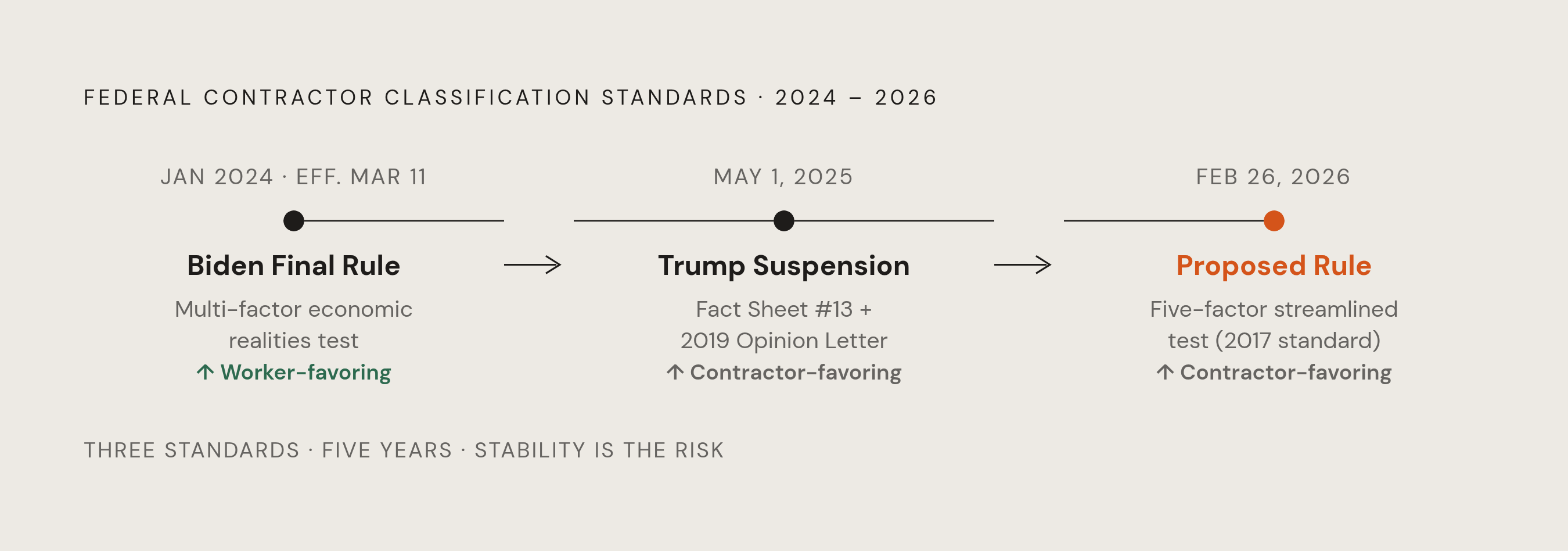
Start with the timeline, because the timeline is the story. The Biden DOL issued a Final Rule in 2024, effective March 11, restoring a multi-factor "economic realities" test for who counts as an employee. The Trump DOL suspended enforcement of that rule effective May 1, 2025, telling investigators to fall back on the older Fact Sheet #13 and a reinstated 2019 Opinion Letter, both friendlier to contractor classification. Then, on February 26, 2026, the DOL proposed a new rule that largely returns to the streamlined five-factor test used during the first Trump Administration. Three standards, five years. Anyone treating the current guidance as settled law is planning around a document that has already been replaced twice, and the assumption of stability is the real risk worth naming.
Here's the part that trips people up. The May 2025 guidance only governs how the DOL itself enforces the law; it says nothing about what a federal judge does with a private class-action lawsuit. Courts are still applying the 2024 Rule's six-factor test in litigation, regardless of what the agency currently prefers. An operator can pass a DOL audit under the lenient 2025 standard and still lose a class action two months later, because the plaintiff's attorney is arguing under a completely different rulebook. That gap between agency posture and courtroom reality is where most operators get blindsided, and it's the gap the rest of this piece keeps coming back to.
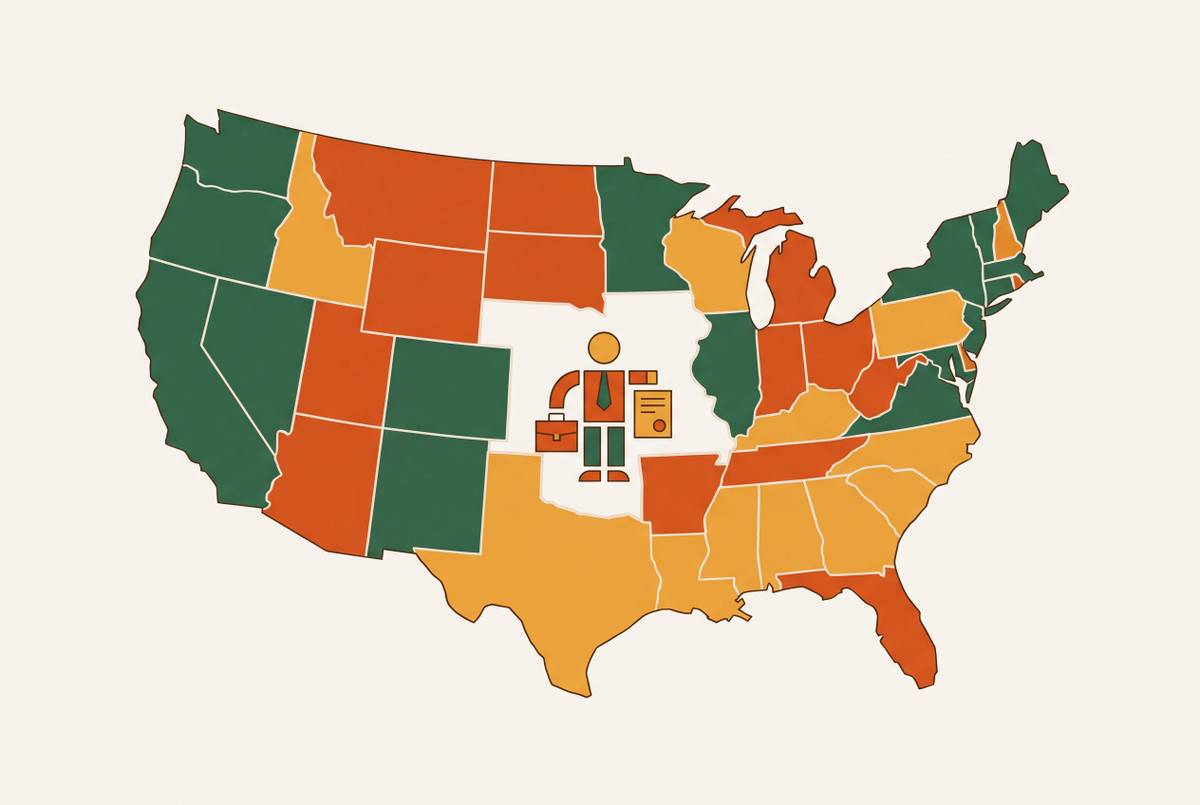
State law doesn't pause for any of this. New Jersey finalized ABC-test regulations effective June 1, 2026. The District of Columbia's Attorney General has settled misclassification claims against multiple delivery companies in recent enforcement actions. States are filling the space federal enforcement has vacated, and they are not waiting for Washington to make up its mind. A driver can be a lawful contractor under whatever federal test currently applies while simultaneously counting as an employee under the law of the state where he actually drives. Operators serving multiple states have to pass every applicable test, in every jurisdiction, at the same time. "We passed last year's audit" carries little weight, because the test itself may not exist anymore by the time anyone checks again.
What the federal penalty stack actually looks like, layer by layer
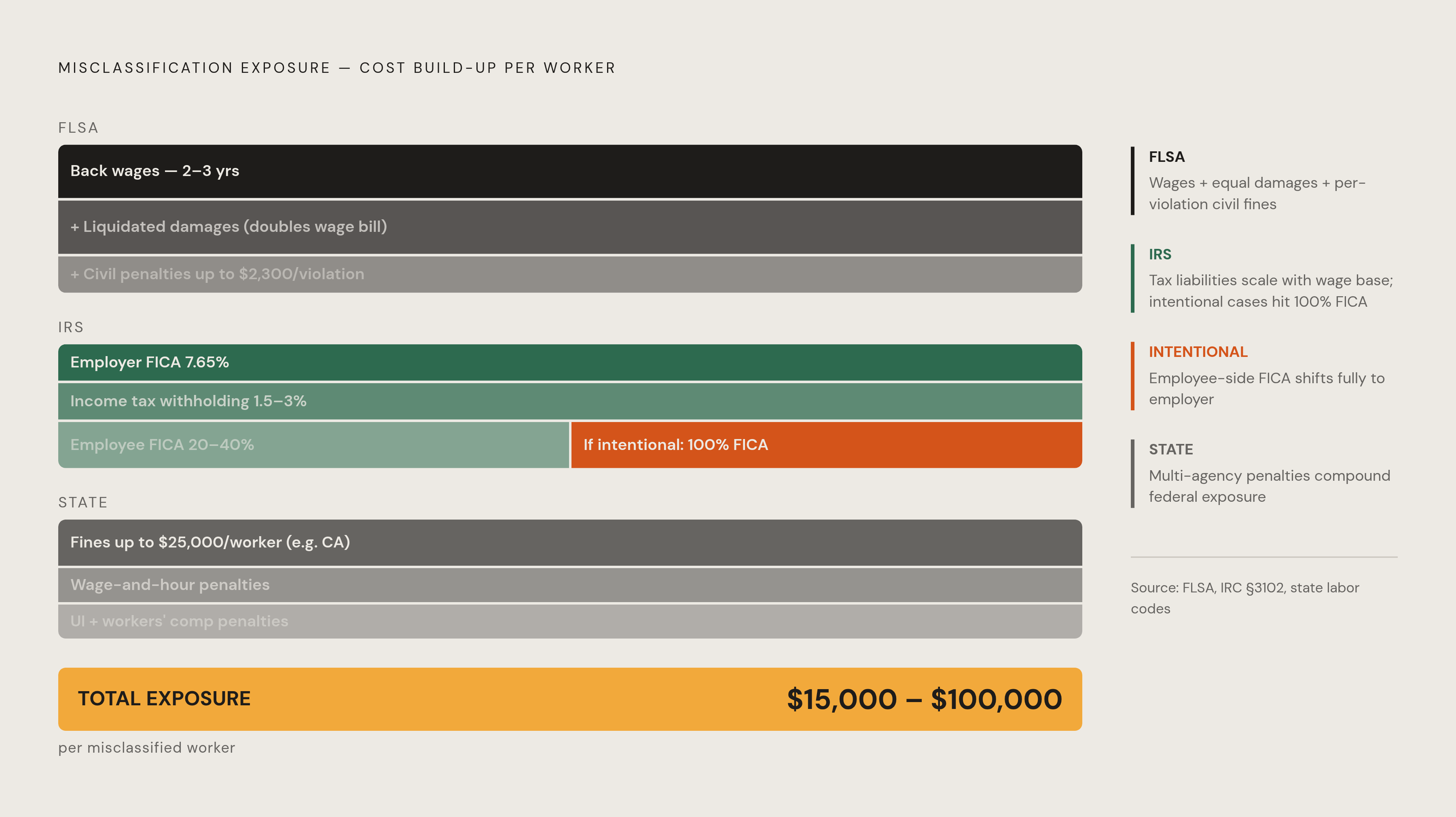
Total exposure per misclassified worker typically lands somewhere between $15,000 and $100,000 once every layer gets stacked, and it usually arrives as three separate bills rather than one.
The FLSA layer covers back wages, reaching two years back for ordinary violations and three years for willful ones. On top of the back wages sits liquidated damages, an amount equal to the wages owed, which doubles the bill before anything else gets added. Civil penalties on top of that can run up to $2,300 per violation.
The IRS layer runs on its own math, and the numbers shift hard based on intent. For unintentional misclassification, unpaid employer-side FICA runs 7.65% of wages, often grossed up further. Income tax that should have been withheld adds roughly 1.5% of wages, rising to 3% if no 1099 was ever filed. Unpaid employee-side FICA typically adds another 20%, or 40% if there's no 1099 on record. Cross the line into intentional misclassification, and the IRS can hold the company liable for 100% of unpaid FICA taxes outright. Interest compounds throughout litigation, so a multi-year dispute grows more expensive while lawyers are still arguing the underlying classification.
State penalties stack on top of both. Fines can reach $25,000 per misclassified worker in states like California, and some states layer on separate wage-and-hour claims, unemployment insurance liability, and workers' compensation penalties independent of anything owed under the FLSA.
Willfulness is the hinge the whole stack swings on, and regulators read it broadly. A prior audit, a memo from counsel flagging risk, or even general industry knowledge that classification is contested can turn an honest mistake into a willful violation in the eyes of a court. Ignorance is a weak defense when the trade group has been sending newsletters about this exact issue for three years running. In fiscal year 2023, the DOL recovered over $274 million in back wages tied to misclassification, during a comparatively lighter enforcement stretch. The machinery runs regardless of which administration is turning the crank.
How penalties compound when a misclassification finding covers multiple workers
Per-worker penalties don't sit still; they multiply. Fifty misclassified drivers at $2,300 apiece in FLSA civil penalties alone produces a six-figure number before a single dollar of back wages or IRS liability enters the picture, and before liquidated damages double the wage component or state fines pile on.
Class and collective actions turn this from arithmetic into something closer to compounding interest. A single plaintiff's attorney can aggregate a driver population across multiple years into one filing, and what looked like a manageable dispute over a handful of workers becomes a company-defining event. Uber's $100 million settlement in New Jersey, covering roughly 300,000 misclassified drivers, is the clearest illustration of where this math ends up. That outcome sits at the ceiling rather than the typical case, and it happened specifically because scale doesn't protect a company; scale is the multiplier.
Delivery and transport carry misclassification rates well above the broader employer baseline, which makes a wide-reaching finding a live possibility rather than a tail risk. And the per-worker fine figures don't even capture everything. Retroactive benefits, health coverage, retirement contributions, workers' comp premiums that should have been paid all along, can get clawed back for the full statutory period once a finding lands. Add regulatory investigations that disrupt onboarding, drive contractor churn, and prompt insurance carriers to ask harder questions about the book of business, and the fine is just the number that shows up first.
What regulators and courts actually look at when evaluating classification
There is no single federal test right now, which is exactly the problem. The DOL currently applies the older economic-realities principles from Fact Sheet #13 and the 2019 Opinion Letter for its own enforcement. Federal courts, hearing private lawsuits, apply the 2024 Rule's six-factor economic realities framework instead. States run their own tests entirely, and many use an ABC test that starts from a different presumption altogether.
The core factors show up, in some form, across nearly every version: how much control the company exercises over how the work gets done, the worker's opportunity for profit or loss based on his own managerial choices, how much he's invested in his own equipment relative to the company's investment, whether the work is central to the company's business, how permanent the relationship is, and how much independent skill and initiative the worker brings. The weighting shifts between frameworks, but the questions underneath don't change.
Two patterns draw particular regulatory scrutiny in the delivery context: providing the vehicle and assigning specific routes. Beyond that, dress codes, mandated equipment, and communication protocols that look like supervision all draw scrutiny, as do exclusivity terms that block a driver from working other platforms, and open-ended relationships with no defined project endpoint.
ABC tests, used across a growing number of states, are structurally tougher to clear than economic realities tests, a distinction most operators underrate. They start from a presumption of employee status and put the burden on the business to prove, affirmatively, all three prongs: genuine independence from control, work that falls outside the company's usual line of business, and a trade the worker customarily runs on his own. That third prong alone kills a lot of delivery arrangements, since driving is rarely outside a delivery company's usual course of business. The question every operator should ask is whether the day-to-day relationship, stripped of the paperwork, looks like independence or supervision.
How do operators structure around misclassification exposure before a finding occurs?
Contract language alone rarely settles the question, since regulators look past what the agreement says to what the relationship actually does. The practices that matter most are the ones that leave evidence behind, not the ones that sound good in a template. Treating the contract as the defense is the most common structural error here, and it's an easy one to fix.
A contractor agreement should reflect the real arrangement: specific to the work, the tools, the scheduling flexibility, and explicit permission to work other platforms, rather than boilerplate copied wholesale. Letting drivers work for competitors, and documenting that they do, directly supports the "opportunity for profit or loss" factor and undercuts any argument that the relationship is permanent or exclusive. Operators should also think twice about vehicle provision and route assignment, since both patterns mirror employee scheduling and are named enforcement flags; where a company does provide vehicles, that arrangement needs its own legal structure, worked out with counsel rather than defaulted into. Keeping records of contractor licensing and credentials helps too, since it shows the worker brings independent professional qualifications rather than depending on the company to train him from scratch.
None of this works as a once-a-year exercise, and treating it that way is the most common mistake operators make. The standard itself is mid-revision and states are moving independently of the federal timeline, so a compliance review done in January can be stale by summer. Real-time monitoring, catching a license that's about to expire or an insurance gap before it opens, does double duty as a classification defense and an operational safeguard, since an uninsured contractor is a liability with or without a misclassification finding attached. Occupational accident insurance for 1099 drivers plays a similar dual role: it covers work-related injuries that contractors can't get through workers' comp, and it reinforces the contractor relationship itself, since it reads as protection built for an independent worker rather than a slice of the employee benefits stack. Workforce platforms built specifically for contractor networks, rather than repurposed W-2 HR software, tend to track the documentation and credentialing detail that economic realities tests actually examine, narrowing the gap between what the paperwork claims and what the relationship can prove.
Safe harbors that limit IRS tax liability when misclassification is unintentional
Section 530 of the Internal Revenue Code gives operators a way to cut off federal tax liability even after a misclassification finding, provided the company meets three conditions.
First, consistent treatment: every worker doing the same kind of work has to be classified the same way. No mixing W-2 employees and 1099 contractors performing functionally identical delivery routes. Second, filing compliance: every 1099 that should have been filed for those workers actually was. Third, a reasonable basis for the original classification, whether that's a past IRS audit that didn't challenge it, a court ruling that supported it, or a long-standing practice across the industry.
Section 530 covers only federal tax liability, and treating it as broader protection is the mistake that surfaces in litigation, not before. It does nothing for FLSA back wages, nothing for state penalties, nothing for a private class action. The consistent-treatment requirement is exactly where a lot of delivery operators fail the test, because running a mixed fleet of employees and contractors doing the same job is the single fastest way to lose Section 530 eligibility. Before relying on it, operators should audit their own workforce segmentation against that internal-consistency bar, not just against the classification tests themselves.
What operators should do now given the regulatory uncertainty ahead
The 2026 proposed rule will probably get finalized in some form. That doesn't make the problem go away, because private litigation under the 2024 Rule keeps running in parallel regardless of what the agency finalizes. Structuring around the most demanding standard that could plausibly apply, rather than the most permissive one currently in effect, is the only posture that survives a rule change, and it's the one most operators skip because the lenient standard is cheaper to comply with today. Betting on the lenient standard staying lenient is a bet the last five years have already undercut.
That means auditing the actual working relationship against economic realities factors in every jurisdiction where contractors operate, not just checking the contract for the right language. It means tracking state exposure separately from federal exposure, since states like New Jersey and California run independent tests and independent enforcement that don't care what the DOL is doing this year. It means building documentation that runs continuously, because the evidence that defends a classification decision two years from now is either being created today or it isn't being created at all.
Insurance belongs inside this framework as a core piece, not an afterthought. A workers' comp claim filed by an uninsured contractor is one of the more common triggers for a classification investigation in the first place, so keeping occupational accident coverage current across the entire contractor base closes off an injury liability and an enforcement tripwire at the same time. Operators who treat this infrastructure as overhead are the ones caught flat when a rule shifts or a plaintiff's attorney files. The ones who survive repeated regulatory cycles are the ones whose documentation holds up no matter which version of the test gets applied to it.