AB5 vs. ABC Test for Delivery Companies
Delivery companies structurally fail AB5's test because their core business is delivery.
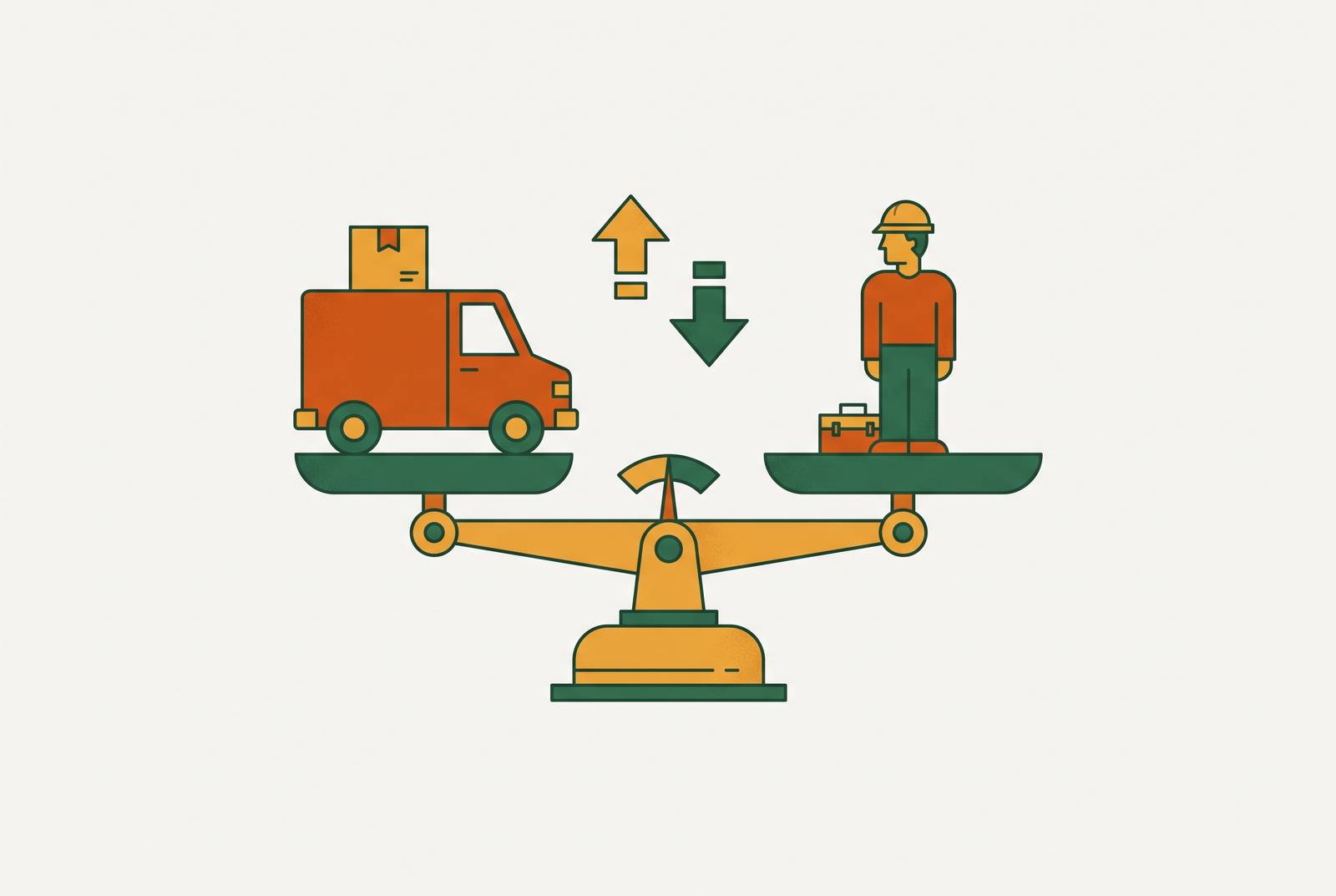
AB5 runs on a three-part test, and delivery companies are the one industry that structurally cannot pass part two. The reason is simple: the test asks whether a contractor's work falls outside the company's usual business, and a delivery company's usual business is delivery. That single overlap, called Prong B, makes last-mile operators more exposed to misclassification liability than almost any other contractor-dependent industry. The last-mile delivery market was valued at $167.3 billion globally in 2025, according to Grand View Research, with the U.S. segment alone worth $35.64 billion according to Precedence Research, and most of that volume runs on 1099 drivers. Get the classification wrong, and the exposure multiplies with every driver, every pay cycle, every route.
Delivery companies structurally cannot pass Prong B of the ABC test because Prong B asks whether the contractor's work falls outside the company's usual course of business, and a delivery company's usual course of business is delivery. When a driver's task and the company's commercial purpose are identical, that prong fails, and the law cares whether the type of work matches, not the volume. Because the ABC test is conjunctive, one failed prong is enough to collapse the entire contractor classification, leaving the company exposed to misclassification liability across every driver running that model. Proposition 22 carved out an exemption for app-based platforms, but traditional courier networks, DSPs, and last-mile operators get none of that protection and sit squarely inside AB5's full requirements.
How the ABC test actually works, and what makes it different from other classification frameworks
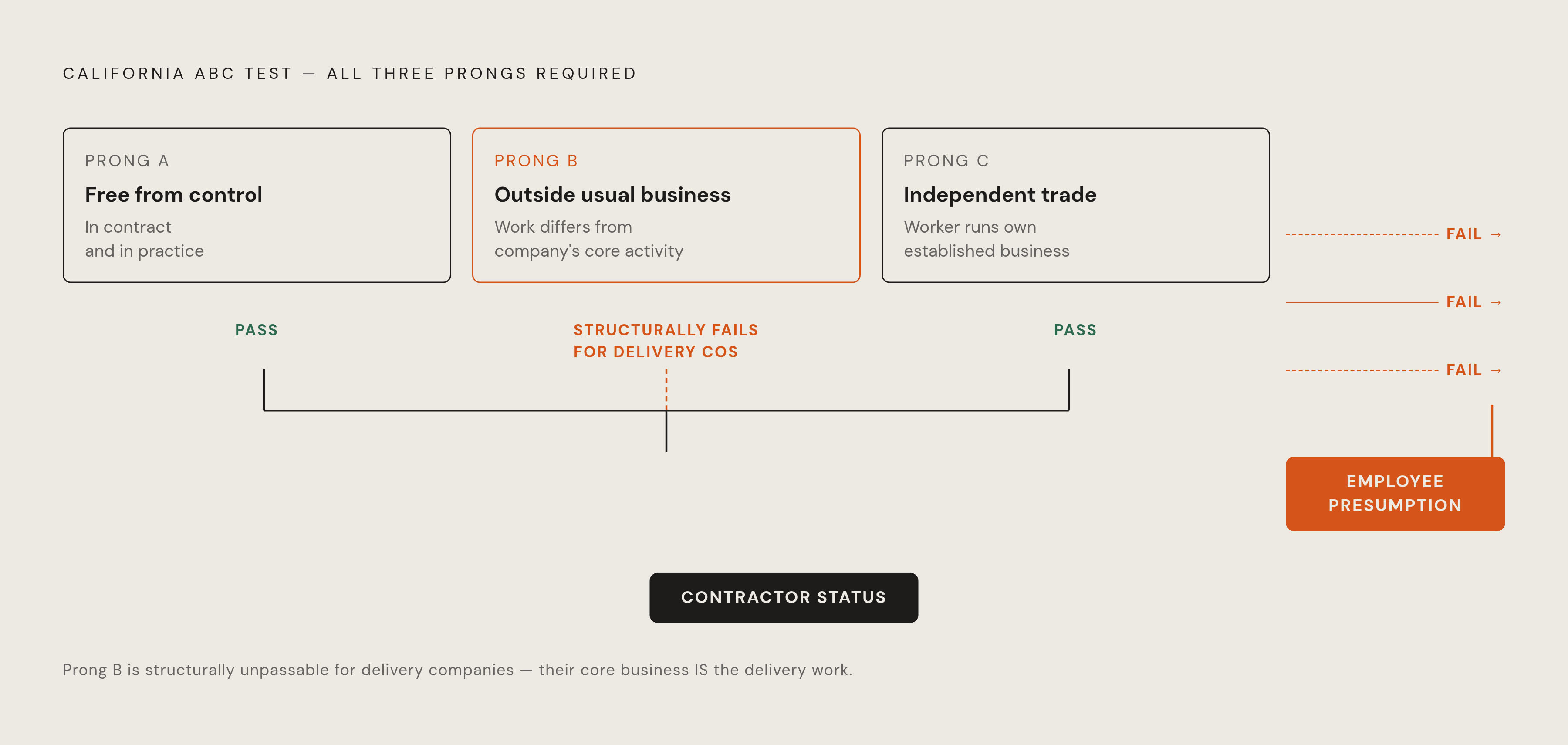
California codified the ABC test under Labor Code Sections 2775 through 2787, effective January 1, 2020. The mechanics are blunt: a worker is presumed to be an employee unless the company proves all three prongs, and two out of three isn't enough.
Prong A asks whether the worker is free from the company's control, both in the contract and in actual practice. Prong B asks whether the work falls outside the company's usual course of business. Prong C asks whether the worker runs an independently established trade of the same kind. It's a conjunctive test: fail one prong, and the whole classification collapses.
Compare that to the federal economic reality test, which looks at the totality of circumstances and asks whether the worker depends economically on the hiring company. There's no presumption of employment baked into that framework, and the IRS's multi-factor test likewise weighs factors without presuming an outcome. Under AB5, the burden sits entirely on the company; under federal frameworks, it's a more even fight. That difference in architecture is why a business can be perfectly compliant with the IRS and still be fully exposed in California.
Why can't delivery companies pass Prong B of the ABC test under AB5?
The California Trucking Association flagged Prong B as the single biggest threat to its member businesses. The test boils down to one question: is the contractor doing the same thing the company exists to do?
A restaurant hiring a plumber clears this easily; fixing pipes has nothing to do with serving dinner. A tech company hiring a freelance accountant clears it the same way. A delivery company hiring a delivery driver does not clear it, because the contractor's task and the company's commercial purpose are identical. The law doesn't care whether contractors handle 10% of deliveries or 90%; it cares whether the type of work matches, not the volume.
This creates an odd trap for operators running mixed fleets, some W-2 drivers alongside 1099 contractors. Companies sometimes think that split helps their argument, but it tends to work against them: if employees are running the same routes as contractors, that overlap is evidence the contractor work isn't distinct from the core business at all; it's the same job with a different tax form attached.
And there's no side door here. Proposition 22 carved out an exemption, but only for app-based transportation and delivery platforms, the Ubers and DoorDashes of the world. Traditional delivery operators, courier networks, and DSPs (delivery service partners, the contractor fleets that run last-mile routes for major shippers) get none of that protection. They sit squarely inside AB5's full requirements. Passing Prong B requires either a real structural argument that the contractor's work differs from the company's core function, or a business model overhaul that most delivery operators simply can't make.
Where Prongs A and C create additional exposure, even when operators think they've addressed them
Prong A trips up companies that assume a well-drafted contract solves the problem. The statute cares about control "in fact," meaning what actually happens on the ground, not what the paperwork says. Mandating specific delivery windows, requiring drivers to run a company app with GPS tracking, dictating the order of stops, setting vehicle or dress standards: all of this undermines Prong A regardless of what the contractor agreement claims. Auditors look at operational reality, not boilerplate language.
Prong C asks a related but separate question: is this person actually running a business, or just carrying a 1099 form? Relevant signals include whether the contractor serves multiple clients, holds a separate business entity, and sets their own rates. A driver who works exclusively for one delivery operator looks weak on Prong C no matter what the contract calls them.
Here's the compounding problem. Even in the rare case where a delivery company clears Prong B, sloppy contract language or excessive route control can still sink Prong A, and a driver working full-time for one platform can still sink Prong C. Failing any single prong triggers the same employee presumption, and because these relationships tend to be standardized across a fleet, the exposure isn't confined to one driver. It scales with headcount: more drivers on the same model means a larger class of potentially misclassified workers, and a larger aggregate penalty if regulators or plaintiffs' attorneys come calling.
The penalty math when AB5 classification fails
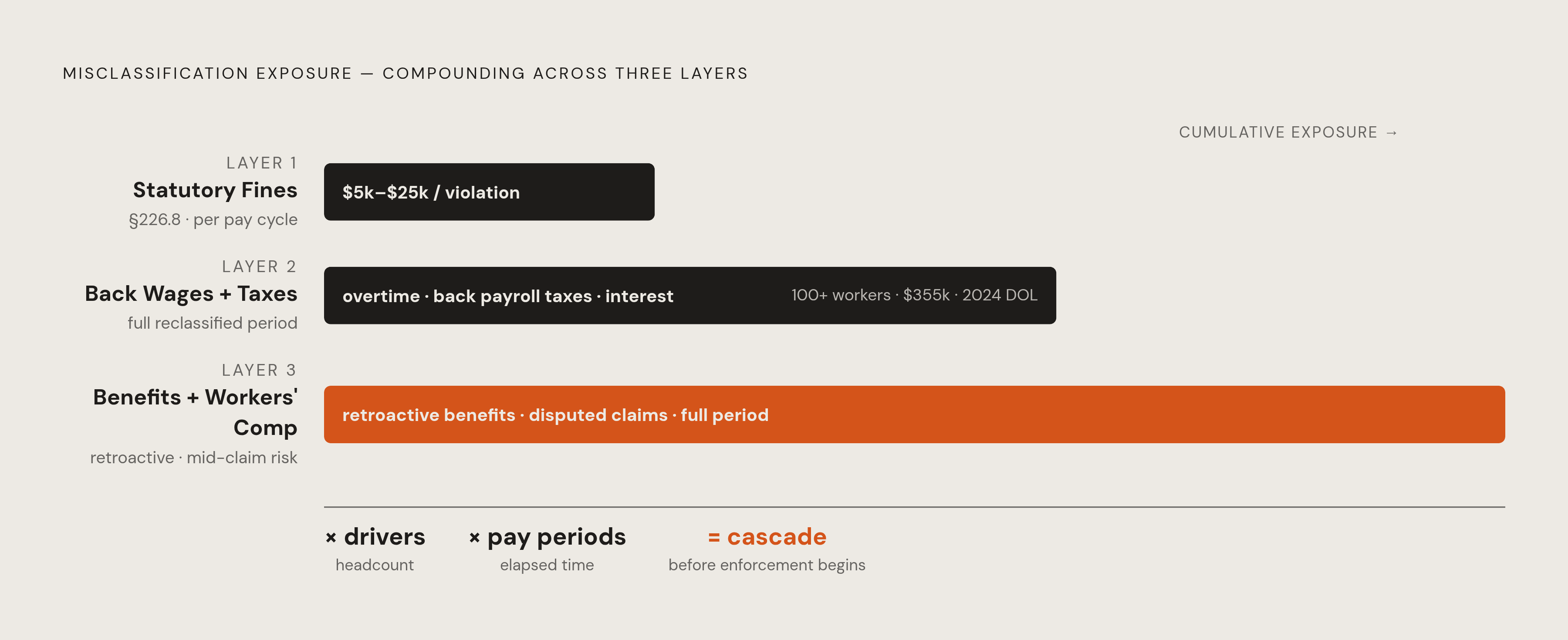
California Labor Code Section 226.8 sets statutory penalties for willful misclassification at $5,000 to $25,000 per violation. That's per violation, not per worker, and each pay cycle or instance of misconduct can generate a separate violation. A single misclassified driver relationship, stretched across months of pay periods, adds up fast.
Beyond the direct fines, a misclassification finding opens the door to back wages and overtime for the entire reclassified period, back payroll taxes with interest, and retroactive benefits if the company offered them to actual employees during that same window. Workers' comp exposure adds another layer: if a driver was covered under occupational accident insurance as a contractor and later gets reclassified as an employee, that coverage can be disputed right when it matters most, mid-claim.
This isn't limited to giant platforms. A 2024 Department of Labor investigation in Louisiana found more than 100 home care workers owed nearly $355,000 in back wages and damages after two providers misclassified them as contractors. Regional operators get caught in this too. Both the DOL and IRS have stepped up scrutiny of contractor misuse, and state labor agencies in ABC-test states run their own parallel enforcement. For delivery operators, one contested driver can trigger an audit of the entire contractor population running the same model.
How other states are adopting the ABC test and why the federal regulatory shift doesn't provide cover
The ABC test predates California's AB5, with other states having adopted versions of their own; New Jersey and Vermont have since adopted versions of their own, and the framework is shaping federal conversations too. State ABC tests operate independently of federal rules, which means a company can satisfy the federal economic reality test and still get nailed under a state ABC test in the same jurisdiction. Passing one exam doesn't excuse you from the other.
The federal landscape has been anything but settled. The DOL's 2024 Final Rule introduced a stricter six-factor economic reality test, effective March 2024. Then in May 2025, the DOL said it would stop actively enforcing that rule and fall back to the older 2008 framework, though the 2024 rule stayed technically on the books for private lawsuits. Then, on February 26, 2026, the DOL proposed scrapping the 2024 rule entirely in favor of a five-factor test that leans heavily on two factors: control over the work, and the worker's opportunity for profit or loss based on their own initiative or investment. That proposal is still pending, with public comments due April 28, 2026, and neither the old rule nor its replacement is fully locked in.
Add to that the Supreme Court's June 2024 ruling in Loper Bright Enterprises v. Raimondo, which ended automatic judicial deference to agency interpretations of ambiguous statutes. Courts can now reach their own conclusions about which DOL framework governs a given case, stacking litigation uncertainty on top of regulatory uncertainty. None of this federal back-and-forth touches state ABC-test exposure. A company operating in California, Massachusetts, or New Jersey answers to those state standards no matter where the federal rule lands. Any company eyeing expansion into a new state should treat the presence of an ABC test as a hard variable in its market-entry math.
The trucking and delivery industry's ongoing legal fight over AB5 — and what the outcome means for operators
The California Trucking Association and the Owner-Operator Independent Drivers Association have led the legal charge against applying AB5 to trucking. In March 2024, the U.S. District Court for the Southern District of California rejected their argument that AB5 shouldn't govern owner-operator truck drivers. OOIDA appealed to the Ninth Circuit, filing its opening brief on August 5, 2024, arguing that AB5's blanket restriction on independent leased owner-operators is unconstitutional. That appeal is still pending as of mid-2026.
A pending appeal is not a safe harbor, since no court has issued a stay and enforcement continues while the case works through the system. Proposition 22 remains the one carve-out on the books, passed by voters in November 2020 and upheld by the California Supreme Court, but it's narrowly built for app-based transportation and delivery workers. It offers nothing to non-app-based courier networks, DSPs, or traditional last-mile fleets.
If the Ninth Circuit eventually applies AB5 in full force to trucking, expect other states to follow California's lead on classification law generally. That makes the California outcome something close to a bellwether for the rest of the country. Waiting to see how the appeal lands is a weak strategy for operators; building compliance infrastructure as though AB5 already applies in full is the sturdier bet, since a favorable appellate ruling is a hope, not a plan.
What compliance infrastructure actually looks like for a delivery company operating under the ABC test
Compliance here isn't a legal memo sitting in a drawer. It's an operational system that touches onboarding, contracts, insurance, and the daily grind of running routes.
On the contract side, Prong A means writing agreements that reflect real operational freedom, not recycled boilerplate, and then actually running operations to match. Prong B means getting an honest read from counsel on how exposed the business really is, rather than assuming a 1099 label does the work by itself. Prong C means structuring relationships so contractors can genuinely work for multiple clients, hold their own business registrations, and set their own rates where the business model allows it.
Credential monitoring matters more than most operators think. Driver's licenses, vehicle registrations, insurance certificates: these need real-time tracking, not a quarterly spreadsheet review, because a lapsed credential mid-relationship adds a second compliance failure on top of the classification risk.
Insurance does double duty here, both protecting the business and signaling genuine contractor status. Occupational accident insurance, built specifically for 1099 workers, covers on-the-job injuries, disability, and accidental death without creating the kind of employment relationship that workers' comp implies. It's typically priced on hours worked or miles driven, scales naturally with a fleet's variable headcount, and can be cheaper than workers' comp when purchased in bulk across a contractor network. Commercial auto coverage matters too, since a driver's personal auto policy often excludes delivery work outright, leaving a gap that surfaces at the worst possible moment, after an accident.
Onboarding is where classification decisions actually get made and documented, and it's also where the system tends to break. Manual onboarding, built on spreadsheets, email chains, and periodic reminders, stretches the window where drivers work without verified credentials or signed agreements. That gap is exactly what enforcement actions target. Platforms built specifically for the 1099 delivery workforce can automate credential renewal, keep audit-ready records on hand, centralize insurance buying at bulk rates, and run contractor pay through same-day ACH or instant debit, handling the complexity without forcing back-office headcount to grow in lockstep with the driver count.
What operators should take from the ABC test's high bar rather than around it
The ABC test isn't going anywhere in California, Massachusetts, or New Jersey, regardless of what happens at the federal level. Lawmakers built it this way on purpose; it's not a drafting accident waiting to be fixed.
Operators who treat classification as a box checked once during a legal review are exposed by design, because driver relationships shift, credentials expire, day-to-day practices drift from what the contract says, and enforcement doesn't pause to wait for anyone. The honest read for most delivery companies is that Prong B is genuinely hard to clear at scale. That reality should shape the whole compliance strategy: build the operational infrastructure to manage exposure across Prongs A and C where control is possible, treat insurance and credentialing as continuous processes rather than annual chores, and stop looking for a workaround to a test built to be failed by exactly this kind of business.