IC compliance platforms built for last-mile and medical courier operations
Specialized compliance stacks for medical couriers are stricter than last-mile delivery requires.

Last-mile delivery is a $167.3 billion market this year, headed to $348.8 billion by 2033 according to Grand View Research. Medical courier work is growing at roughly 10% a year on top of that, pushed along by home-based care and diagnostic testing. Both sectors run almost entirely on independent contractors, yet the compliance rules governing those contractors look nothing alike. A last-mile operator worries about license checks and insurance minimums, while a medical courier operator worries about all of that plus HIPAA training, bloodborne pathogen certification, and whether a blood sample survives the trip intact. Gig-economy software built for general gig work wasn't built for either problem specifically, and that gap is where the risk lives.
Last-mile delivery IC platforms typically require license verification, insurance minimums, background checks, and drug screening. Medical courier IC platforms carry all of that and add two requirements with no parallel in standard last-mile work: HIPAA training with a signed policy acknowledgment on file for any contractor handling medical records or patient-identifiable specimens, and bloodborne pathogen certification under OSHA rules for anyone who may come into contact with biological specimens. Chain-of-custody documentation is a further medical courier requirement, both for specimen integrity and for surviving a legal challenge, while vehicles must meet temperature-controlled capacity standards for biologics. Hospital systems and lab networks routinely impose their own credentialing requirements above the regulatory floor, so the compliance stack a medical courier IC actually needs to carry is heavier and more specialized than what a last-mile IC platform is built to manage.
How the independent contractor model became the default workforce structure in both sectors — and what that shift demands
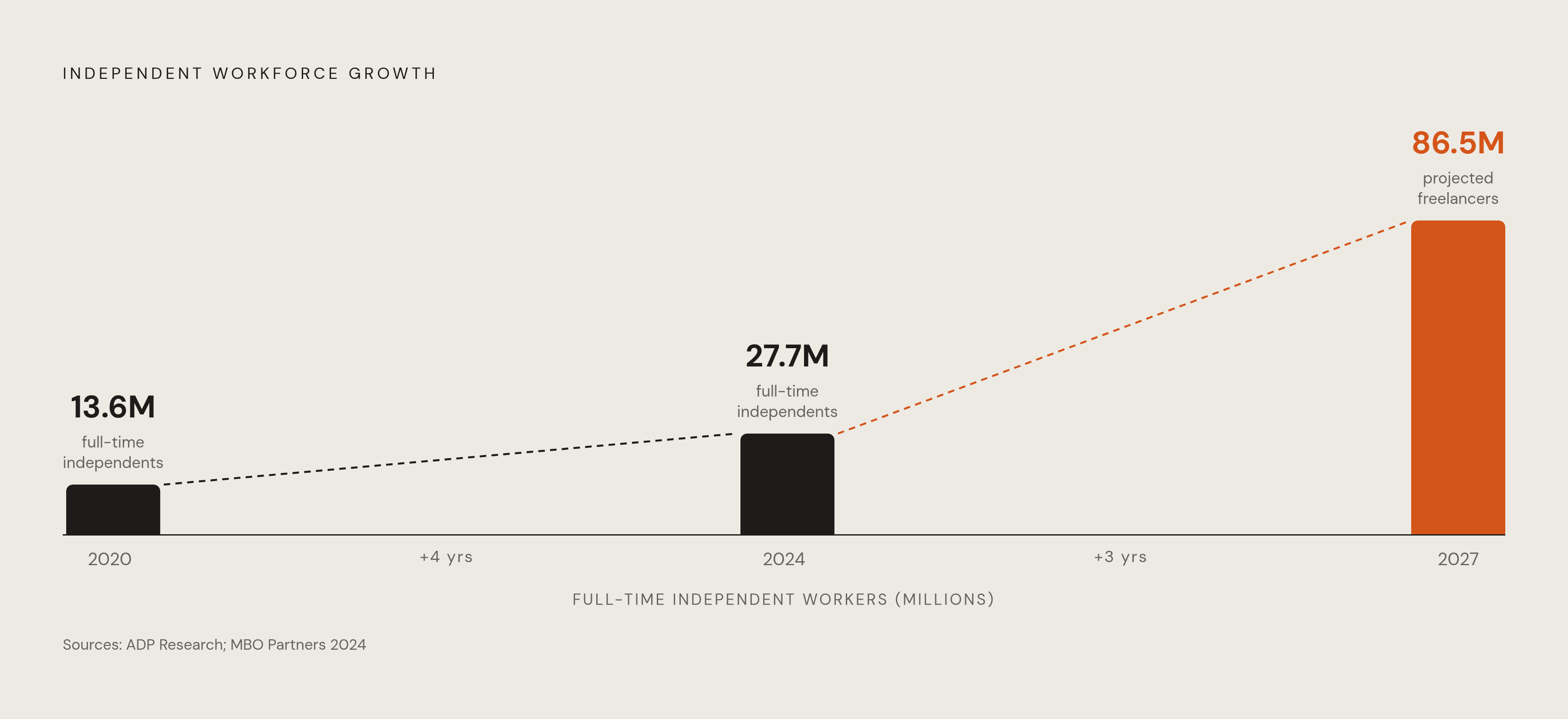
Roughly 70.4 million Americans freelanced in 2025, representing approximately 36% of the workforce, and the line has been climbing for years without much sign of bending back. Full-time independents went from 13.6 million in 2020 to 27.7 million in 2024, with projections pointing toward 86.5 million by 2027. ADP Research tracked monthly IC counts rising from 300,000 in 2019 to 450,000 in 2024. Step back far enough, and this looks less like a labor trend and more like a rewrite of how physical goods get moved on a deadline.
Delivery networks, freight brokers, and 3PLs built their operating model around IC fleets on purpose, not by accident. It handles volume and flexibility in ways a W-2 fleet struggles to match.
Medical courier work runs a split system worth sitting with for a second. W-2 roles pay $16 to $24 an hour with benefits attached, which caps upside for the worker and locks in fixed costs for the operator. IC contractors and owner-operators bill $600 to $1,500 per weekly route and can run multiple accounts at once, stacking income in a way no hourly job allows. Attractive to both sides on paper, but the IC model pushes insurance, credentialing, and HIPAA compliance onto the contractor, and that arrangement only holds up if the operator actually verifies that contractors carry what they claim. About 70% of independent contractors say they're freelancing by choice, not necessity, per MakeMyPayStub, so this workforce isn't filing back into payroll departments anytime soon. The real question is whether the back office can manage thousands of these contractors without losing track of who's qualified.
The classification minefield operators are navigating right now
Federal rule on IC classification has flipped three times in five years. Call that careful deliberation or call it proof nobody in Washington can settle on an answer; depends who you ask. The 2021 IC Rule gave way to a six-factor economic reality test that took effect March 11, 2024, and the Department of Labor then paused enforcement on that test through Field Assistance Bulletin No. 2025-1 in May 2025. A 2026 proposed rule now floats a five-factor test built around one question: is the worker economically dependent on the business, or actually running their own operation? Simple in theory, but in practice it's the single most litigated issue in the industry, so any confident answer deserves scrutiny.
State law adds a layer that doesn't always sit flush with the federal one. California's ABC test, under AB5, requires a worker to clear all three prongs to count as an IC, and prong B (the part asking whether the work falls outside the hiring entity's usual business) is brutal for delivery operators specifically, since delivery is the business. Massachusetts and New Jersey run close to the same three-part structure, and more states keep adopting some version of it. An operator running drivers across a dozen states ends up tracking a dozen different tests for the same job, sometimes for the same driver crossing a state line mid-route. Genuinely absurd way to run a fleet, but here we are.
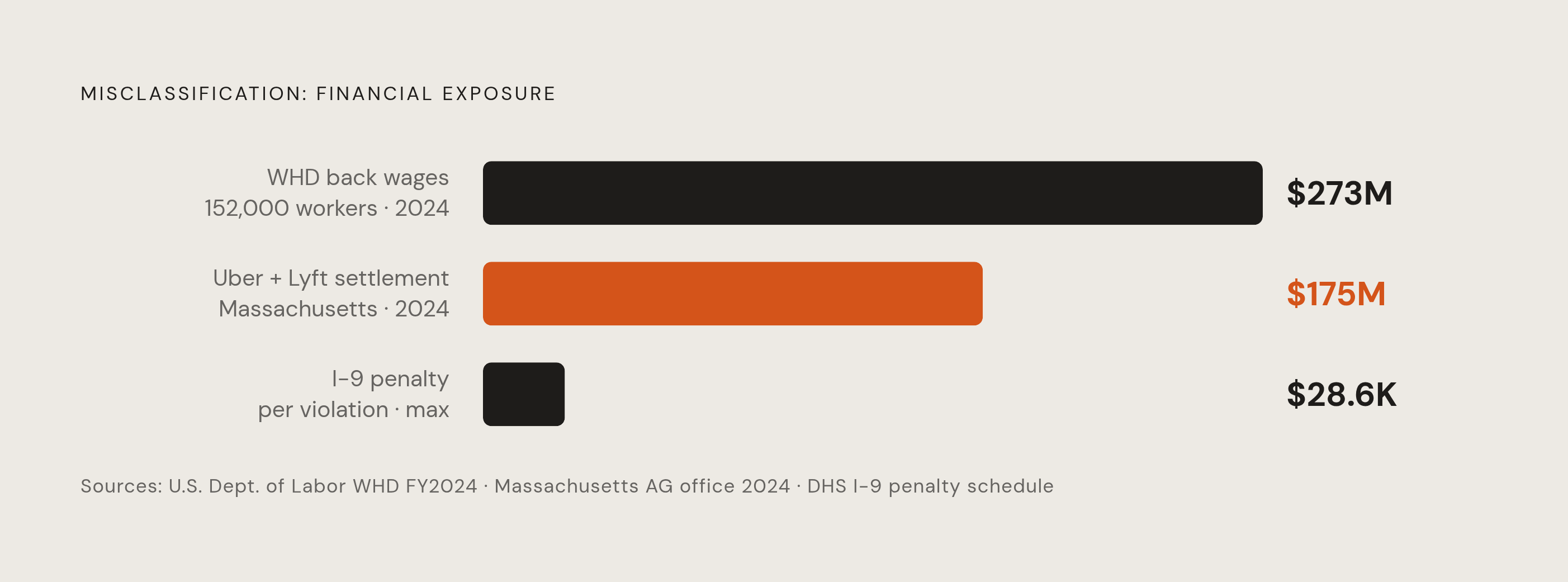
The Economic Policy Institute puts the misclassification rate at 10% to 30% of employers misclassifying at least one worker as a 1099. The Wage and Hour Division recovered more than $273 million in back wages and damages for nearly 152,000 workers in 2024 alone, and Uber and Lyft settled a Massachusetts misclassification case that year for a combined $175 million, the kind of number that gets a board's attention regardless of industry. Add I-9 penalties running up to $28,619 per violation, and a driver reclassified from IC to employee after an incident can trigger denied insurance claims right when the operator needs coverage most.
Why negligent hiring has become as serious a liability as misclassification
Evolving negligent hiring doctrine has shifted the calculus for freight brokers and logistics operators, pushing the exposure to board-level consideration. Finishing onboarding is no longer sufficient to clear an operator of liability. Operators now have to show contractors stay credentialed, qualified, and monitored on an ongoing basis, well beyond a single check on day one.
Medical courier and pharmaceutical delivery operators feel this hardest, because hospital and lab clients increasingly demand proof of contractor credentialing as a contract term, not a courtesy. Clinical trial transport and regulated hazmat work stack another requirement on top: contractor qualification has to be documented in a form that survives a regulatory audit, not filed away and forgotten.
Here's the practical shift. A license that expires, a policy that lapses, a credential that quietly runs out six months after onboarding: all of it creates the same liability as never checking in the first place, and periodic audits catch this too late. Montgomery demands monitoring that runs continuously, turning the compliance question from "did we onboard this person correctly" into "do we know, right now, the status of every contractor currently on the road."
How do HIPAA training and bloodborne pathogen certification requirements differ between last-mile and medical courier IC platforms?
Medical courier work sits closer to healthcare logistics than to parcel delivery, and the paperwork reflects that. Contractors handling medical records or patient-identifiable specimens need HIPAA training and a signed policy acknowledgment on file, while anyone who might touch biological specimens needs bloodborne pathogen certification under OSHA rules. Chain-of-custody documentation matters both for specimen integrity and for surviving a legal challenge down the road. Vehicles need temperature-controlled capacity for biologics and calibrated equipment for anything time-sensitive; background checks plus drug screening are standard for facility access at most hospitals. Hospital systems and lab networks often layer their own requirements on top of the regulatory floor, because the regulatory floor is a minimum, not a target.
Every credential expires eventually, and a contractor who checked every box at onboarding might not be qualified six months later, with nobody noticing until something breaks. Modern Healthcare US reported that 61% of lab supervisors experienced irreplaceable specimen loss tied to courier errors. Part of the reason that number exists is that credentialing lapses and handling mistakes are nearly impossible to catch in a spreadsheet updated only when someone remembers to. Run that math across a few hundred contractors spread over a dozen states, and manual tracking stops being an inconvenience. It becomes a slow accumulation of liability nobody's actually watching.
The insurance coverage stack that last-mile and medical courier IC operations require
A contractor's personal auto policy does not cover them on a paid delivery route. That exclusion appears in nearly every personal policy, in plain language, and operators still get surprised by it. Commercial auto liability fills the gap, covering third-party injury and property damage tied to the vehicle. Occupational accident insurance covers the contractor's own work injuries in a setup where workers' comp doesn't apply, which is the default for ICs. Cargo insurance covers whatever's actually being hauled, and for medical couriers that means specimens, pharmaceuticals, and equipment, distinct from the cardboard boxes a typical last-mile driver carries around.
Medical cargo carries stakes beyond ordinary inventory value. A damaged specimen or a lost pharmaceutical shipment costs far more than its sticker price would suggest; it can mean a delayed diagnosis or a scrapped clinical trial sample that took months to collect. The exposure compounds when a misclassified driver gets reclassified after an incident, because that's exactly when an insurer looks for a reason to deny the claim. Buying insurance in bulk at the operator level and passing it down through the network tends to save money over everyone shopping individually, and it keeps coverage consistent instead of depending on what each contractor felt like buying that year. A platform that handles credentialing but hands insurance to a separate vendor, or the reverse, means the operator is stitching two systems together to manage what is functionally one risk.
What the onboarding and activation bottleneck costs operators in practice
McKinsey estimates that 13% to 19% of logistics costs come from inefficient handovers across mid and last-mile operations, adding up to roughly $95 billion a year in losses across the U.S. economy. Contractor onboarding is one of the sharper versions of that waste: every day a qualified, insured contractor sits waiting for activation is a day of capacity nobody's using and nobody's billing.
Manual onboarding, the kind that involves collecting documents over email, chasing insurance certificates by phone, running background checks through a separate vendor, and typing all of it into a dispatch system by hand, stretches activation to multiple weeks. That delay has teeth in medical courier work specifically: a hospital system signs a new contract, and if the operator can't staff it fast with qualified people, both the contract and the operator's credibility take the hit. Manual onboarding doesn't degrade gracefully as a fleet scales from dozens of contractors to thousands, either. It breaks, all at once, the moment paperwork volume outpaces what a back office can process by hand.
There's a retention cost hiding in here too. Contractors who wait weeks to get activated, then weeks more to get paid, go find other work; with 70% of ICs freelancing by choice and no shortage of other operators willing to take them, there's nothing keeping them around. Cutting onboarding from weeks to days is often the actual, unglamorous difference between winning a contract and watching a competitor staff it first.
What a compliance platform built for these sectors must actually do
This isn't a feature-checklist exercise. Treating it like one is how operators end up with software that looks complete on a sales call and falls apart in week three. The real question is whether one system can pull license verification, background checks, drug screens, insurance thresholds, and sector credentials like HIPAA and bloodborne pathogen certification into a single workflow, flexible enough to absorb a new hospital client's custom requirement without a rebuild.
Real-time status monitoring matters more than any onboarding checklist, because a credential that lapses in month four is just as dangerous as one that was never verified. Classification risk needs to be built into the documentation and workflow itself, in a way that holds up under whichever state or federal test applies to that driver on that route. Insurance (occupational accident, commercial auto, cargo) needs to live inside the same platform instead of requiring a separate broker relationship for each line. Payment speed matters for retention too: instant debit or same-day ACH is table stakes now for keeping contractors from walking to the next app. Compliance status also has to flow directly into the TMS or dispatch system the operator already runs, because a compliance flag sitting in a separate portal does nothing to stop a non-compliant driver from being dispatched.
That last point is where negligent hiring liability actually gets managed, or doesn't. When a license lapses, the driver needs to come off active duty automatically inside dispatch, not sit in a queue waiting for a manual review that may arrive too late. Platforms built specifically for this space can support 25 or more compliance modules, then let operators add more for a specific hospital system or lab network without rebuilding the whole setup from scratch.
How to evaluate IC compliance platforms against these requirements
The real test is whether a platform was built from the ground up for regulated, high-volume IC operations, or whether it's a general HR or payroll tool wearing a delivery-flavored coat of paint.
Ask whether it handles HIPAA, bloodborne pathogen certification, and chain-of-custody tracking natively, or whether those require a workaround someone in the back office invented. Check whether it monitors compliance continuously and flags lapses on its own, or whether it only gives a snapshot from whenever someone last logged in. Confirm whether it plugs into the TMS already running, so a compliance issue actually changes a routing decision instead of sitting in a report nobody opens. Find out whether insurance (occupational accident, commercial auto, cargo) comes bundled in, or whether that's yet another vendor to manage on the side. Look at how it handles multi-state classification differences, and ask, honestly, how long it takes a new contractor to go from application to first paid route: days, or weeks.
GigSafe is one platform built around this specific list, running 25-plus compliance modules with insurance, continuous monitoring, and direct TMS connectivity built in, aimed at operators managing thousands of contractors without adding headcount to track them. It's not the only vendor in the field, and it shouldn't get taken on faith just because it's purpose-built rather than adapted from something else. Yet that's the standard to hold any platform to before signing: built for this from day one, not retrofitted after the fact. Operators who treat compliance as infrastructure see the payoff in fewer denied claims and fewer contracts lost to slow staffing. Those who treat it as paperwork tend to find out what it costs in a courtroom, long after fixing it was cheap.