IRS Form 1099-NEC Filing Requirements for Delivery Companies
Delivery companies must file 1099-NECs for drivers earning $600 annually.
Last-mile delivery runs on independent contractor networks, which means dozens or thousands of drivers get paid per route, per drop, or per week, and every one of those payments can trigger a 1099-NEC filing obligation. U.S. parcel volume hit 22.37 billion shipments in 2024, with the last mile eating 53% of total shipping costs: an enormous industry running on razor-thin margins. In that kind of business, tax penalties from sloppy contractor paperwork can turn a profitable quarter into an ugly one. What follows walks through the obligation in the order an operator encounters it: onboarding, payment, filing, and post-filing errors.
The four conditions that trigger a 1099-NEC obligation and how delivery arrangements typically satisfy all of them
The IRS needs four things true at once before a 1099-NEC is required: payment to someone who isn't an employee, for services tied to a trade or business, paid to an individual, partnership, estate, or certain corporation, and totaling at least the yearly threshold.
Delivery companies check every box without trying. Pay an independent contractor driver, and the IRS already names food delivery workers as a category that triggers the form. Drivers classified as 1099 contractors sit off payroll, so there's no withholding, but the reporting duty stands on its own regardless. The "trade or business" condition rules out casual payments, like slipping a neighbor twenty bucks to help haul boxes, but a delivery company running routes for profit sits squarely inside a trade or business. No argument there. The corporate exception, which lets payers skip reporting to incorporated vendors, offers little relief, since most drivers work as sole proprietors.
The real question a delivery operator faces is whether the dollar total for a given driver crossed the line.
The $600 threshold for 2025 filings and the $2,000 change arriving for 2026
For the 2025 tax year, that line sits at $600. Pay a contractor $600 or more across the year, in any combination of payments, and a 1099-NEC goes to both the IRS and the contractor.
That number moves in 2026. The One Big Beautiful Bill Act raises the threshold to $2,000 for nonemployee pay in 2026, with those returns due in 2027. Some occasional or seasonal drivers who crossed $600 in 2025 will land under $2,000 in 2026, trimming the paperwork pile at the edges. Drivers running routes weekly or daily will still clear $2,000, so the change helps at the margins, not at the core of the driver base. Anyone expecting the new law to halve their filing count is misreading which drivers actually drive the volume.
One trap worth naming directly: the $2,000 figure does not apply to 2025 filings. Applying next year's threshold to this year's forms is itself a filing error, and an easy one to make if someone skims a headline instead of checking the effective date. The threshold also aggregates across the whole year, not per payment, so a driver paid weekly needs every single payment added up before anyone decides whether a form is owed.
The February 2, 2026 filing deadline and why 1099-NEC has almost no extension relief
For 2025 filings, Form 1099-NEC is due to the IRS and to contractors by February 2, 2026. January 31 lands on a Saturday, which bumps the deadline to the next business day.
Unlike several other 1099 variants, 1099-NEC doesn't come with a broad automatic extension. The 30-day extension available for some other information returns doesn't apply here in any general way, so operators can't count on breathing room. Both the IRS copy and the contractor copy are due the same day, another spot where 1099-NEC differs from forms that split the two deadlines.
That means contractor payment data, W-9 details, and generated forms need to be locked down before January ends, not scrambled together during its last week. High driver turnover makes this worse: a driver who ran a dozen routes in March and vanished by June is a lot harder to track down for corrected information in January than a driver still on the roster. Year-end reconciliation belongs in December. Treat it as a January task and the deadline gets missed.
Electronic filing is now mandatory for most delivery operators, and the threshold is lower than many realize
Returns required on or after January 1, 2024 fall under a new rule: file 10 or more returns in a year, and electronic filing is mandatory. The old threshold was 250 returns. Dropping it to 10 pulls in a huge number of small and mid-size delivery operations that used to file on paper without a second thought.
That count of 10 isn't limited to 1099-NEC forms. It aggregates W-2s, every 1099 variant, and other business returns together. A delivery company running a few W-2 dispatchers alongside eight or more 1099 drivers is almost certainly over the line. Paper filing stops being workable at that scale, so operators need an e-file path: payroll software, a tax filing service, or the IRS FIRE system directly. Building e-file capability into the same system that already tracks contractor payments beats bolting it on separately; re-entering the same data twice is exactly how new errors get introduced.
Why collecting W-9s before the first payment is the foundational step everything else depends on
The W-9 supplies the three pieces of data a 1099-NEC actually needs: legal name, taxpayer ID number, and address. IRS guidance is blunt about timing: collect the W-9 before the first payment goes out, not at year-end when a driver may have moved twice and changed phone numbers.
Collect it even when a contractor looks unlikely to hit $600. Payment volume shifts, drivers pick up more routes than expected, and the threshold gets crossed faster than anyone planned for. For companies onboarding drivers in batches or continuously, W-9 collection belongs inside the onboarding workflow as a required step, not something triggered by a December scramble through payment totals.
A contractor who won't provide a TIN, or provides one that fails validation, starts the backup withholding clock. That turns W-9 collection from a paperwork task into a legal and financial safeguard. One more wrinkle: payments made through credit card or platforms like PayPal get reported by the processor on Form 1099-K, not by the delivery company. Operators need to track which payment method applies to each driver, or risk reporting the same income twice.
TIN matching before filing and what happens when TINs are wrong after filing
The IRS runs a TIN Matching program that lets payers check name and TIN combinations against IRS records before anything gets filed. It's available for 1099-NEC filers, free through the IRS e-Services portal, and the only real cost is the time it takes to run it. The IRS's own framing: payers who use it end up with fewer CP2100 notices and fewer penalty notices later.
CP2100 and CP2100A notices go out periodically, flagging returns with incorrect TINs from the prior year's filings. Getting one starts a clock: the operator has to send a "B notice" to the contractor and begin backup withholding if corrected information doesn't arrive within 30 business days. For a delivery company with a large driver file, one wrong digit entered during a rushed onboarding session can turn into a withholding obligation and penalty exposure months later. TIN matching before filing is the cheap fix; chasing corrections after a CP2100 notice is the expensive one. Waiting never works out better.
The penalty tiers for late or incorrect 1099-NEC filings and what they cost at delivery-company scale
The IRS penalty structure is tiered by how late a form is. File within 30 days of the deadline, and it's $60 per form. More than 30 days late but before August 1, and it's $120 per form. After August 1, or not filed at all, and it jumps to $310 per form. Intentional disregard of the requirement pushes that to $630 per form.
Incorrect forms, wrong TIN, wrong amount, wrong name, carry the same penalty tiers as missing ones. Filing a hundred 1099s with TIN errors could reach $68,000 in penalties, potentially double if the IRS decides the errors reflect intentional disregard rather than honest mistakes. For a delivery company managing hundreds or thousands of contractors, even a small error rate across the file turns into six figures fast.
Failure to furnish the form to the contractor carries its own penalty exposure on top of the filing penalty, so the same underlying mistake can generate liability on more than one front. Don't plan around edge-case exceptions narrowing penalty exposure — the core obligation is to file correct, complete forms on time.
Backup withholding: what triggers the 24% obligation and what it costs if ignored
Backup withholding kicks in when a contractor doesn't provide a TIN, provides a wrong one, or the IRS tells the payer to start withholding after a CP2100 notice. The rate is 24% of payments to that contractor, sent straight to the IRS.
Once a B notice is issued, the clock starts running before withholding becomes mandatory. Miss it without corrected information in hand, and the operator is legally required to start withholding. For a contractor earning $100,000 a year, failure to withhold creates $24,000 in potential liability before interest and penalties, and that figure applies per contractor, not per company. Delivery networks with seasonal surges and rapid onboarding carry more of this risk simply because data gets collected fast and under pressure during exactly those periods. The fix sits upstream, in W-9 collection and TIN matching done right the first time, so backup withholding never becomes a live issue in the first place.
Worker classification and how misclassification interacts with 1099-NEC obligations
Filing a 1099-NEC doesn't make someone a contractor. Classification comes from the actual facts of the working relationship, not from the form filed or the contract signed, and no amount of careful paperwork overrides a regulatory finding that says otherwise.
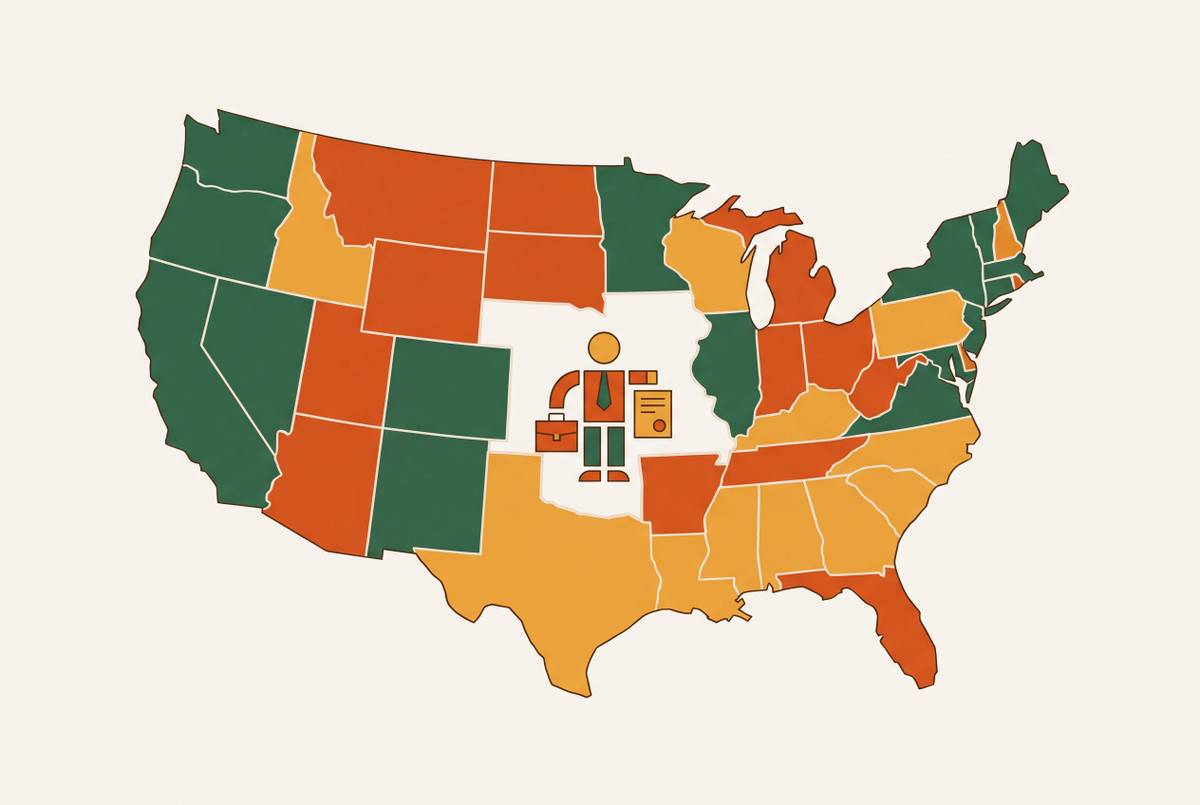
The ABC test asks whether a worker is free from control, performs work outside the hiring company's usual business, and runs an independent operation of their own. Delivery companies need to check their driver relationships against whatever version of this test applies in each operating state, because the rules aren't uniform nationwide, and treating California's answer as the national answer is a mistake that costs money.
California adds its own layer. California's Proposition 22 allows app-based delivery drivers to stay classified as contractors if they meet its specific conditions, but compliance is ongoing, not a one-time box to check. City rules stack on top: New York City requires app-based delivery drivers earn at least $17.96 per hour, rising to $19.96 by April 2025, and other jurisdictions are adopting their own parallel rules for gig workers.
Misclassification is estimated to cost the federal government roughly $3 billion a year in lost tax revenue, which says plenty about how much enforcement attention this draws. Here's the part that stings: an operator who files 1099-NECs for workers later reclassified as employees faces back payroll taxes, interest, penalties, and liability for the contractor's share of taxes too. The 1099-NEC in that scenario stops being protection and starts being evidence against the operator who filed it.
How automated contractor management infrastructure reduces 1099-NEC filing risk at scale
Every failure mode covered here, missed deadlines, TIN errors, backup withholding exposure, classification gaps, traces back to the same two things: data quality and timing. Get either one wrong at a hundred-driver scale, and the cost multiplies fast.
Spreadsheets and email-based W-9 collection work fine for a dozen drivers. They fall apart at a few hundred, because the error rate doesn't stay flat as headcount grows, it climbs with it. That's the part manual systems get backwards: the tools that felt adequate at ten drivers are precisely the tools that generate six-figure penalty exposure at a thousand. Workforce management systems built for contractor networks handle W-9 collection at onboarding, run TIN matching before anything gets filed, track payment methods to avoid double-reporting with 1099-K, and generate e-file-ready returns on a schedule that doesn't depend on someone remembering to do it in late January. The underlying obligation stays the same either way. Good infrastructure closes the gap between what the law requires and what actually happens inside a company moving fast with a high-turnover contractor base.