Occupational Accident Insurance for Independent Contractors
Independent contractors face financial ruin from workplace injuries with no safety net.
More than 70 million Americans now do gig work in some form, which puts about 36% of the working population one bad ladder rung or one rear-ended van away from a financial hole with no bottom. That's not a metaphor. It's a description of what happens when someone classified as an independent contractor gets hurt on the job: no wage replacement, no automatic medical coverage, nothing waiting to catch them. Roughly a third of gig workers already say they struggle to cover basic expenses, and close to half couldn't handle a $400 emergency without borrowing. Layer a broken ankle or a torn rotator cuff on top of that, and the injury stops being a medical event and starts being a solvency event.
This isn't an oversight anyone forgot to patch. It's the point. Classifying someone as an independent contractor means, by design, that state workers' compensation laws mostly don't apply to them. A handful of states carve out exceptions for specific IC categories, but the general rule holds: no employer, no employer-mandated comp coverage. So something else has to fill that space, and understanding exactly what that something covers, and doesn't, matters to the contractor writing the premium check and the company that put them on the road in the first place.
What occupational accident insurance actually is
Occupational accident insurance, OAI for short, is a voluntary accident policy built for people who sit outside the workers' comp system: independent contractors, sole proprietors, owner-operators. Nobody has to buy it. A contractor can buy it individually, a deploying company can buy it on their behalf, or a platform or motor carrier can wrap a whole fleet into one group policy. All three structures exist in the market right now.
The most important distinction, and the most misunderstood, is that OAI is not a no-fault system the way workers' comp is. Fault can affect whether a claim gets paid. Trip over your own dropped cargo strap because you weren't paying attention, and depending on the policy language, that might complicate the claim in a way it never would under workers' comp.
Industries buying this coverage read like a list of jobs where things fall on people: truck driving, delivery, and construction among others. Carriers active in the space include Crum & Forster Accident & Health, distributed through brokers, agents, wholesalers, and program managers, not sold directly. And the coverage boundary is narrower than people assume: OAI pays for accidental injuries that happen on the job. It does not pay for a bad knee that's been getting worse for a decade, and it does not pay for what happens off duty unless the policy specifically says otherwise.
The four benefit categories OAI typically pays
Medical expenses come first: hospital stays, surgery, medication, rehab. Crum & Forster's version of this, for example, carries no medical caps, no sub-limits, and no aggregate limit at the account level, which is a meaningfully different structure than a policy that caps out at a number that sounds fine until the ambulance bill alone eats half of it.
Disability benefits split into two buckets. Temporary total disability replaces a slice of average weekly earnings while someone can't work, capped at 100% of gross earnings under Crum & Forster's structure. Permanent disability, including dismemberment, pays out as a structured benefit for lasting loss of function or a limb.
Accidental death and dismemberment (AD&D) pays the family if the accident is fatal. Some policies bolt on survivor benefits as a separate line item; Crum & Forster's trucking product skips that because it doesn't sublimit AD&D in the first place, so there's nothing extra to bolt on.
A few specialized extensions show up depending on the policy: occupational disease, cumulative trauma, hernia and hemorrhoid benefits (yes, that's a real, named category in this business), passenger accident coverage, and scheduled non-occupational benefits. None of these are universal. All of them are worth checking line by line, because the absence of one is exactly the kind of gap that only becomes visible after the injury happens.
The ceiling on all of this sits around $1 million in most policies. Workers' comp has no such ceiling; it's statutory and uncapped by design. That gap is the trade-off baked into the whole product.
How OAI differs from workers' compensation in ways that matter
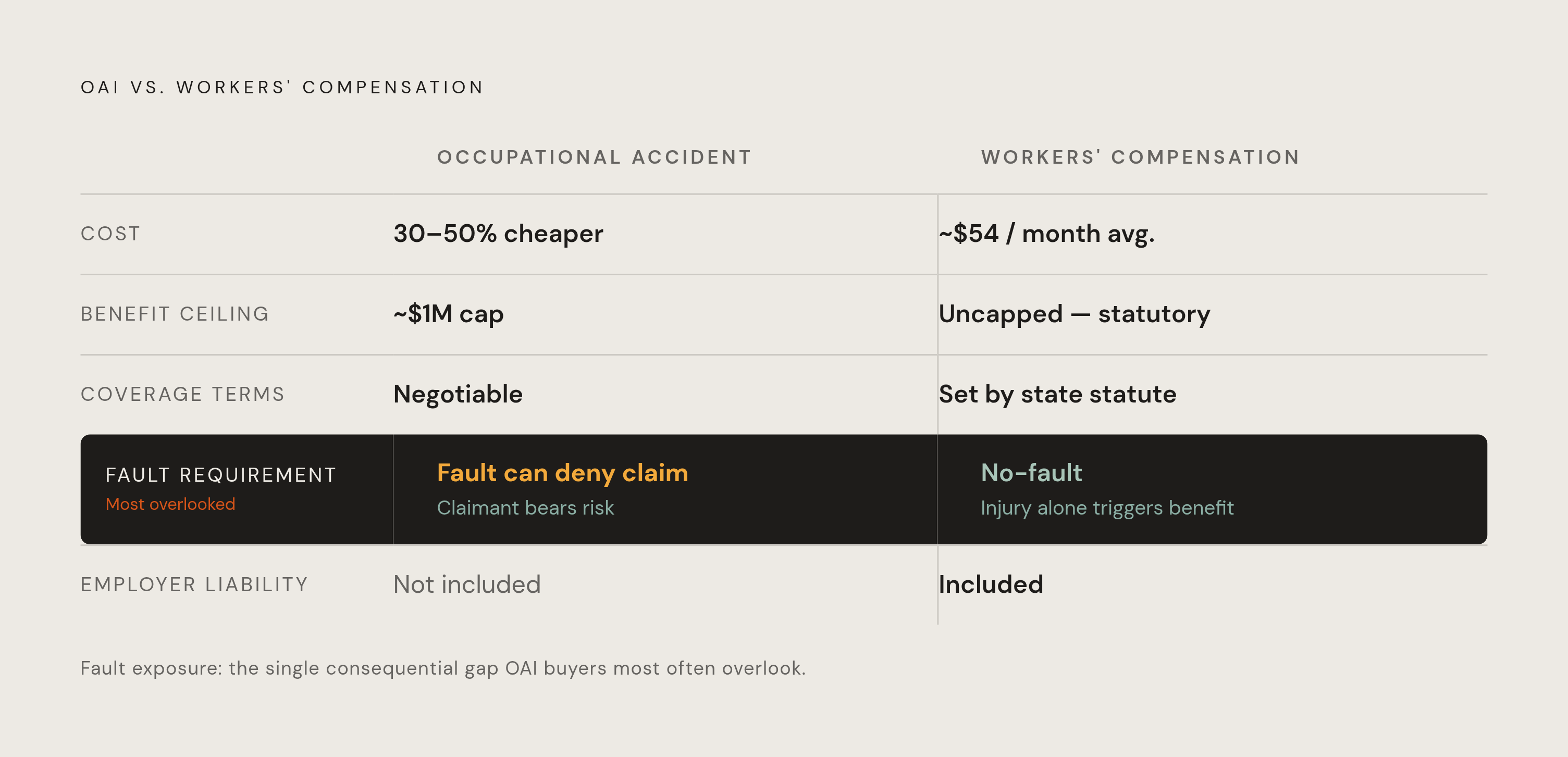
Workers' comp is mandatory, state-run, and no-fault. OAI is voluntary and privately underwritten. Those aren't small differences, they're the two products pointed in opposite directions on almost every axis that matters.
Cost tells part of the story. OAI runs 30% to 50% cheaper than workers' comp, according to Insureon, which is the single biggest reason it exists as a commercial product rather than a hypothetical one. Cheaper coverage with a lower ceiling and fault exposure isn't a scam, it's a different set of dials: less comprehensive, more controllable, and priced accordingly.
Workers' comp also folds in employer's liability, the piece that protects the company from being sued over the injury itself. OAI doesn't automatically include that. It just covers the worker's body. Anyone assuming OAI quietly handles the company's legal exposure too is wrong, and that's exactly what the next section addresses.
The upside for the buyer is control. Workers' comp terms are written by state statute; nobody negotiates them. OAI limits, covered risks, and benefit structure can all be tailored to the job and the budget. That flexibility cuts both ways: cheaper and adjustable, but capped and conditional on fault, leaving an at-fault contractor with a policy that might not pay.
Contingent liability insurance and why deploying companies need both
Misclassification is the risk OAI was never built to touch. If a contractor challenges their 1099 status and a court or agency agrees they should've been a W-2 employee, the company on the other end can get hit retroactively: back wages, benefits, and workers' comp costs it never budgeted for. Estimates put misclassification rates at 10% to 30% of employers, and the Department of Labor closed out more than 17,000 wage and hour violation cases in 2024 alone. That's not a fringe risk sitting in a compliance memo nobody reads.
Contingent liability insurance is the policy built for that specific exposure. It covers legal defense costs if a motor carrier or operator gets sued over classification, and it can cover workers'-comp-equivalent benefits if a contractor is ruled an employee after the fact, structured as either first-dollar coverage or reimbursement depending on the policy.
Put the two together and the logic clicks: OAI covers the contractor's body, contingent liability covers the company's legal neck. Buying one without the other is like wearing a seatbelt with the airbags disconnected. Some carriers, Crum & Forster among them, sell both out of a single department, which is a small operational convenience but a real one for motor carriers managing large fleets of owner-operators. The American Trucking Association counts more than 350,000 truckers currently working as independent contractors, so for carriers running fleets at that scale, the exposure isn't theoretical, it's a Tuesday.
What OAI costs and what drives pricing
Workers' comp averages around $54 a month for a small business, per Insureon. OAI, again, runs 30% to 50% below that baseline. In trucking specifically, occupational accident policies with limits between $500,000 and $1 million run $60 to $160 a month per operator, which is a real, usable number for anyone actually budgeting a fleet rather than just nodding along at a sales pitch.
Pricing moves on a short list of levers: how dangerous the work is (delivery and trucking sit well above event staffing), the limits and deductible chosen, whether the policy covers one contractor or a whole roster, the claims history behind the operator or platform, and geography. Buying in bulk through a program manager or wholesaler tends to knock the per-contractor rate down further, which is exactly why platforms and carriers buy group policies instead of leaving everyone to shop alone.
Who actually pays for it is its own question. Plenty of deploying companies pass the OAI premium down to the contractor rather than eating the cost themselves, and that's a standard structure in trucking rather than some kind of corner-cutting move. Worth reading all of this against the wider commercial insurance climate for 2025: auto liability potentially up 10% to 20%, physical damage up 20% to 25%, umbrella liability up 10% to 30%. OAI's relative affordability looks even better against a transportation insurance market where almost everything else is rising simultaneously.
Where OAI fits in the full coverage stack for delivery and last-mile contractors
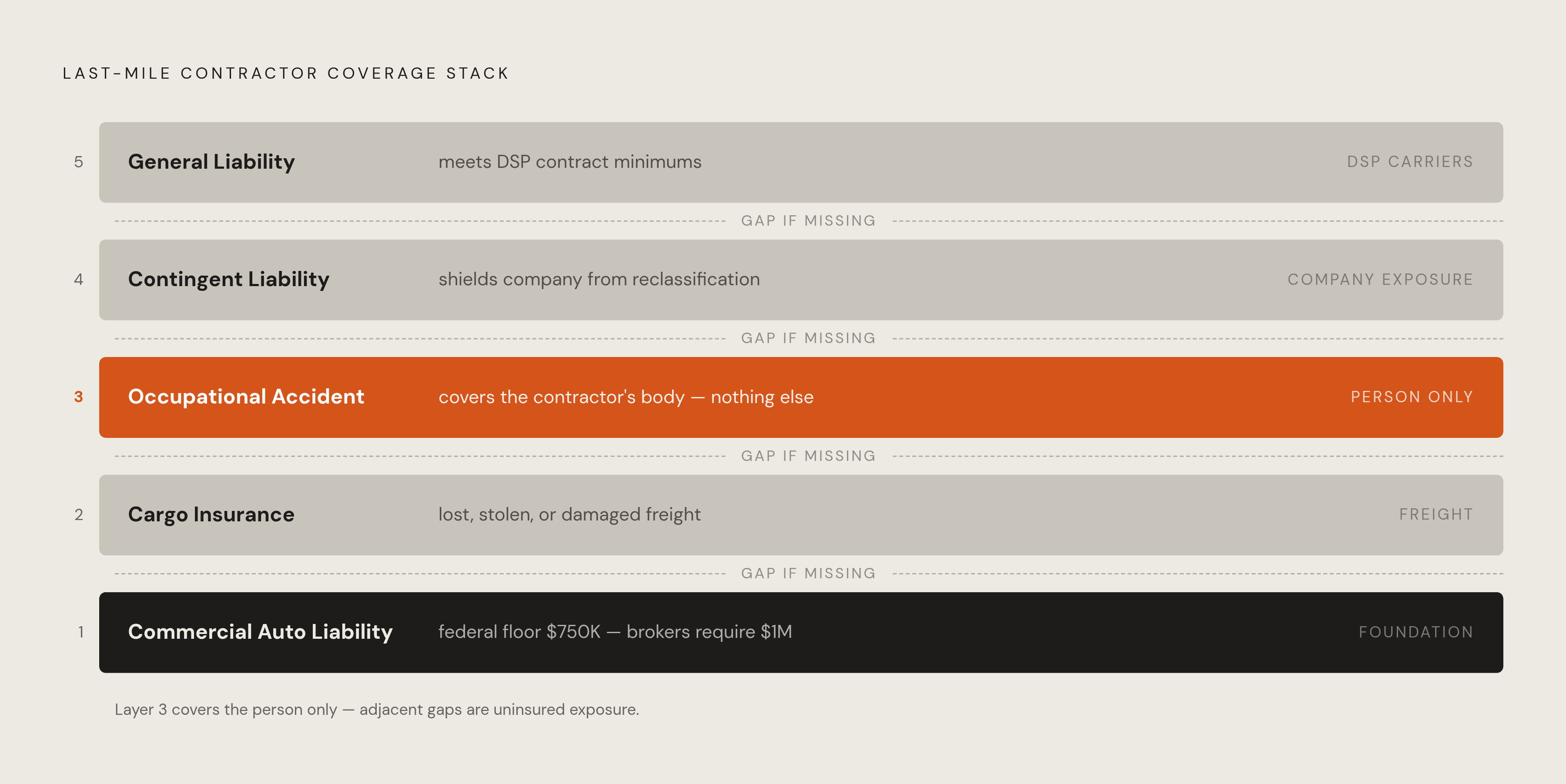
OAI covers one thing: the person. Not the van, not the freight, not a claim from someone the van hit. For a last-mile or delivery contractor, it's one piece of a five-piece stack, and treating it as the whole stack is the mistake that shows up in claims data after the fact.
Commercial auto liability is the base layer, with a federal floor of $750,000 for general freight carriers running interstate under 49 CFR Part 387, though brokers frequently contract for $1 million instead. Cargo insurance sits alongside it; a motor truck cargo policy covers lost, stolen, or damaged freight. OAI covers the contractor's body specifically, which matters because W-2 drivers need actual workers' comp, not this. Contingent liability, as covered above, protects the company. And general liability rounds it out for DSP contract carriers working to contract minimums.
Skip OAI in a 1099 fleet and the gap is immediate: an injured contractor has no coverage for the injury, and the company has no buffer against the resulting liability. Separately, and worth knowing regardless of insurance structure, the Carmack Amendment sets hard deadlines on cargo claims: carriers must acknowledge a claim within 30 days and either pay it, deny it, or make a firm written offer within 120 days, with status updates every 60 days after that if it's still open. None of that touches OAI, but it's the kind of obligation that piles up if the coverage stack underneath it isn't already solid.
The market building around all of this is growing fast: last-mile delivery insurance is projected to go from $1.2 billion in 2024 to $2.3 billion by 2033, a 7.5% annual growth rate. And increasingly, carrying OAI where applicable isn't just good practice, it's a contractual and regulatory checkbox that contracting companies are required to confirm for every contractor on the roster.
How to evaluate and buy an OAI policy, what contractors and operators should check
Contractors shopping for their own policy should start with one question: does the platform or company already provide OAI, or is this entirely on you? Some include it automatically, some make it opt-in, some offer nothing at all, and the difference between those three is the difference between a formality and an urgent errand.
From there, check the benefit limit against what an actual injury costs in the real world, not the mildest-case scenario. A policy capped well below likely surgical or disability costs leaves a gap that only becomes visible in the recovery room. Check the waiting period before disability payments start. Read the exclusions line by line: pre-existing conditions, fault-based denials, and off-duty carve-outs all vary policy to policy, and none of them are boilerplate worth skimming. OAI also pairs well with existing health insurance, since it covers what health plans typically don't, income replacement and AD&D, functioning as a backstop rather than a replacement.
Companies deploying contractor fleets face a different set of questions. Decide upfront whether the company absorbs the OAI premium or passes it to the contractor, both models are common, and the pass-through structure is standard in trucking specifically. Buying through a program manager or wholesaler at group scale generally beats shopping individual policies on price. Confirm the policy doesn't carry a restrictive on-duty or under-dispatch requirement: Crum & Forster's trucking product, for instance, has neither, which closes the gap that would otherwise open up between assignments. Pair OAI with contingent liability, always, since OAI by itself does nothing for the company's reclassification exposure. And build in real-time monitoring of contractor insurance certificates rather than periodic audits, since a quarterly check misses the lapse that happened in month two.
A workforce platform that automates credential and insurance tracking closes the manual gaps that show up once a contractor network gets past a few dozen people. And both sides of the relationship, contractor and company, should confirm the policy actually covers the injury types most likely to occur in that specific line of work. Cumulative trauma, occupational disease, hernia coverage: none of these are universal inclusions, and finding out they weren't included is a bad way to learn that lesson.