State-by-State Gig Worker Classification Laws
State rules for classifying gig workers vary drastically, creating legal exposure.
Full-time independents went from 13.6 million in 2020 to 27.7 million in 2024, and the freelance workforce as a whole is on track to hit 86.5 million by 2027, roughly half of all US workers. More than 70 million Americans, 36% of the workforce, already call themselves gig workers, adding $1.27 trillion to the economy. Roughly 70% of independent contractors say they chose this arrangement, worth sitting with given how often the workforce gets framed as a last resort. For delivery companies, that workforce isn't a side detail. It's the entire business model, and misclassifying even a slice of it creates legal exposure that compounds fast.
Why no single classification rule applies across state lines
Worker classification in the US runs through three overlapping layers: federal standards under the FLSA and IRS rules, state wage and labor law, and, in some cities, municipal ordinances stacked on top of all of it. Each layer can look at the exact same delivery driver and land on a different answer. A driver working in Sacramento and Austin in the same week can be an employee in one state and a contractor in the other, simultaneously, under the same company's contract. For a multi-state operator, that's a routine Tuesday.
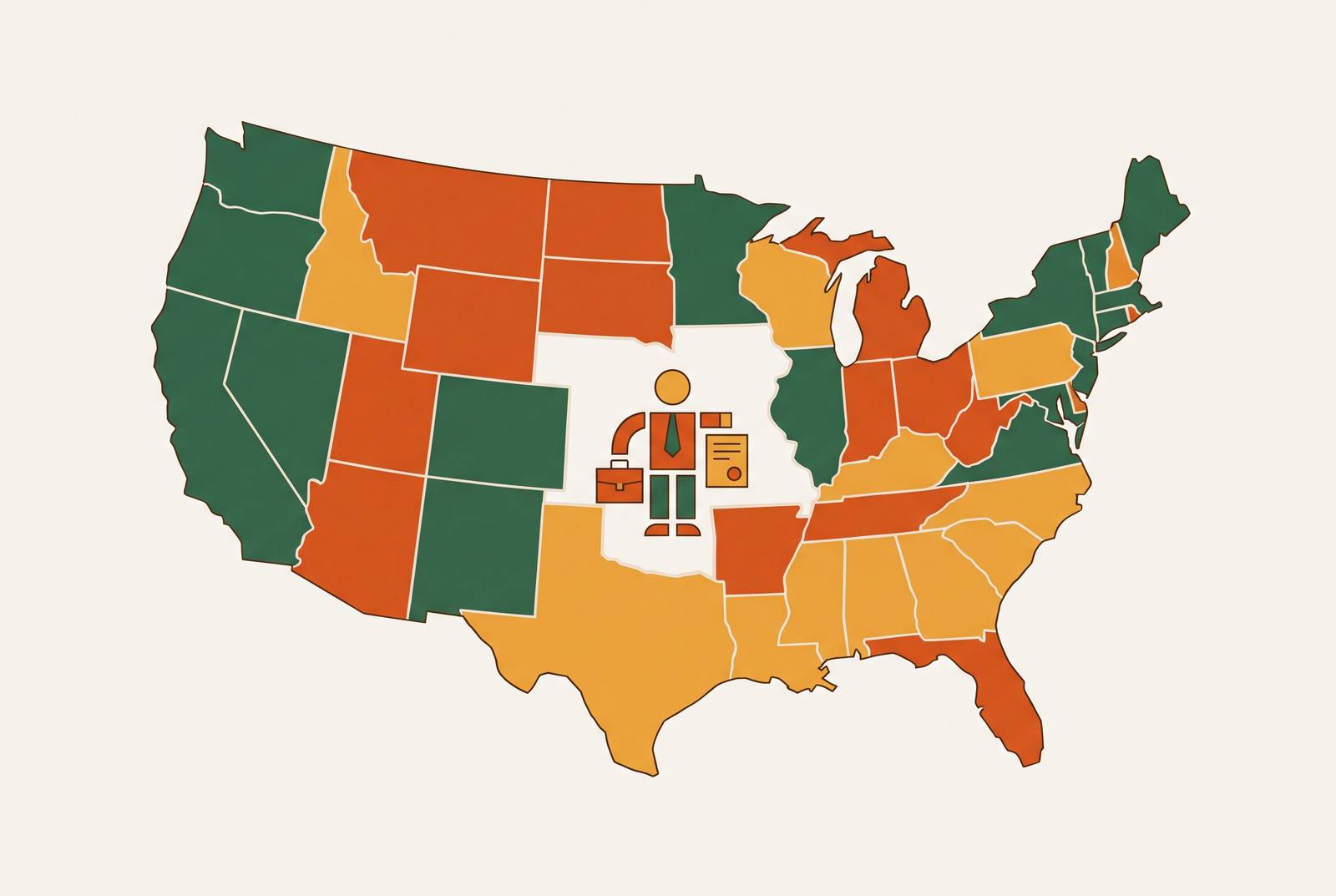
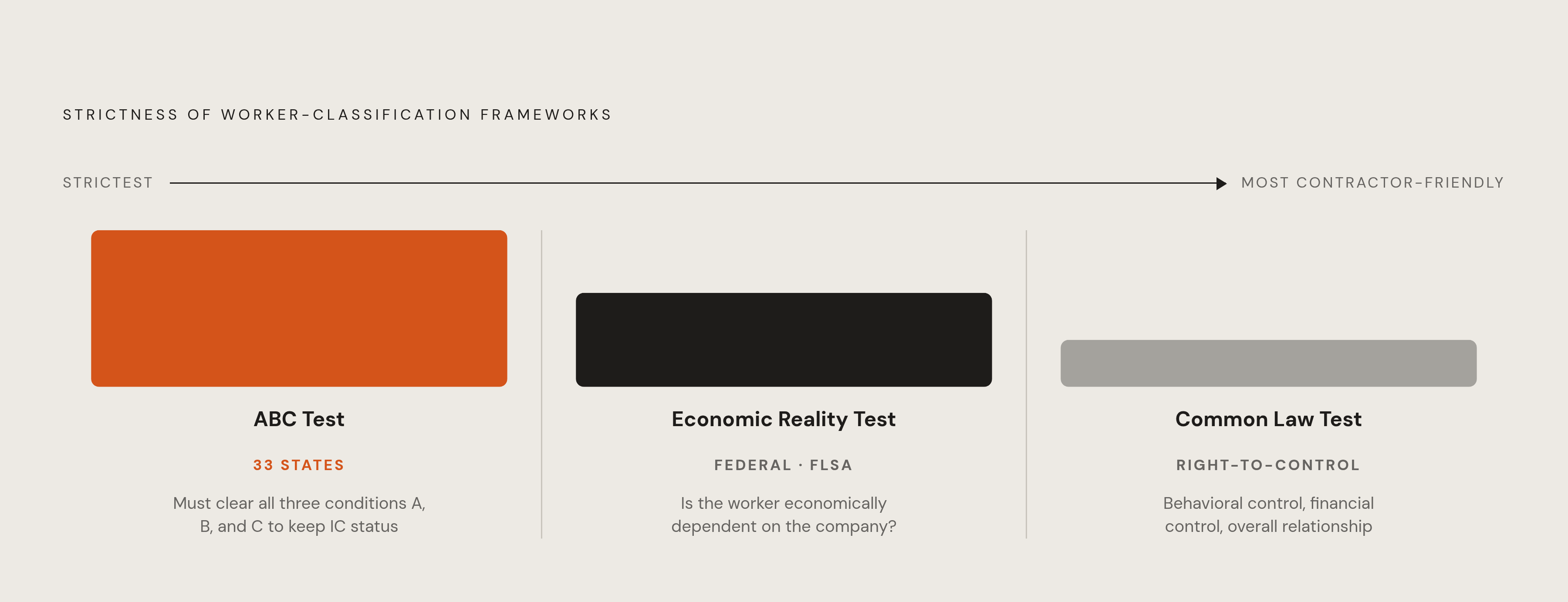
Three frameworks do most of the work here. The ABC test is the strictest: 33 states use it or something close to it, and a worker only keeps IC status if the company clears all three conditions, usually labeled A, B, and C. The economic reality test is the federal baseline under the FLSA, and it asks a simpler question: is this person, as a matter of economic reality, running their own business, or dependent on the company that hired them? Then there's the common law or right-to-control test, which weighs behavioral control, financial control, and the overall relationship, and tends to be friendlier to IC status than the ABC test.
A handful of states have begun exploring modified approaches to the ABC test, though the core three-condition structure still governs in the strictest jurisdictions. The test that governs a driver is determined by where the work happens, not where the company is headquartered. A delivery network running drivers in a dozen states is running a dozen separate legal analyses at once, whether anyone in the general counsel's office wants to admit that or not.
The states where misclassification risk is highest for delivery operators
California remains the most litigated classification environment in the country, and it isn't close. The state still applies the ABC test under AB5, with ongoing legislative activity continuing to adjust certain exemptions. Legal challenges to California's classification framework have continued to work through federal courts, with operators watching the outcomes closely. Prop 22 continues to provide a narrow exemption for app-based delivery and rideshare platforms that meet defined earnings and health subsidy thresholds. Qualifying under Prop 22 takes active, ongoing compliance, not a one-time filing, and that's the part companies keep underestimating.
Massachusetts applies a strict ABC test and enforces it. Massachusetts settled a misclassification action against Uber and Lyft for $175 million, plus forward-looking compliance commitments. Legislative activity in the state continues, which tells you the legislature isn't done here.
New Jersey pairs its ABC test with serious enforcement exposure, treating misclassification as more than just a labor issue. Stop-work orders are among the authorized remedies, which means a compliance failure in New Jersey can shut down operations on the spot, not just generate a bill months later.
New York stacks city rules on top of state law. NYC set a minimum wage of $17.96 an hour for app-based delivery drivers, scheduled to climb to $19.96 by April 2025. New York has continued expanding worker protections beyond the city level, with mandatory contract requirements and formal enforcement processes extending further across the state. Other cities have moved to pass similar minimum pay protections for app-based delivery workers. Colorado has added misclassification-specific fines to its existing wage law framework. Illinois now requires independent contractor records to be kept for at least five years under recent labor transparency reforms.
The states that offer more room to operate, and why that room is not unlimited
Florida and Texas get cited constantly as the friendlier jurisdictions, and the reputation is earned, as far as it goes. Neither applies the full ABC test, enforcement posture is lighter, and the common law control test governs instead. Florida also has the highest concentration of gig workers of any state, 22% of its workforce, which makes it an attractive place to operate and, increasingly, a place drawing federal attention precisely because of that concentration.
Washington doesn't use a strict ABC test but is building structure anyway, with evolving worker protections that have drawn attention across the industry.
Here's the catch, and it's the one operators miss most often: none of this state-level permissiveness insulates a company from federal law. The FLSA's economic reality test applies nationwide regardless of state posture, and DOL enforcement, even in its current relaxed mode, isn't zero. Private plaintiffs can still sue under the FLSA no matter what the agency's enforcement priorities happen to be this quarter. Federal scrutiny beyond the DOL remains a factor, and that exposure doesn't track which states are considered friendly. Operating in Florida or Texas lowers one kind of exposure. Federal exposure stays fully in play regardless.
Where federal classification law stands after two years of policy reversals
The 2024 DOL Final Rule at 29 CFR Part 795 is still on the books, technically. But on May 1, 2025, the DOL said it would stop applying that rule in enforcement and fall back on older, more contractor-friendly guidance instead. Then on February 26, 2026, the DOL proposed formally rescinding the 2024 rule, a process now underway but not finished.
That leaves a strange dual track. Agencies enforce under the older, more contractor-friendly guidance, while private FLSA plaintiffs can still point to the 2024 rule's language in court. Whichever version of guidance is in play, the underlying question hasn't moved: is the worker in business for themselves, or economically dependent on the company? Federal exposure beyond the DOL adds a separate wrinkle, operating independently of whatever the DOL is doing.
Congress, for its part, is punting entirely. Recent federal legislative activity touching gig worker benefits has largely left IC classification status intact, which is Washington's way of telling states: you handle it.
What misclassification actually costs when a state or federal agency acts
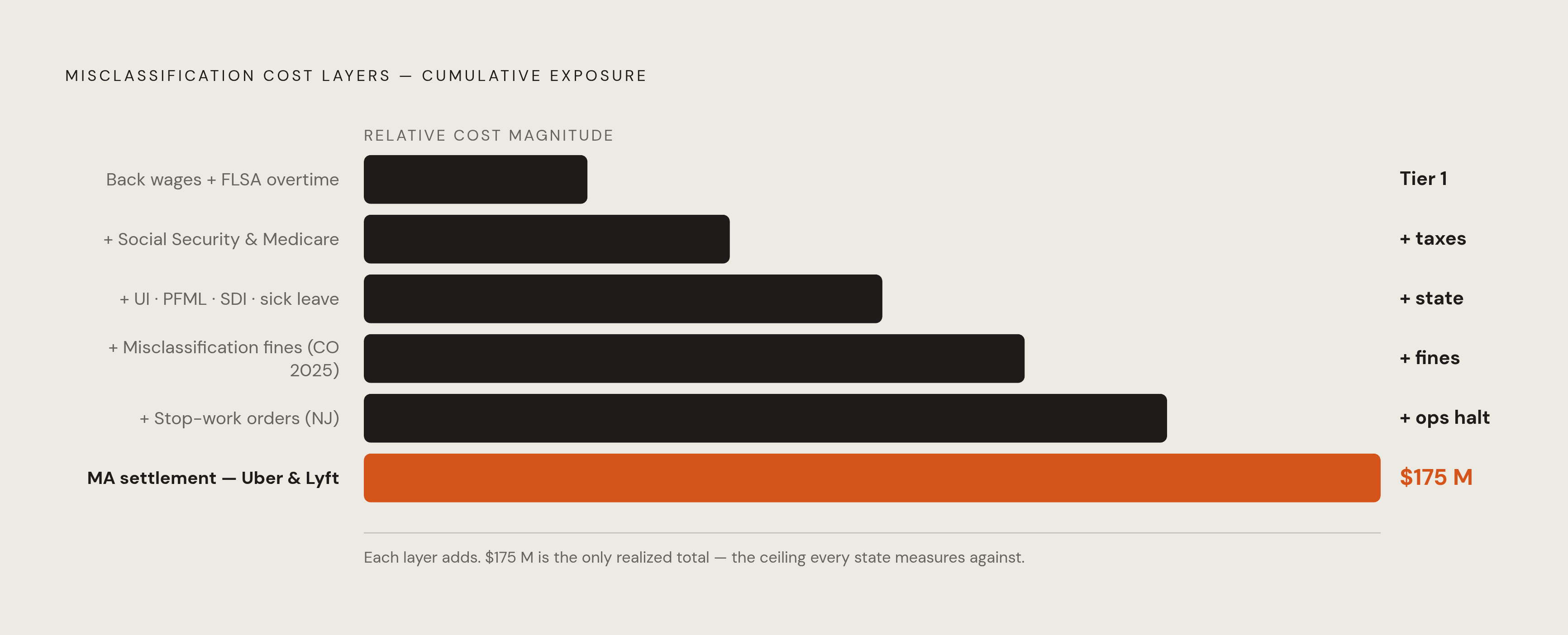
Start with the number that already happened: $175 million, the Massachusetts settlement against Uber and Lyft. That's a real outcome for a real app-based platform, not a hypothetical ceiling, and it sets the bar other states will measure against.
Even accidental misclassification creates liability. Companies can owe back wages, FLSA overtime, and employment taxes including Social Security and Medicare contributions. Willful violations stretch the retroactive claims window to three years, which multiplies exposure fast if a company has run the same arrangement across multiple states for a while.
State-level costs stack on top of federal ones: back contributions to state unemployment insurance, back contributions to paid family and medical leave funds where those exist, state disability insurance arrears, and accrued sick leave under state mandates. Each carries its own penalty structure, and running afoul of five states at once doesn't average the exposure, it adds it up. Colorado's recent amendments added misclassification-specific fines onto everything already on the books, a sign that states are tightening penalties, not loosening them.
The costs that don't show up on a balance sheet are just as real. Contractors who sense a company is playing loose with classification tend to walk, or simply stop accepting shifts. Investors get nervous too: long-tenure contractors who look, on paper, like they meet employee criteria can spook a funding round faster than a bad quarter. And New Jersey's stop-work orders are the most disruptive outcome of all, since they halt operations immediately, dollar figure be damned.
The classification factors that put delivery companies at particular risk
Across every major test, ABC, economic reality, common law, the same factors keep tipping a worker toward employee status, and delivery networks tend to hit all of them at once. How much control does the company hold over schedule, route, and the work process? Is the work central to the business, or peripheral to it? For a staffing agency, a contractor's specialized work sits outside the company's core business. For a delivery company, the driver is the core business, with no daylight between what the contractor does and what the company sells.
That's the misread most delivery operators make: they treat classification risk like a paperwork problem when it's actually a business-model problem. Long-tenure contractors working next to W-2 employees doing the same job is a pattern regulators and plaintiffs' attorneys specifically hunt for, and for good reason. It's a clean signal that the classification is doing more work than the job itself justifies. Algorithmic dispatch, now under FTC scrutiny, complicates this further, since a routing algorithm assigning jobs and enforcing acceptance rates can look a lot like behavioral control, even with zero human managers involved.
A worker whose services are essential to the business, who works exclusively for one platform, and who has little room to negotiate pay or turn down assignments is going to struggle to clear Part B of the ABC test in a strict state. The relationship has to be built with classification in mind from the start. Retrofitting it after a complaint lands is closing the barn door well after the horse has made three deliveries and left a bad review.
How operators running multi-state contractor networks manage classification consistently
Everything starts with knowing which test applies in each state where the work actually happens, not where the company is incorporated or where a contract gets signed electronically from a laptop in Delaware. That's table stakes, not strategy.
Compliance isn't a one-time box to check either. State law keeps moving: Colorado's 2025 amendments, Washington's digital protections, New York's statewide Freelance Isn't Free Act. A contractor relationship that passed muster at onboarding six months ago can drift out of compliance as work patterns shift, without anyone deciding to change anything.
Documentation is the frontline defense. Illinois requires five years of IC records, and any operator running a multi-state network should treat that as the floor everywhere, not just in Illinois. Written agreements need to reflect how the relationship actually works day to day, not how it reads in a template pulled from a law firm's website in 2019. Washington's move toward digital contract verification is probably a preview of where other states are headed.
At real scale, this stops being something a compliance team manages by hand, and treating it as a manual job is the mistake that catches up with operators eventually. A network running thousands of contractors across a dozen states needs state-specific onboarding flows built around each jurisdiction's actual test criteria, and it needs to catch compliance drift in real time, not in an annual audit that surfaces the problem eleven months too late. A contractor's business license lapsing, or a pattern of exclusive work developing where none existed before: these are the small, easy-to-miss shifts that create retroactive liability if nobody's watching for them. Spreadsheets and a once-a-year legal review don't scale to that. Platforms built specifically for the 1099 delivery economy, GigSafe among them, automate state-specific onboarding and flag compliance drift as it happens, cutting down the manual back-office work that multi-state compliance otherwise demands.
Insurance coverage as a structural component of compliant IC relationships
Correctly classified independent contractors aren't covered by a company's workers' compensation policy, full stop. Occupational accident insurance and commercial auto coverage function as the actual safety net for delivery ICs, filling that gap directly.
This isn't just a coverage question, it's a classification signal, and companies that treat insurance as an afterthought are missing it. Providing occupational accident insurance, built for contractors, supports IC status. Providing benefits that look and function like employee benefits does the opposite, and can be read by a regulator or a plaintiff's attorney as evidence the relationship was never really independent to begin with. Occupational accident coverage protects a contractor from on-the-job injury without blurring that line.
Commercial auto coverage is its own specific trap for delivery operators, since personal auto policies routinely exclude commercial use entirely. A contractor making deliveries on a personal auto policy can find out the exclusion applies at the worst possible moment, mid-claim, after an accident. Buying insurance in bulk across a large contractor network brings the per-contractor cost down and keeps coverage consistent across the fleet, terms an individual contractor could never negotiate alone. States are starting to codify this too: California's Prop 22 and Massachusetts's 2025 portable health fund both require qualifying platforms to offer certain health subsidies, and any coverage structure built to satisfy those rules has to do it without accidentally creating an employee-benefit relationship in the process.