compliance stack configurations for multi-state last-mile delivery operators
Operators must configure compliance separately in each state, not apply one national policy.

Last-mile delivery hit $167.3 billion in 2025, growing at a 9.8% clip through 2033, according to Grand View Research. Consumers drive most of that growth: the B2C segment already makes up 69.6% of the market, and North America alone holds 36.24% of the global total. Nobody puts this part on the slide deck though: every new state an operator enters comes with its own rulebook for contractor classification, insurance, credentialing, and pay. It is common for a company to get comfortable running compliance in one state, then find itself exposed the moment a second state's rules don't match the first. Multi-state operation carries more than single-state operation's mileage; the job itself changes shape.
Expanding into a second or third state on a 1099 model requires a five-layer compliance stack, and each layer must be configured per jurisdiction rather than applied as a single national policy. The bottom layer is classification governance: jurisdiction-mapped rules and documentation built around the specific test each state applies, whether ABC, economic reality, or a hybrid. Above that sits onboarding and credentialing, which must route each contractor to a state-specific agreement template and collect W-9s, license checks, background checks, and insurance enrollment before the first package is touched. The insurance layer maps occupational accident, commercial auto, and cargo coverage to where contractors physically work, not to the operator's home state, because state mandates vary and a standard policy may not satisfy every jurisdiction on its own. Payment compliance then watches piece-rate and per-stop structures against each state's timing rules, with mileage tracked at the IRS's 2025 rate of 70 cents per mile and documented per contractor. The fifth layer, real-time monitoring, tracks credential expiration, insurance certificate status, and regulatory changes continuously across all active states, because a lapsed credential or a quietly amended classification rule creates live liability the moment it occurs, not the moment someone notices it in a quarterly review.
The workforce underneath all this growth is mostly 1099. Gig workers now number more than 70 million in the US, about 36% of the total workforce in 2025, and the independent contractor model is what makes fast geographic expansion financially sane in the first place. No W-2 overhead, no payroll tax registration in fifty places, no benefits administration at scale. But that same model creates the compliance exposure that piles up with every new state added to the map. Cheap expansion and risky expansion are the same thing wearing different clothes.
How the state-by-state regulatory patchwork actually works against a single compliance approach
There's no federal preemption here, and there probably never will be. Classification tests, credentialing rules, payment timing, and recordkeeping retention all live at the state level, and the variation is wide enough to make a single national policy nearly worthless. The federal layer keeps moving too, which doesn't help. The Department of Labor issued Field Assistance Bulletin 2025-1 in May 2025, reverting to the pre-Biden economic reality test, then proposed a rule in late February 2026 to swap the 2024 Biden-era IC standard for a two-factor framework closer to the 2021 Trump-era approach. None of that touches state law. States still run their own tests, and they run them differently.
California remains the hardest place to operate, full stop. The California Supreme Court upheld Proposition 22 in July 2024, so app-based delivery drivers can stay classified as ICs if the conditions are met, but AB 1514, effective January 1, 2026, narrows the ABC-test exemptions for certain professionals right back down. New York City is weighing the Delivery Protection Act, which would force operators running warehouses larger than 50,000 square feet to directly employ their delivery workers; that one proposal alone would gut the IC model for anyone it touches. New York State already has the Freelance Isn't Free Act on the books, establishing contractor protections around written contracts and payment obligations. Illinois piles on its own recordkeeping and invoicing rules, adding another layer of documentation obligations operators must track separately. Massachusetts and New Jersey run tougher classification tests, and both states carry significant misclassification exposure for operators who get the analysis wrong. Florida and Texas look easier on paper, but that ease just relocates the risk: lighter state standards don't insulate operators from federal classification scrutiny, so the exposure shifts rather than disappears.
A policy built to survive California's ABC test will overcorrect in Texas, piling on restrictions nobody there needs. Flip it around, and a Texas-built policy walks straight into a violation in Massachusetts. Operating in more than one state means building something that flexes by design. A single uniform policy just doesn't hold up.
What misclassification actually costs when it surfaces across multiple jurisdictions
Misclassification, whether intentional or just sloppy paperwork, can trigger IRS penalties, DOL investigations, and class-action lawsuits at the same time, in different states, off the same underlying policy decision. Operators tend to underestimate that part. One classification call, applied nationally, can produce three or four simultaneous violations the moment an auditor or a plaintiff's attorney starts digging. Penalty severity isn't uniform either; California and New Jersey sit at the steep end, and most states are maintaining or increasing their enforcement activity rather than pulling back.
Here's the wrinkle that catches a lot of logistics operators off guard: even a correctly classified contractor can get a company held vicariously liable for what that contractor does on the job. Getting the classification right changes which door the lawsuit walks through more than it closes the door entirely. Transportation and delivery services sit squarely in the sectors most directly affected by the DOL's proposed 2026 rule changes, so this isn't an abstract risk for the sector; it's the daily weather.
The real cost of misclassification runs deeper than the initial fine. A retroactive liability tail can extend back across the full period of misclassification, per jurisdiction, stacking as it goes. Fixing a classification problem after the fact costs far more than building it right the first time. Upfront compliance works like an asset that pays returns over time; damage-control compliance carries an ongoing expense with interest attached.
What compliance stack layers do multi-state last-mile operators need for contractor classification, insurance, credentialing, and pay?
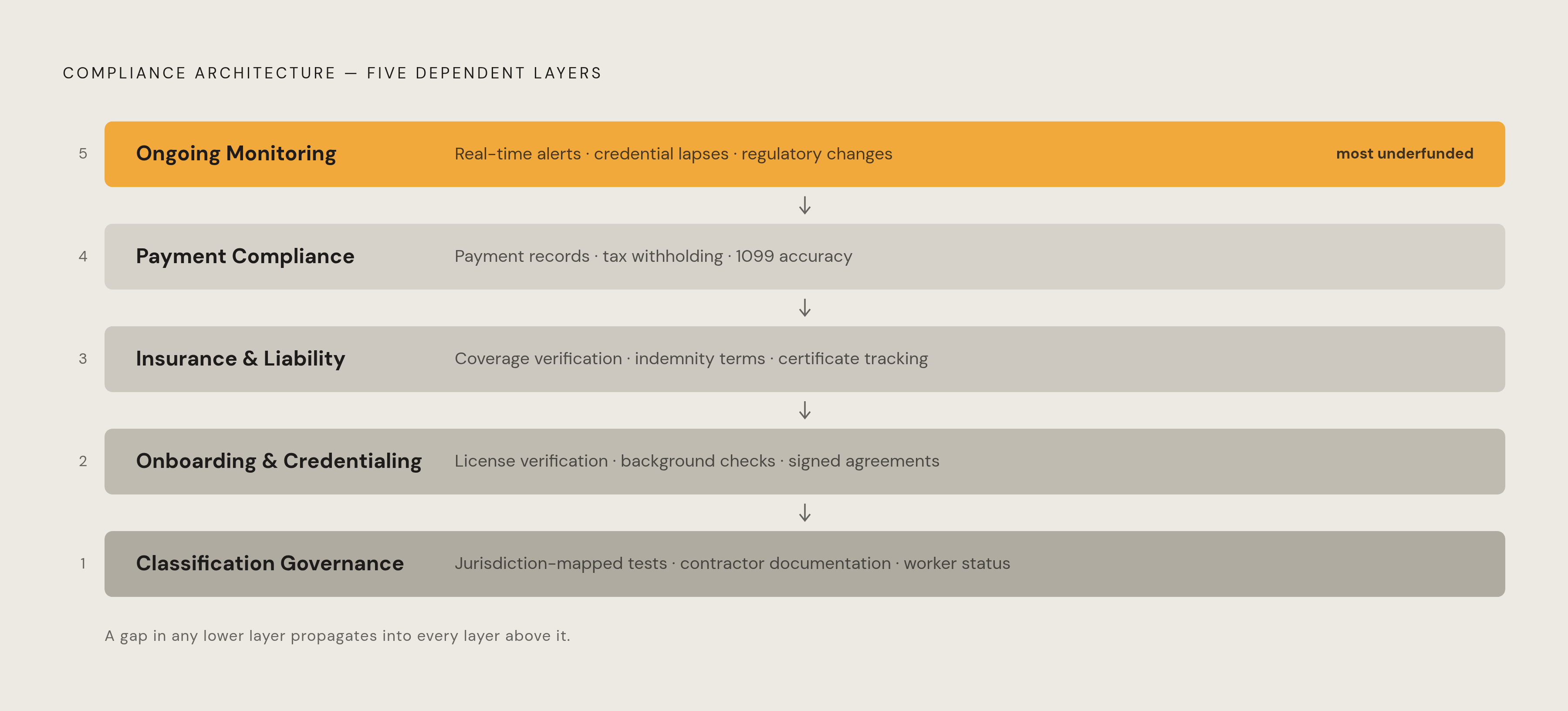
Think of these as layers stacked on top of each other, not a checklist to tick off. A weak spot in one layer doesn't stay put; it climbs into every layer above it.
Classification governance sits at the bottom: jurisdiction-mapped rules dictating how each contractor relationship gets documented, built around whatever test the specific state actually applies. Above that sits onboarding and credentialing, the intake process that gathers classification-supporting paperwork, W-9s, license checks, background checks, and state-specific contract terms before a contractor ever touches a package. Collecting the W-9 before the first payment goes out is also what makes automated 1099-NEC generation possible at year-end, and any operator paying a contractor $600 or more owes them that form. No exceptions.
Third layer: insurance and liability coverage, meaning occupational accident insurance, commercial auto, and cargo coverage, all mapped to where contractors actually work rather than where the company's headquarters happens to sit. Fourth is payment compliance, watching pay structures (piece-rate, per-stop, mileage) against each state's timing and documentation rules. The IRS standard mileage rate for 2025 sits at 70 cents per mile for business use, and operators reimbursing on mileage need to apply that correctly and document it per contractor. Fifth, and the one everyone underfunds, is ongoing monitoring: tracking compliance status continuously instead of glancing at it once a quarter, with alerts firing the second a credential lapses or a state rewrites its rules.
None of these five are optional once an operator crosses into a second state. Enforcement finds the thin layer, and it usually finds it fast.
Why the onboarding layer is where multi-state compliance is won or lost
W-2 onboarding happens once, and you're done. IC onboarding never really stops: licenses expire, bank accounts change, and a contractor picking up work in a new state needs a new agreement, not a footnote stapled to the old one. In most jurisdictions, the written contractor agreement is the single strongest piece of evidence in a classification defense, so state-specific terms need to be built into onboarding from day one instead of bolted on after a complaint lands on someone's desk.
New York's Freelance Isn't Free Act and Illinois's labor transparency rules each demand specific contract language and recordkeeping that a generic IC agreement just doesn't cover. So the stack has to route each contractor to the agreement template matching their actual state of work, not a single boilerplate document handed out regardless of geography. A working onboarding module covers classification documentation, the state-specific contract, the W-9, background and motor vehicle record checks, license verification, insurance enrollment, and payment setup, at a minimum.
At real scale, this cannot run through manual review. Push thousands of contractors across dozens of states through a person doing this by hand, across time zones and templates, and you get inconsistency. Inconsistency is exactly what auditors go looking for. The upside: platforms built for this can meaningfully accelerate onboarding, and speed and compliance line up nicely once the stack is actually put together right.
How insurance coverage must be structured when contractors cross state lines
Vicarious liability is why insurance functions as the backstop for a simple, uncomfortable fact: even correctly classified contractors can expose the company that hired them. It deserves treatment as a core part of the classification decision, not an afterthought. Three coverage types matter most for multi-state delivery. Occupational accident insurance covers contractors for on-the-job injuries and works as baseline protection, given that many gig workers have no access to employer-provided benefits at all; it also doubles as a classification-preserving alternative to traditional workers' comp. Commercial auto matters because personal auto policies typically exclude delivery use outright, so contractors need coverage built for the job, with the operator's liability backstopped behind it. Cargo coverage protects goods in transit, and the thresholds shift depending on the shipper contract and, in some states, direct regulation.
State insurance mandates aren't consistent either. Coverage requirements vary by state, and a standard occupational accident policy may not satisfy every jurisdiction's expectations on its own. Coverage has to map to where contractors physically work, not to the operator's home state. There's a cost angle too: managing insurance through the compliance stack, instead of leaving each contractor to shop for a policy alone, is a structural advantage available only to operators who treat coverage as part of the stack rather than pushing it onto contractors one by one. A lapsed policy is a live liability exposure the moment it lapses. It deserves immediate attention, not a slot on the pre-audit cleanup list.
What real-time compliance monitoring means in practice versus periodic audits
The quarterly or annual audit model has a built-in flaw: it catches problems after they've already compounded. A lapsed CDL, an expired insurance certificate, a state that quietly rewrote its classification test last month. All of these create liability the moment they happen, well before someone finally notices during a review six months later.
Real-time monitoring in a multi-state IC stack tracks credential and license expiration across every active contractor by jurisdiction, insurance certificate status for both operator-provided and contractor-sourced coverage, and regulatory change alerts the second a state modifies its classification test, payment timing rules, or recordkeeping requirements. It also flags pay structures, catching contractors whose effective hourly rate under piece-rate or per-stop pay drifts below what's acceptable in their jurisdiction, and it triggers background and MVR re-checks on schedule or after an incident. Illinois's five-year recordkeeping requirement shows why this has to run on automation: keeping records by hand for thousands of contractors across multiple states is close to a guaranteed way to fail an audit.
There's a defensive upside too. A consistent, timestamped record of real-time compliance checks reads as evidence of a well-run IC program, and that carries real weight in a DOL investigation or a class action. The DOL's 2026 rule is still working through the process, and state legislatures keep amending their own IC rules on their own schedule, unbothered by anyone else's timeline. The operators who come out ahead are the ones tracking those changes continuously, well ahead of whatever policy review is penciled in for next quarter.
Payment compliance across states and why pay speed is a compliance variable, not just an operational preference
Payment timing rules vary by state, and New York's are among the most demanding: the Freelance Isn't Free Act turns a late payment from an awkward relationship hiccup into a contractual violation with its own enforcement process. Pay structure monitoring is a separate obligation on top of that: piece-rate and per-stop structures need per-pay-period checks on effective hourly rates, mileage reimbursement needs to track the IRS's 70-cents-per-mile 2025 rate and get documented per contractor, and any operator relying on a statutory exemption from FLSA overtime for interstate drivers needs that eligibility assessed and documented individually, not assumed across the whole fleet.
Pay speed itself carries real compliance weight, more than its reputation as a nice-to-have perk suggests. Contractors who wait weeks to get paid start behaving like employees who happen to lack benefits, and that behavior pattern is exactly what strengthens a reclassification argument later. Fast payment options have become a practical necessity, the thing that keeps an IC relationship looking and acting like one. Flexibility, cited by 70% of gig workers as the main draw of the work, only means something if the pay actually lands fast. All of this points toward one system: payment processing belongs inside the compliance layer, generating pay structure monitoring, timing compliance, and 1099 documentation off the same record, instead of a separate system somebody reconciles against it later by hand.
How to evaluate and select the technology components that form the compliance stack
Most operators back into their compliance stack by duct-taping point solutions together: one vendor for background checks, another for insurance, a third for payments, a fourth for document storage, and then someone on staff spends their week trying to get the four of them to talk to each other. That's a common failure mode. Data doesn't move between these systems in real time, so a credential lapse flagged in the background check tool doesn't automatically show up in the payment or scheduling system. That gap is exactly where a violation sits undetected until an audit finds it, usually the hard way.
A purpose-built IC compliance platform needs multi-module onboarding handling classification documentation, credentialing, insurance enrollment, and payment setup inside one workflow, plus jurisdiction-aware agreement templates that route each contractor to the contract matching their actual state of work. Each layer depends on the one below it, and a gap anywhere climbs upward. That's the whole case for buying one integrated system instead of stitching five together yourself. End-to-end platforms like GigSafe, built for multi-state 1099 contractor networks, combine classification governance, credentialing, real-time monitoring, and payment workflows into a single system rather than leaving operators to bolt these pieces together across dozens of jurisdictions on their own. Given how fast the rules keep shifting state to state, and how little room for error actually exists, that kind of integration is the baseline cost of operating in more than one state at a time, not a nice extra.