IC Compliance Checklist for Delivery Operators
Delivery operators face four overlapping regulatory regimes with real misclassification liability.

A delivery network built on independent contractors sits under four regulatory regimes at once: worker classification law, vehicle and cargo insurance rules, credential verification standards, and a patchwork of state-level contractor statutes. That overlap isn't shrinking. Delivery work draws the sharpest scrutiny of any gig category, because the same driver running the same route for the same operator, day after day, is exactly the fact pattern regulators are trained to flag. Transportation and logistics now rank among the industries most named in IC misclassification lawsuits, alongside healthcare and financial services. Run more than a handful of contractors and the checklist becomes infrastructure, with real liability attached the moment it gets ignored.
How the regulatory landscape for IC classification has shifted since 2024
The Department of Labor's final rule on IC classification took effect March 11, 2024, and it swapped the old two-factor test for a multi-factor economic realities test that weighs the whole relationship instead of one or two variables. In January 2025, a federal court upheld that rule in Colt & Joe Trucking v. DOL, confirming that a worker economically dependent on one business has to be treated as an employee under the Fair Labor Standards Act. That ruling lands directly on delivery contractors who work exclusively for a single platform, which describes a large share of last-mile drivers.
Since then, the DOL's Wage and Hour Division has paused active enforcement of the 2024 rule while it runs a review, but its guidance keeps pointing back to the traditional economic-realities framework. Enforcement paused, but the legal standard held steady.
States aren't waiting either. New York's freelancer agreement law, effective May 20, 2024, requires a written contract for any engagement worth $800 or more, a bar most delivery IC relationships clear before lunch. Some states are pushing legislation that would let agencies issue stop-work orders for uncorrected misclassification, which turns a fine into a shutdown. The IRS also dropped its electronic-filing threshold for 1099s from 250 returns down to 10, which sounds like a paperwork footnote until an operator running 40 contractors realizes the back office now has to file digitally, no exceptions. Most operators build the checklist for the most lenient jurisdiction they touch, but it's the stricter jurisdictions that end up mattering.
Getting classification right before anything else on the checklist matters
Classification needs review whenever the scope of work changes, a short-term gig turns into a standing arrangement, a contractor starts acting like staff, or a contract renews in a different shape than the one it started in. For delivery networks, the warning signs repeat themselves: a driver working for one operator only, using operator-supplied equipment, following a fixed schedule, or getting managed route by route like an employee with a different tax form.
The economic realities test cares about control and about the contractor's real opportunity for profit or loss, so the paperwork has to match actual working conditions, not the arrangement an operator wishes were true. Three documents do the heavy lifting: a signed IC agreement that reflects reality, a statement of work built around deliverables instead of hours, and a short memo explaining why the role makes sense as an IC role in the first place. Skip that memo and there's nothing on file the day an investigator asks why a driver working five days a week for eight months isn't an employee.
Misclassify even one worker and the exposure stacks fast: a DOL Wage and Hour investigation, back payroll tax liability (6.2% for Social Security and 1.45% for Medicare on the employer side), unpaid benefits claims, and interest that compounds while the case sits open. Classification review belongs on a recurring calendar, not filed away as a task completed on day one and forgotten. A driver's unemployment claim has a way of reopening a checkbox that was closed too early.
The contract and documentation layer every IC engagement requires
The written IC agreement is the foundation, and it needs to spell out scope, deliverables, payment terms, the contractor's right to work for other companies, and the absence of supervision over how the work gets done. New York's $800 threshold is worth adopting as a universal floor: any engagement generating a 1099 should have a signed agreement in place before the first shift starts.
The statement of work, a separate document, carries just as much weight as the master agreement. Route assignments, delivery windows, and performance targets should describe outputs, not hours worked or methods supervised. Tax paperwork comes before the first dollar moves: a W-9 for domestic contractors, the W-8 series for anyone working from abroad. Skip that step and accurate 1099-NEC generation at year-end becomes impossible, putting the operator out of step with the IRS's electronic filing rule.
Records need to outlive the engagement itself, since investigations tend to surface months or years after the work wrapped, not during it. Offboarding deserves the same formality as onboarding: a documented close-out with a timestamp and final deliverable sign-off closes the door on arguments that the relationship quietly kept going after the contract ended.
Credentialing and background verification as an operational checkpoint, not a pre-hire formality
Delivery networks carry a credential load most IC programs never touch: a valid driver's license, current vehicle registration, a motor vehicle record check, and often a background check as a condition of getting platform access at all. Enterprise shippers and regulated industries, alcohol, cannabis, pharmaceuticals, frequently stack their own drug testing and screening requirements on top of whatever the baseline law demands.
Credential expiration is the risk that never announces itself, since a license that lapses mid-route creates two problems at once: an insurance claim that may get denied outright, and a classification record now full of holes. Automated tracking, with alerts ahead of expiration and reminders to renew, is the only approach that scales past a few contractors. Spreadsheets stop working somewhere around contractor number twenty, and nobody notices until the twenty-first driver's license expired three weeks ago.
Safety orientation and policy sign-off should happen digitally with a timestamp attached, building a record that the contractor received and acknowledged the rules without turning that acknowledgment into the kind of mandatory training relationship that hands the other side an employee argument. Recurring motor vehicle record checks, not a one-time pull at onboarding, are becoming standard practice for operators carrying commercial auto liability exposure.
The insurance gap that leaves delivery operators and their contractors exposed
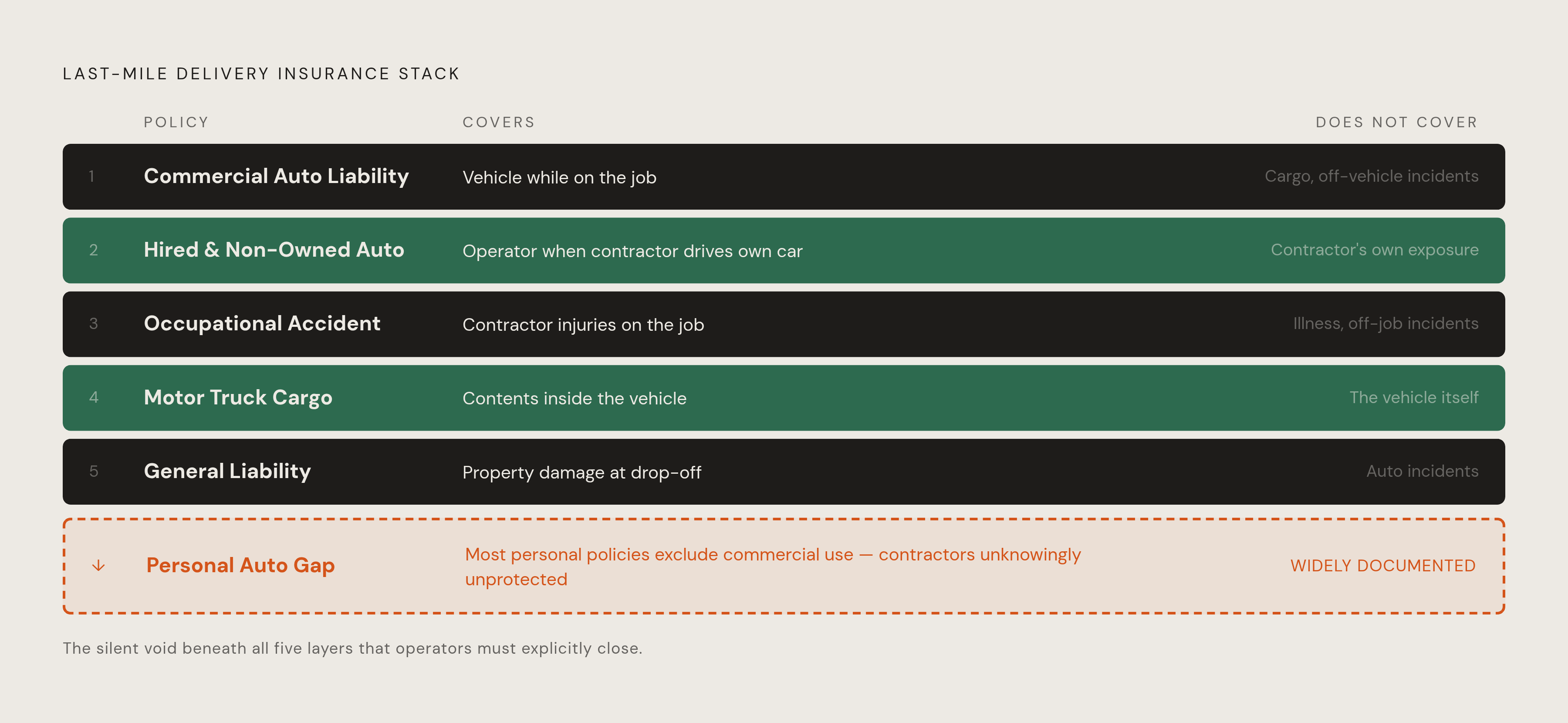
Most personal auto policies exclude commercial use outright, so a contractor mid-delivery who gets into an accident may find the personal policy simply doesn't pay, full stop. Because IC status disqualifies contractors from workers' compensation, an injury on the job leaves them with no safety net unless the operator has set up occupational accident coverage for the network. Coverage gaps among gig delivery drivers are widely documented, and a significant share of contractors carry personal auto policies that exclude commercial use entirely. The gap is common enough that any operator assuming its drivers are covered is guessing.
Five policies make up the real insurance stack for last-mile delivery: commercial auto liability, which covers the vehicle while it's working; hired and non-owned auto coverage, which protects the operator's own liability when contractors drive their own cars; occupational accident insurance, the IC-world substitute for workers' comp; motor truck cargo insurance, which covers what's inside the vehicle rather than the vehicle itself; and general liability, for non-auto incidents like property damage during a drop-off. Buying insurance in bulk across the whole contractor network, instead of leaving each driver to shop for a policy alone, beats what any individual contractor could get on their own, and it's one of the few cost levers an operator actually controls.
Certificates still need verification at onboarding and tracking for expiration afterward, or none of it matters, since a lapsed certificate discovered the day of an accident turns into a coverage dispute the operator inherits, not the driver.
Why ongoing monitoring matters more than the initial compliance setup
A contractor who was fully compliant at signing isn't guaranteed to be compliant six months later, since licenses expire, insurance lapses, the scope of the work drifts, and new state laws land without warning. Quarterly or annual audits catch none of that in real time, and by the time a periodic review flags a lapsed credential, the operator may already be carrying liability from whatever happened in the gap between checks.
Real-time monitoring, automated alerts on credential expirations, insurance renewals, and classification trigger events, is the only method that keeps pace with an active network. Certain events should force an immediate mid-engagement classification review: a contractor's scope creeping beyond the original agreement, a shift in the geographic territory covered, a client contract that starts dictating how the work gets done rather than just what needs delivering, or a contractor who quietly stops working for anyone else.
Regulators and plaintiff attorneys look for patterns across the whole roster, not isolated incidents, and one lapsed contractor can be the thread that unravels an investigation into everyone else. An audit trail is the defense against that: timestamped records showing monitoring was active, showing exactly when credentials were checked, showing flagged issues got fixed rather than filed away.
Contractor payments as a compliance checkpoint, not just an operations function
IC payments have to look different from payroll starting with the first transaction: no withholding, payment by invoice or per-delivery basis, and a 1099-NEC issued at year-end for anyone paid above the threshold. Collect the W-9 before that first payment moves, since skipping it exposes the operator to backup withholding obligations and reporting errors that surface later, at the worst possible time.
Electronic 1099-NEC filing is now mandatory past 10 information returns, a bar any real delivery network clears within its first few months, so automated payment records and document collection stop being optional back-office niceties. Pay speed matters too, and not just for keeping good drivers around: same-day ACH or instant debit settlement, instead of a weekly payroll cycle, reinforces the IC relationship by paying for completed work the way one business pays another, rather than running contractors through a schedule built for employees.
Every payment record does double duty, functioning as both an operational log and a piece of classification evidence: proof the contractor got paid by the route or the delivery, not by the hour. Scaling past a small roster means the payment system has to track year-to-date totals per contractor automatically and produce 1099-NEC forms without someone reconciling spreadsheets by hand every January.
How treating this checklist as infrastructure separates scalable operators from exposed ones
Every checkpoint here, classification, documentation, credentialing, insurance, monitoring, payment structure, can be run by hand when the roster is small, but it breaks the moment the network grows past what one compliance person can hold in their head. The failure mode is rarely ignorance of the rules; more often it's a system that can't keep up with volume: a classification trigger nobody reviewed, a certificate that expired with no alert attached, a W-9 that never got collected before the first check went out.
Operators who automate these checkpoints cut onboarding from weeks down to days, hold real-time visibility across the whole contractor base, and walk into a regulatory inquiry with an audit trail instead of an excuse. A spreadsheet reflects what happened last quarter; an automated system flags what's about to go wrong. The rules around this labor pool are tightening, not loosening, and operators who onboard faster, keep contractors compliant longer, and pay them without delay end up winning the enterprise shipping contracts that demand documentation as a condition of doing business.
Purpose-built workforce platforms that combine onboarding, credentialing, insurance tracking, monitoring, and payments into one system get this done without hiring an entire back office to babysit spreadsheets. Compliance infrastructure makes growth possible, while ad-hoc compliance puts a ceiling on how far that growth can go, and every operator eventually finds that ceiling, usually at the worst possible time, usually in a courtroom.