Rules for Issuing 1099 Forms to Independent Contractors
Operators must track two thresholds simultaneously when filing 2025 and 2026 contractor payments.

Issuing 1099 forms to independent contractors turns on the worker’s status, the payment type, the annual total, and the filing deadline. For large contractor networks, the immediate challenge is applying the lower threshold to 2025 payments while preparing for the higher threshold for 2026 payments. The higher threshold reduces filing volume while leaving the need for reliable contractor records unchanged.
Why operators running large contractor networks face two different 1099 thresholds at the same time
The payment year determines which threshold applies. An operator filing in early 2026 is reporting payments made during 2025 under the older rule. Meanwhile, payments made on or after January 1, 2026 fall under the new rule. The same accounts-payable team has to follow both rules at once.
The One Big Beautiful Bill Act (OBBBA), signed in 2025, enacted the increase for Form 1099-NEC and Form 1099-MISC. For delivery and last-mile networks, the transition is especially relevant because high contractor churn leaves many drivers with modest annual totals. Applying the higher threshold to 2025 payments would miss required filings, while retaining the lower threshold for 2026 would produce unnecessary forms.
What Form 1099-NEC is, who must file it, and the four-point test that determines the obligation
Form 1099-NEC reports nonemployee compensation paid for services in the course of a business. One copy goes to the contractor and another to the IRS. Contractors report that business income on their own Schedule C. Issuing it does not itself establish that a worker is an independent contractor.
The filing obligation rests on four conditions. The recipient must be a service provider who is not an employee, and the payment must be for services in the payer’s trade or business. The recipient must be an individual, partnership, estate, or corporation covered by an exception. Finally, the calendar-year total must meet the applicable reporting threshold. Most C-corps and S-corps are exempt, though there are specific exceptions for payments to attorneys and healthcare providers.
Payment method creates a separate reporting boundary. When payments fall under the credit-card, debit-card, or third-party settlement organization exception, the payer does not report them on Form 1099-NEC. The processor reports those payments on Form 1099-K, including payments made through arrangements with PayPal or Stripe that qualify for the exception. Delivery operators that use push-to-debit rails or platform wallets need to check which payments fall under that exception, since the same rule does not cover every payout. Form 1099-MISC covers other types of payments, such as rents, royalties, and legal settlements.
The lower threshold that still governs 2025 payments and what operators must do before February 2026
For calendar year 2025, covered service payments to a contractor that meet or exceed the lower threshold trigger Form 1099-NEC reporting. The later law does not rewrite that year. An operator preparing these returns must use 2025 totals and the exceptions already described, even if its current payment system is configured for 2026. The deadline to furnish contractor copies and file with the IRS is February 2, 2026. The statutory January 31 date falls on a Saturday, moving both obligations to the next business day.
As that deadline nears, teams need to get any missing contractor information before they start filing. A filled-out Form W-9 has the contractor’s legal name, address, and taxpayer identification number, or TIN. Those details belong in the record before the first payment. If collection was deferred, a quiet contractor account is still a reporting obligation when its covered payments reached the lower threshold.
A contractor’s failure to provide a TIN, or provision of an invalid TIN, can trigger backup withholding at the applicable statutory rate. The IRS sends CP2100 notices concerning name and TIN mismatches, creating further work through the “B-notice” process. Waiting for the higher threshold will solve neither.
The higher threshold that takes effect for 2026 payments and what it actually changes — and what it does not
For payments made on or after January 1, 2026, the reporting threshold rises for Form 1099-NEC and the covered Form 1099-MISC payments. The threshold adjusts for inflation in subsequent years. Contractors whose covered 2026 service payments stay below the higher threshold will not receive a 1099-NEC from that payer. Networks with many drivers who work only now and then will have fewer year-end forms to file.
All contractor income remains taxable regardless of whether a form is issued. A contractor below the reporting threshold must still report the income and account for self-employment tax. Operators must also still collect a W-9 before they pay a contractor and deal with TINs that are invalid or missing. The backup withholding rules align with the higher threshold, but the underlying need for valid contractor information remains. The reporting threshold is not an onboarding exemption.
The IRS’s 2026 forms also add reporting for cash tips, including Treasury Tipped Occupation Codes, or TTOCs, and for qualified overtime compensation, categories tied to deductions created under the OBBBA. They are separate from the threshold increase. For delivery operators in tipped-occupation categories, the practical step is to monitor IRS guidance on the new boxes. Their presence does not change the basic distinction between a payer’s reporting obligation and a contractor’s taxable income.
Filing deadlines and penalty tiers for 2026 tax year forms due in early 2027
For tax year 2026, Form 1099-NEC is due to contractors and the IRS by February 1, 2027. January 31 falls on a Sunday that year. The IRS does not grant an automatic extension for this form, although a single nonautomatic 30-day extension may be requested on paper Form 8809 with a qualifying hardship justification. Operators need to plan to file on time without an extension.
Form 1099-MISC follows the same recipient schedule, with separate IRS deadlines of March 1, 2027 for paper filing and March 31, 2027 for electronic filing. Operators filing ten or more information returns in aggregate must e-file. That count is not limited to one contractor form type. Payment totals also follow the calendar year even when the business uses another fiscal year. A company operating from June to May still reports contractor payments made from January 1 through December 31.
Penalties escalate as the delay grows longer. Corrections made after August 1 carry a higher penalty per form, while intentional disregard carries the highest penalty per form with no cap on the total for the year. An error repeated across a network can lead to penalties on many returns. Federal filing is also not necessarily the final step. Some states require direct filing and have separate deadlines or reporting details beyond the IRS Combined Federal/State Filing program, so operators in states such as California should verify those requirements separately.
How misclassification risk compounds every filing error and why the IC test is itself unsettled in 2026
A 1099-NEC issued to someone who should receive a W-2 does not protect the operator from back payroll taxes, penalties, and interest. In that situation, an accurately transcribed payment total sits on the wrong form. The deeper error precedes the filing process.
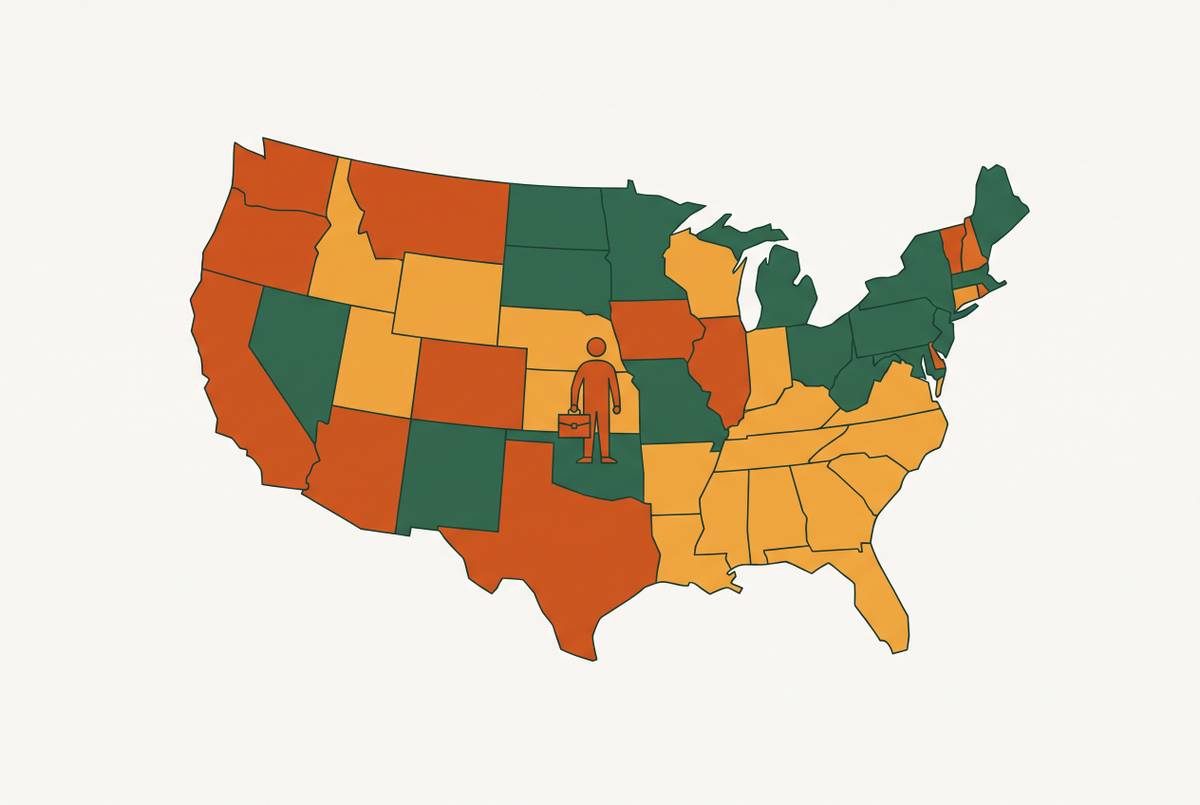
The IRS bases classification on three factors: behavioral control, financial control, and the overall nature of the relationship. The contract’s label does not override how the work actually operates. State law adds another layer for multistate delivery networks. California, Massachusetts, and New Jersey use ABC tests that are significantly harder to satisfy than the federal economic-reality standard. California AB 5 penalties can also be substantial for each misclassified worker.
The proposed 2026 federal classification rule is not finalized. A perceived move toward federal flexibility is therefore not a settled replacement test, and state enforcement continues regardless of federal direction. For operators, the lesson is to treat classification accuracy as a precondition for choosing the reporting form. The reporting threshold answers how much covered compensation triggers reporting.
The upstream recordkeeping and W-9 workflow that makes correct filing possible at scale
Operators should collect a completed W-9 before any payment and validate the name and TIN against IRS records. That validation reduces mismatches that lead to CP2100 notices. Timing is the point of the control. A contractor who has moved on or become unresponsive is harder to reach when the filing deadline is near.
Payment records then need to preserve the reporting distinction throughout the year. Amounts paid by check or ACH belong in the 1099-NEC calculation, while payments covered by the card or third-party network exception belong to the processor’s 1099-K reporting. Combining both categories can cause double-reporting. For networks using several payout methods, an annual contractor total alone is not enough. The record must also show how those payments were made.
Manual email-based W-9 collection can bottleneck onboarding, delay first payouts, and introduce errors when dozens or hundreds of contractors join each month. Automated digital collection with real-time TIN validation against IRS records addresses that workload before filing season. Operators should keep W-9s, payment records, and filed copies for at least four years. Those records support the return after the submission itself is finished.
The higher threshold does not justify suspending collection for apparently low-volume contractors. At onboarding, an operator cannot know whether a driver will remain below the higher threshold for the full year. Tracking all payments also remains necessary to determine when the reporting threshold has been reached.
A side-by-side reference — 2025 filing season rules versus 2026 filing season rules
Reporting thresholds. For tax year 2025 returns filed in early 2026, the lower threshold applies to payments covered by Form 1099-NEC and Form 1099-MISC. Tax year 2026, filed in early 2027, uses the higher threshold, with inflation adjustments in subsequent years. The payment year selects the rule in each case. Backup withholding triggers for contractors without valid TINs align with the lower threshold for 2025 and the higher threshold for 2026.
Filing dates and delivery method. The 2025 Form 1099-NEC deadline is February 2, 2026 for both contractor copies and IRS filing. Its 2026 counterpart is February 1, 2027. For Form 1099-MISC, the IRS paper deadlines are March 2, 2026 and March 1, 2027, respectively, while electronic deadlines are March 31 in each filing year. Ten or more aggregate information returns require electronic filing in both years.
Continuing controls and form changes. Both years require W-9 collection before the first payment, payment-method separation for processor-reported transactions, and attention to state filing requirements. C-corps and S-corps remain generally exempt, subject to the relevant exceptions. The 2026 forms add the tips and qualified overtime reporting categories. Across the transition, the useful constant is a workflow that preserves contractor identity, validates TINs, and distinguishes payment methods, so that each year’s rules can be applied without rebuilding the records.