1099 vs W-2 Classification for Delivery Company Workforces
Misclassification lawsuits expose delivery companies to years of back pay and penalties.
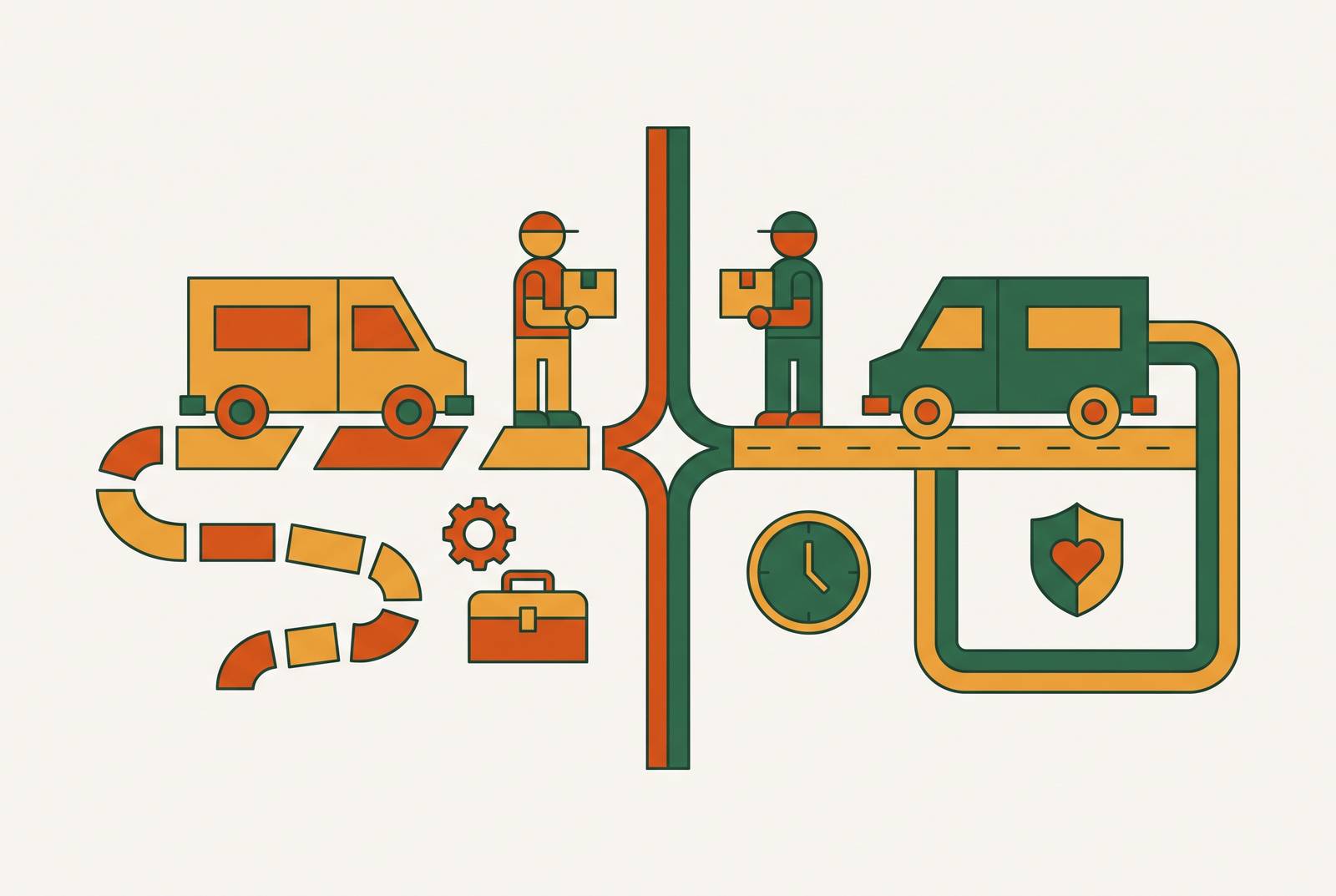
Delivery companies reach for the 1099 model because it is cheap and fast: no payroll tax withholding, no benefits administration, easy to scale a fleet up or down with demand. But the choice of label on a contract does not settle how a worker gets classified under the law. Classification follows the actual working relationship: who controls the work, who carries the financial risk, how central the role is to the business. That is why findings so often look back instead of forward. An operator who has run a contractor model for three years can discover, in a single audit, that the exposure covers all three years, not just the quarter under review. Delivery sits at the center of regulatory attention for a specific structural reason: drivers on fixed routes, wearing company colors, working schedules the company sets, look like employees no matter what the onboarding paperwork says. Independent contractor labor has become the backbone of how delivery and logistics companies operate, not a side arrangement for busy weeks, and that scale is why regulators have turned more of their attention toward the sector.
The three overlapping classification tests for delivery operators
A federal tax agency, a federal labor agency, and each state all use their own test, so three bodies can look at one driver and land on three different answers. A driver can pass the IRS version and still fail a state's version, with no contradiction in the law, just three separate yardsticks.
The DOL runs what it calls the economic-reality test, which asks whether a worker depends economically on the company paying them. Six factors get weighed together, and none of them decides the question alone. In May 2025, the DOL said it would stop enforcing its 2024 classification rule, moving back toward the older economic-realities approach laid out in its Fact Sheet #13.
For delivery operators specifically, the toughest hurdle sits inside the ABC test, in what's known as the B prong: a business has to show that the worker's job falls outside its usual line of work. A delivery company cannot make that argument about its own delivery drivers. Delivery is the business. Four states carry the sharpest version of this exposure. California, Massachusetts, and New Jersey apply the full ABC test broadly across wage and hour law, but Vermont uses it mainly for unemployment insurance.
None of this turns on what the contract says. Courts look at how the work gets done day to day, and a signed agreement calling someone a contractor carries no weight if the evidence shows ordinary employer-style supervision.
Where the regulatory ground is actively shifting in 2026
Two changes in 2026 mean an operator's compliance plan from a year ago is already out of date. The DOL proposed a rule on February 26, 2026 to rescind the 2024 independent-contractor rule, with the public comment period running through April 28, 2026. Until a final rule exists, companies sit inside a dual-standard risk: the DOL may no longer enforce the 2024 rule, but that same rule can still govern private FLSA lawsuits brought by workers or their attorneys. The safest posture is to build documentation that survives either standard, because the core legal question, who actually controls the work, has not moved an inch under any version of the rule.
A second shift touches paperwork rather than classification itself. The One Big Beautiful Bill Act raised the 1099-NEC reporting threshold well above its prior level, so fewer contractor payments now trigger a filing requirement. That changes who shows up on a 1099 form. It does nothing to change whether a given driver counts as a contractor or an employee under the IRS, DOL, or state tests. If you read a higher reporting threshold as lower classification risk, you have misread the policy. Meanwhile the IRS has gotten better at matching business filings against individual tax returns automatically, so a misclassified relationship is more likely to get flagged even as the federal rulemaking stays in flux.
State regulators have given no sign of waiting for federal rulemaking to finish. California, Massachusetts, and the other ABC-test states continue to bring classification claims on their own timeline, and the settlements described below came out of state enforcement, not federal action.
What enforcement looks like for delivery companies
The cases from the past year show misclassification as a recurring finding across the delivery sector, not an isolated incident. In August 2025, the Massachusetts Attorney General announced a settlement with Weee! Logistics LLC, Weee! OD Foods LLC, and company president Min Liu, after investigators determined the companies had misclassified more than 160 delivery drivers as independent contractors under the state's ABC statute. Those drivers had been denied mandatory paystubs and earned sick leave. The settlement required the companies to reclassify the drivers as employees and bring their wage and hour practices into compliance across the board.
Two months later, in October 2025, a state labor regulator cited Costco, Ryder Last Mile, and Mega Nice Trucking for a combined $868,128 in misclassification violations, the state agency overseeing workplace enforcement reported.
The financial exposure compounds because the penalties stack on top of each other rather than replacing one another. The IRS can claim a significant share of a misclassified worker's earnings as back taxes and penalties. The DOL can add its own wage claims and fines on top of that. California's Labor Code § 226.8 adds civil penalties per worker for willful misclassification, with higher penalties where regulators find a pattern or practice, and findings there can reach back four years. Reclassification itself opens the door to retroactive claims for unpaid overtime, missed meal and rest break premiums, wage statement penalties, and unreimbursed expenses, all of which scale with the size of the misclassified workforce. Settlements and enforcement actions become public record once filed, so a finding like Weee!'s or Costco's brings a financial cost, and alongside it a reputational one that touches employer branding, carrier relationships, and customer trust.
The real cost and control tradeoffs between 1099 and W-2 in a delivery operation
Treating the 1099 model as simply the cheaper option skips over what an operator gives up to get there. The savings are real on the payroll side. So is the loss of control.
Under a genuine 1099 arrangement, a company can define what the finished job looks like but not how, when, or where the work happens. In most industries that limitation is manageable. In delivery, where route timing, handling procedures, and the customer's doorstep experience are the product, that limitation touches the core of the operation. If a company wants to specify exact delivery windows, mandate a particular handling procedure, or require drivers to follow a prescribed route sequence, it is exercising the kind of behavioral control that pushes a relationship toward employee status, no matter what the contract calls the worker.
W-2 employment buys back that control. A company can train employees to its own standard, enforce procedures directly, and build drivers into its dispatch systems, and none of that integration creates legal risk once the classification matches the relationship. That control costs money: payroll tax, benefits, and the administrative overhead of running employment rather than renting labor.
The 1099 model keeps one real advantage beyond cost: the labor market itself. The freelance workforce keeps growing, and a sizable share of gig workers report genuine satisfaction with independent status over traditional employment. An operator that builds a contractor program with fast pay and real protections competes better for that labor pool than one offering only a W-2 slot with a fixed schedule. That advantage only holds, though, if the program is built to survive the tests above, not just to attract applicants.
Applying the classification tests to a delivery driver relationship
An operator does not need to wait for an auditor to run these tests. Each one translates into a short set of questions that apply directly to a delivery relationship.
Control comes first. The company assigns specific routes and time windows, or the driver picks when and where to work. Does the driver have to use company branding or a company-mandated app? Does the company dictate delivery sequence or handling procedure? If you answer yes to any of those, the relationship leans toward employee status.
Economic independence comes next. Can the driver take work from other delivery companies at the same time? Does the driver carry real financial risk: do they run their own vehicle, pay their own fuel, and come out ahead or behind based on their own choices? A driver locked to one platform, working rates the platform sets unilaterally, looks economically dependent no matter what the contract says.
The third question is the one delivery operators tend to lose on automatically. Delivery is the core business for most last-mile operators, so you can barely clear the ABC test's B prong. In the states that apply ABC broadly, an operator should assume the B prong will not be satisfied and build a plan around that assumption rather than argue against it.
Documentation discipline turns these questions into a defensible record rather than a one-time guess. Classification screening belongs at onboarding, before a driver's first shift, not after a complaint arrives. Contracts should define the job by outcome, deliveries completed, service levels met, rather than by method, specific route, specific timing, specific sequence, and those contracts need to sit in a central file that can be produced on short notice during an audit.
Classification is not a fact fixed at onboarding and forgotten. A relationship that starts out as legitimate contractor work can drift toward employee status as operational practices change: a dispatcher starts assigning fixed routes, a manager starts mandating specific hours, and so periodic review of how the work actually happens matters as much as the initial screening did.
Where self-assessment turns up a relationship that no longer holds up, the IRS offers a formal way out through the Voluntary Classification Settlement Program. Qualifying employers pay a small fraction of the wages paid to the reclassified workers for the most recent tax year, with no interest and no penalties attached. That program works as a contingency for a relationship that has already drifted, rather than a substitute for getting the classification right from the start.
Building an IC contractor model that holds up to scrutiny
A 1099 program that survives scrutiny rests on three things at once: structural independence in how the work actually happens, documentation at every stage of the contractor's time with the company, and monitoring that runs continuously rather than once a year.
Structural independence means you give contractors real choice over scheduling and route acceptance, drop exclusivity requirements, and let drivers work for other companies if they want to. It also means resisting the temptation to fold contractors so deeply into company systems that they lose any independent identity as a business. A driver who can only ever work one platform, on that platform's schedule, inside that platform's branding, has stopped looking like a contractor regardless of the paperwork.
Contract language should describe the engagement by outcome, deliveries completed, service level achieved, rather than by method, specific route, specific sequence, specific timing. Nothing in the agreement should suggest an ongoing, indefinite relationship. Every signed contract needs a home where it can be pulled up on demand if a regulator asks.
Onboarding needs a hard gate on credentials and insurance, not a soft recommendation. Active commercial auto insurance, with standard minimums in logistics contracts running at $1 million per occurrence for auto liability, a valid CDL or delivery license where the work requires one, and any cargo-handling credentials the role calls for, all belong in place before a contractor makes a single delivery. If a contractor works without verified coverage, they hand the operator exactly the liability the contractor structure was supposed to keep separate.
The IRS, DOL, and state regulators each apply a different test to the same driver, so a single relationship can pass one framework and fail another. Delivery operators need documentation built to survive all three at once. End-to-end systems for managing an independent contractor workforce, tracking behavioral control, financial independence, and work autonomy together across each jurisdiction's standard, give operators a way to close that gap rather than discover it during an audit.
Credentials expire. Insurance lapses. A license can go invalid six months after onboarding without anyone in the office noticing. The compliant contractor from January can be an uninsured liability by June. Delivery operators that want their IC model to hold up need systems that enforce genuine contractor autonomy and record it as it happens. Platforms built specifically for 1099 workforce management, GigSafe among them, automate that kind of monitoring across a contractor network, producing an audit trail that reflects how the work actually happened rather than how the contract said it would. With dual-standard litigation risk still open and IRS data-matching catching more inconsistencies between business filings and personal returns, that kind of real-time record is what lets an operator document a defensible posture under whichever rule ends up governing the relationship, rather than finding out which rule applied only after a regulator has already decided.
Sources
- 1099 vs. W-2: Navigating U.S. Worker Classification in 2025
- W-2 vs. 1099 Employees: A Practical Guide to Worker Classification in 2026
- DOL proposes independent contractor rule to replace Biden-era standard
- Delivery Driver Misclassification Claims
- New Industries Subjected to Lawsuits Alleging Independent Contractor Misclassification: March 2026 IC Legal News Update - Lexology
- 2026 Gig Economy Trends for Freelancers and Self-Employed Workers - Carry