Experience Modification Rate Impact on Delivery Contractor Insurance Costs
Frequent small claims cost more than one catastrophic injury under workers' comp math.
Workers' comp premiums for a delivery fleet come down to one number, and that number is the Experience Modification Rate. The EMR is a multiplier built from a company's actual claims history, measured against the industry average for businesses of the same size and classification code, and the math behind it lets any operator trace what it's costing them. An EMR of 1.0 is the industry average. Fall below it and premiums drop; climb above it and a surcharge kicks in. That 1.0 line is the floor, not a target to aim for. It's the floor, and staying at it means paying what every other operator in the same risk pool pays.
The practical range runs from roughly 0.60 for companies with excellent safety records to 2.0 or higher for those with a poor claims history. The formula itself is a ratio: actual losses divided by expected losses, with "expected" set by NCCI or the relevant state rating bureau for companies matched on size and classification code. NCCI runs the calculation in most states, but California, New York, New Jersey, Pennsylvania, Delaware, and a handful of others use their own rating bureaus instead, so the exact process varies depending on where a fleet operates.
The data window matters as much as the formula. EMR draws on three years of claims history, and it excludes the most recent policy year entirely, so a rate effective in 2026 is built from 2022, 2023, and 2024 claims.
Inside that three-year window, the formula splits each claim into a primary portion, everything below a set dollar threshold, and an excess portion above it. The primary portion counts in full toward the rate, while the excess portion gets partially discounted, and the primary loss threshold is set per claim for 2025. That split is the entire ballgame for how the rate behaves, and it sets up a counterintuitive fact that trips up a lot of operators who assume total claims dollars is what matters.
Claim frequency damages the EMR more than a single large injury
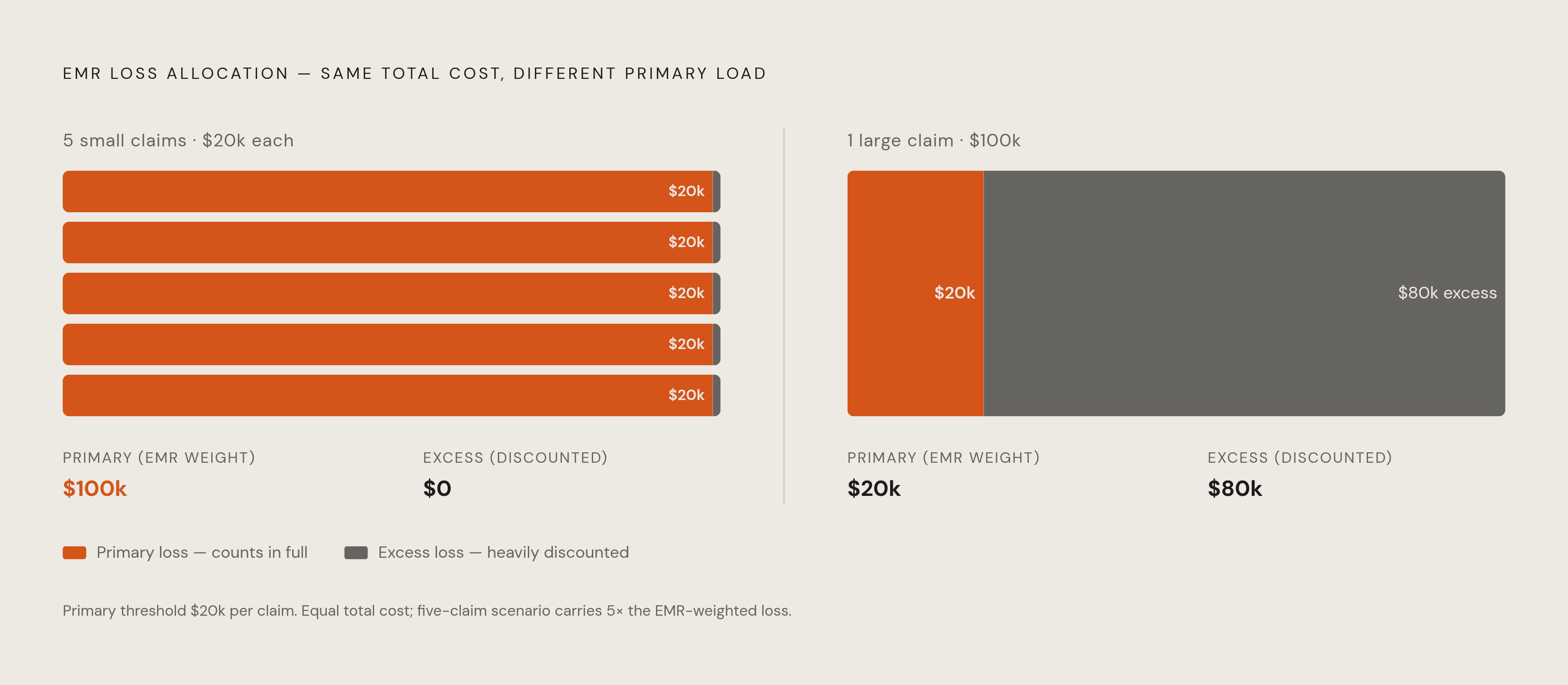
Because the primary portion of every claim counts in full and the excess portion gets discounted, five small claims damage an EMR more than one large claim adding up to the same total cost. Safety Evolution lays out the comparison directly: five moderate claims each contribute their full primary amount to the calculation, while a single large claim of equal total size has most of its dollar value pushed into the discounted excess bucket. Running the arithmetic shows the large claim, despite costing the same or more, does less damage to the mod than the string of small ones.
That's not an accident of formula design. NCCI treats frequent claims as a signal of systemic safety failure, and the formula is built to penalize that pattern harder than a single bad-luck incident. Associated Builders and Contractors of Wisconsin makes the same point in plainer terms: small, frequent claims indicate systemic safety issues, not isolated bad luck. A single catastrophic injury can look like an outlier.
For delivery fleets, the practical fallout lands squarely on the injury types nobody thinks twice about. Sprains, strains, minor vehicle accidents, and slip-and-falls during deliveries occur constantly in last-mile work and form the claims category that erodes an EMR fastest. A driver who tweaks a knee stepping off a curb generates a primary-loss claim that counts against the fleet in full. A driver who breaks a leg in a genuine accident generates a claim that, dollar for dollar, counts against the fleet less. That inverts the intuition most safety directors carry around: the incident that looks minor on an incident report is often the one doing the most damage to the rate. The entire safety strategy has to shift from bracing for catastrophic events toward stamping out the small, recurring stuff that never makes headlines but appears on every claims report.
How delivery operations amplify EMR exposure
Delivery work sets up the exact injury pattern the EMR formula punishes hardest, and it does that structurally, not because delivery operators run a sloppier shop than anyone else. The operational model itself, stop after stop, lift after lift, generates repeated low-severity exposure events at a rate that office-based or single-site contractors never see.
Classification code 7231, covering companies delivering small packages and items locally, including Amazon DSP operators and contract drivers for UPS and FedEx, carries a higher base rate than general trucking, and for a specific reason: the work involves frequent stops, repeated loading and unloading, residential navigation under time pressure, and constant exposure to pedestrians. Other delivery-related codes include 7230, covering retail store delivery, and 7380, covering drivers, chauffeurs, messengers, and their helpers on a commercial basis. Getting the code assignment right isn't a paperwork footnote. It sets the baseline rate before the EMR multiplier ever gets applied, so a misclassified fleet is paying the wrong starting price before the mod even enters the picture.
The injury log from an actual last-mile operation shows the pattern fast: back strains from lifting, slip-and-falls on icy driveways, minor vehicle accidents backing out of tight residential streets, the occasional dog bite. Every one of those is a small, frequent claim, and small, frequent claims are precisely what the EMR formula weighs most heavily.
Volume compounds the exposure. The 2026 Annual Gig Mobility Report found couriers logging significantly more hours than in recent years, with average quarterly work hours approaching levels last seen during the early pandemic surge. More hours on the road means more stops, more lifts, more chances for a minor injury, and more exposure events translate directly into higher claim frequency, which is the exact lever that drives EMR upward. Champion Risk frames the broader shift well: last-mile delivery has become the most complex and expensive part of the supply chain, moving from a straightforward trucking operation into a fragmented network of vans, independent contractors, and gig workers navigating residential streets. That fragmentation is precisely what makes the EMR math harder to manage. A fleet running standardized routes with employee drivers can control conditions in ways a network of independent contractors, each running different hours, different routes, different vehicles, simply cannot.
The real dollar range of what a high or low EMR costs a delivery operator at scale
The dollar impact of an EMR isn't a flat fee. It scales with payroll, so an operator who grows a contractor network without actively managing the mod isn't just holding a cost disadvantage steady, they're widening it every quarter the network expands. The formula for the actual premium is a straight multiplication: annual workers' comp premium equals base premium times EMR, and because that multiplier applies to the entire base premium, every dollar of underlying payroll exposure gets touched by it.
Running the same base payroll through a strong mod and a weak one produces a gap that is not subtle. Safety Evolution's modeling shows a poor mod applied to identical payroll can run close to double what a strong mod would cost on that same base, a swing that recurs every single year the rate stays in effect. Stretch that across the three-year window a given EMR reflects and the gap compounds significantly, so an operator sitting on an elevated mod isn't absorbing one bad year of cost, they're absorbing three.
Workers' comp is among the largest insurance expenses contractors face, and an elevated EMR can increase premiums by tens or hundreds of thousands of dollars annually on operations already running tight delivery margins. The wider market trend adds to the pressure: workers' comp rates rose a further 6% in 2026 across the industry, a moderate move relative to other insurance lines, but one that stacks directly on top of whatever EMR surcharge an operator is already carrying. A fleet with an elevated mod pays more than the surcharge alone suggests. It's paying 30% over a baseline that itself climbed 6% year over year, and those two numbers multiply rather than sit side by side.
How EMR gates contract access and bid eligibility
A high EMR doesn't just cost more. It gets an operator removed from consideration before anyone looks at price, service quality, or fleet size. That's a different kind of damage than a premium surcharge, because a surcharge is a cost an operator can absorb or price around. Disqualification is a door that closes before negotiation starts.
General contractors, owner-operators, and prequalification platforms routinely require subcontractors to submit their EMR as a bidding requirement, and Safety Evolution names ISNetworld, Avetta, and ComplyWorks as platforms where this is standard practice. The thresholds aren't soft guidelines. Most commercial and industrial work requires an EMR below 1.0, high-risk projects often demand below 0.85, and a mod above 1.25 frequently disqualifies a bidder outright, no exceptions. ABC of Wisconsin confirms the pattern from the contractor side: many general contractors and municipalities set the bar at 1.0 or lower, and some go stricter still, down to 0.90. A bid gets rejected at that stage before scope, pricing, or qualifications are even reviewed.
The construction-sector mechanics translate directly to delivery network contracting. For operators running delivery networks, the same gatekeeping occurs through 3PL contracts, DSP agreements, and platform partnerships: a poor safety record brings elevated scrutiny, tighter contract conditions, or exclusion from network participation. A low EMR does double duty as a reputational signal in that process. Clients read it as evidence the operator invests in training, hazard prevention, and accountability, which makes the number a stand-in for operational reliability in decisions where a client can't personally audit day-to-day safety practices.
Independent contractor classification and its intersection with workers' comp and EMR liability
For any operator running a network of independent contractors, the coverage architecture chosen, and whether it survives an audit, sets whether the EMR reflects real exposure or hides a bigger liability that appears later during a reclassification event. That's a distinct risk from anything discussed so far: it's about whether the claims being counted are the right ones in the first place, not about managing claims well.
The baseline split is straightforward on paper: W-2 drivers require workers' compensation coverage, while 1099 independent contractors typically fall outside the workers' comp mandate in most states. Occupational accident insurance fills part of that space for independent contractors, and it costs meaningfully less than workers' comp while typically covering medical expenses, certain lost wages, and death benefits up to the policy limit. A handful of states carve out their own rules on top of that baseline rather than leaving it purely to the federal default. California requires app-based transportation and delivery companies to carry occupational accident insurance, and Washington State extends workers' comp protection to rideshare and delivery drivers while they're actively working, both state-specific requirements rather than the national norm. California backs its rule with real teeth: penalties for operating without proper workers' comp coverage can reach $30,000 for repeat violations under 2026 legislation.
Getting the classification wrong, whether through an incorrect class code or treating an employee as a contractor, triggers premium adjustments and penalties when an audit catches it, and if workers get reclassified as employees after the fact, the entire uncovered claims period becomes the operator's direct financial exposure. The regulatory ground under classification keeps moving, too. The DOL issued a new Notice of Proposed Rulemaking on employee or independent contractor status under the FLSA, FMLA, and MSPA on February 26, 2026, marking the third governing test change in under three years. California's AB5 keeps its own strict classification rules in force, and New York's Freelance Isn't Free Act adds strict contract and payment requirements on top. Misclassification risk builds gradually as operational patterns start to resemble employment: fixed schedules, assigned internal tasks, close supervision, all the things delivery pressure tends to introduce without anyone intending to blur the line.
The coverage gap in occupational accident insurance
Occupational accident insurance costs less than workers' comp, but it doesn't cover everything, and the gaps it leaves behind matter for how an operator thinks about the EMR long-term. Treating occ/acc as a full substitute rather than one tool among several is how uncovered exposure builds quietly until it turns into a claim nobody budgeted for.
Occ/acc policies typically apply only during active deliveries. The drive between platforms, off-app time, and anything outside the specific covered task falls outside the policy, and that gap is where uncovered claims originate. The scale of the problem isn't hypothetical: roughly one in four gig workers carries no insurance coverage at all, a figure that says the coverage gap is the current operating reality across a large share of the IC delivery workforce, not an edge case. Because occ/acc is optional in most states, operators who skip it leave contractors without any financial backstop for a work-related injury, a decision with ethical weight as well as financial exposure attached to it.
Roughly one in four gig workers is uninsured, and coverage gaps are the current operational reality across much of the IC delivery workforce rather than a theoretical risk. It argues for running it with better visibility than most operators currently have. Delivery networks generate exactly the high-frequency, low-severity claims the EMR formula penalizes hardest, precisely because the operational model, frequent stops, tight windows, residential navigation, repeated loading, produces constant small exposure events across hundreds of contractors at once. Catching those patterns before they accumulate into a surcharge requires real-time visibility into safety trends across the whole network instead of a quarterly claims report reviewed after the damage is already locked into the three-year window. Contractor workforce management platforms built for this problem give operators ongoing monitoring and compliance tracking that surfaces emerging safety issues while there's still time to correct course, before the EMR recalculates against a fleet's worse-than-expected quarter. GigSafe, for instance, is a 1099 workforce operations platform purpose-built for delivery companies that includes real-time compliance monitoring across contractor networks. The mod rewards operators who catch the pattern early, and it's built specifically to penalize the ones who only find out at renewal.
Sources
- Experience Modification Rate: EMR Explained
- Workers' Comp for Delivery Service: Costs & Requirements
- Understanding the Experience Modification Rate (EMR) and Its Impact on Construction Contractors - Associated Builders and Contractors | ABC of WI
- Construction Insurance Costs Surge 22% in 2026: Control Premiums | Buildermuse