Automating 1099 Driver Onboarding Workflows to Cut Processing Time From Weeks to Days
Automation collapses five sequential onboarding stages into parallel workflows.
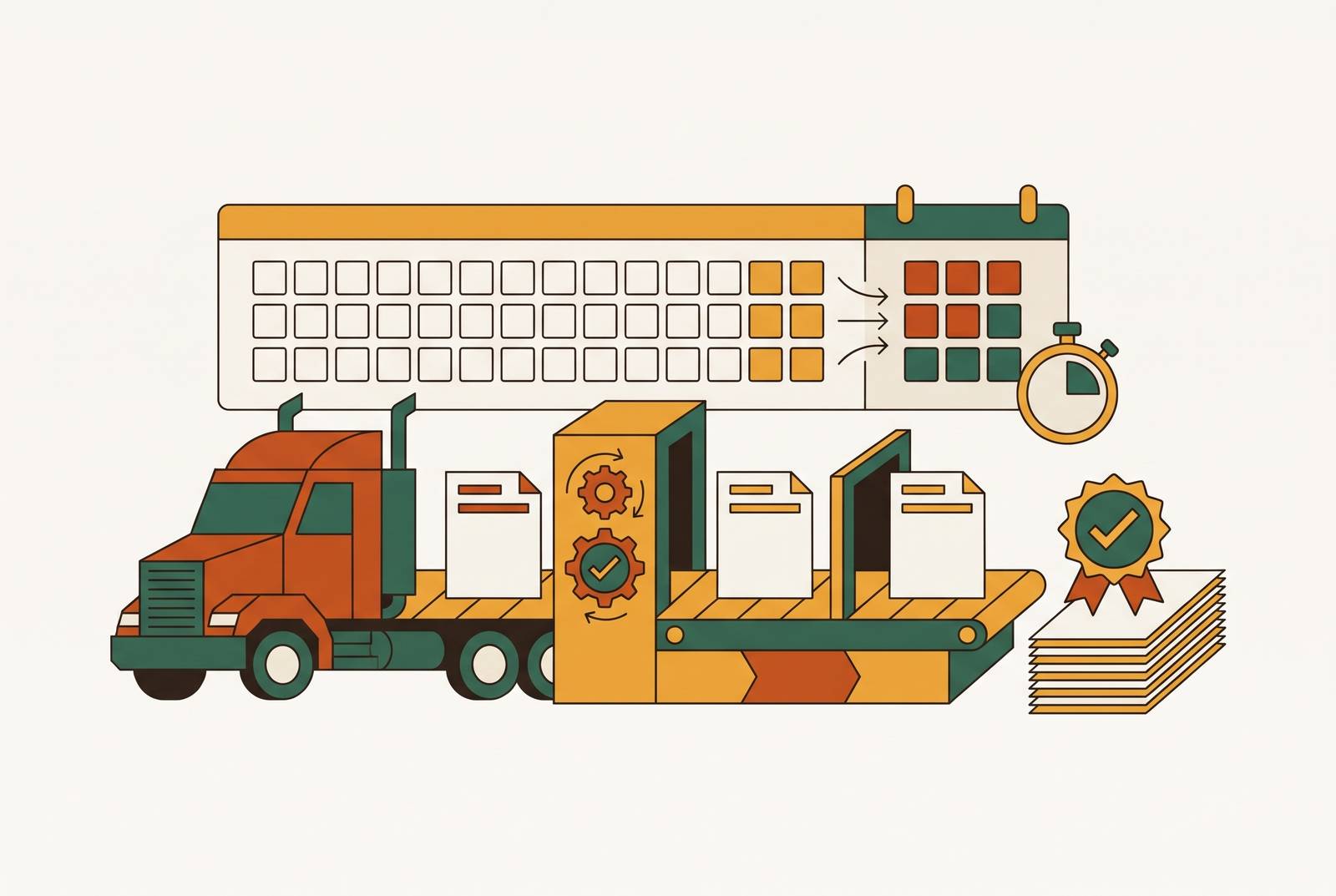
Automating 1099 driver onboarding cuts processing time from weeks to days when it removes the waits between steps. For last-mile delivery operators, the strongest approach connects intake-stage TIN verification, parallel screening and credential tracking, insurance enrollment, and automated payments. That connected workflow lets operators activate drivers at scale without making every new contractor another round of administrative handoffs.
Why manual 1099 driver onboarding creates a structural bottleneck, not just a paperwork delay
A delivery operator has drivers ready to start, but their records are scattered across email, spreadsheets, and screening systems. Someone must get the missing information before someone else can order a check. Another person must check the result before training can go ahead. The queue advances only when each handoff happens. Faster typing does not fix that design.
The U.S. last-mile delivery market handled 22.37 billion shipments in 2024, and gig workers make a large share of last-mile deliveries around the world. Contractor intake is therefore a continuous process that leaves no seasonal pause for the back office to catch up. Manual workflows struggle because each new applicant enters the same chain of dependencies. Data collection, validation, and credentialing are individually manageable, but arranging them in series makes their waiting periods accumulate.
The five stages of a manual 1099 driver onboarding workflow and where each one stalls
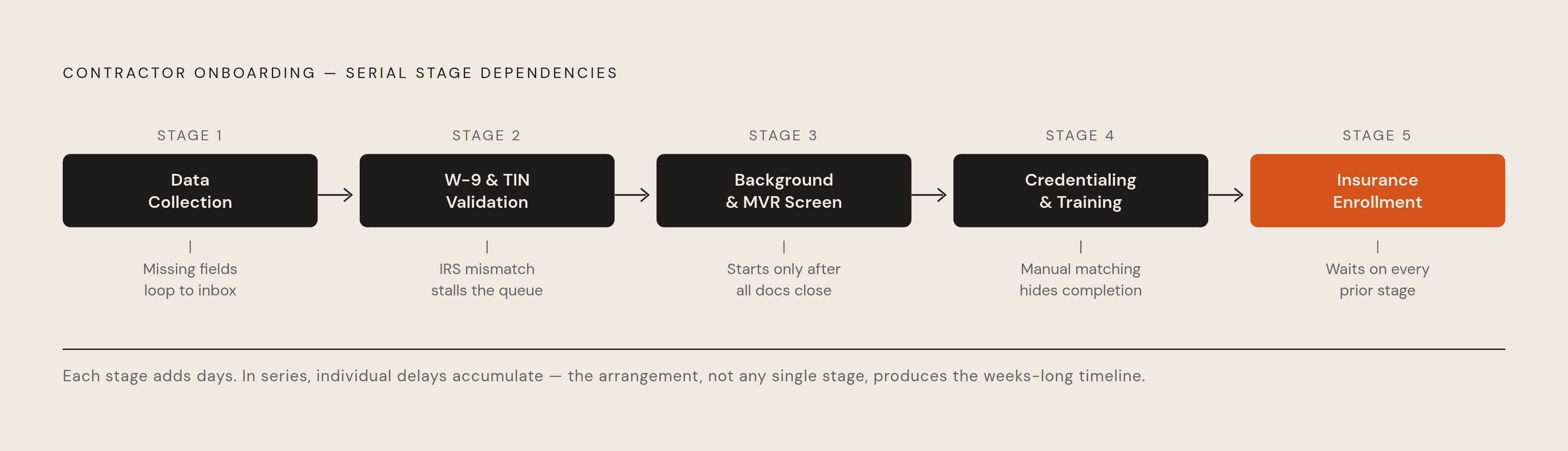
The first stage is data collection, including the contractor’s name, TIN, address, and payment details. With email and paper, staff must ask for missing fields to be filled in, then match the replies to what is in their spreadsheets. A small omission becomes another trip through the inbox. When hundreds of people apply at once, those trips take up a lot of processing time.
The second stage is W-9 collection and TIN validation. Routable notes that missing or outdated W-9 forms create bottlenecks when payees change their information or business structure. Manual validation also pushes error detection downstream. A TIN mismatch found at filing can trigger an IRS B-notice, requiring renewed W-9 collection, corrected filings, and staff attention long after the driver entered the network.
The third stage is background and motor vehicle record screening. Checks must be ordered, returned, and reviewed before clearance, so starting them only after all document collection ends adds business days. The fourth stage is credentialing and training confirmation, including required defensive driving, safety certifications, and platform-specific modules. Missing completion records can leave an otherwise ready driver waiting. When staff track records by hand, it is hard to tell work that is unfinished from work that is done but has not been recorded.
The fifth stage is insurance enrollment, when staff confirm that occupational accident coverage is in place before work begins. When staff handle enrollment separately from the information already collected, another handoff enters the schedule. None of these stages is inherently unmanageable. In sequence, however, their individual delays produce the weeks-long timeline operators experience as “onboarding.”
What changes when data collection and TIN validation move to intake
Collecting the W-9 and verifying the TIN at first engagement removes a major source of later rework. Instead of chasing documents near a filing deadline, an automated intake process requests them at first payment authorization, parses and archives submitted forms, and flags missing or mismatched TINs before work clearance. The discrepancy stays close to its source. Staff can resolve it while establishing the relationship.
Routable recommends collecting W-8/W-9 forms during vendor onboarding to avoid missing tax documents at filing deadlines. Intake becomes a defined entry point where required information is collected and checked before the first payment. A mismatch corrected there requires a follow-up request, rather than the re-solicitation, corrected filings, and CP2100 responses associated with a later B-notice.
This changes the rhythm of the work. Continuous contractor intake needs continuous verification. A contractor onboarded in July should have a verified TIN on file by July, ahead of the following January. Moving that check upstream also lets the rest of the workflow use the same intake information without waiting for a separate tax-document exercise.
How parallel processing and automated credential tracking speed up new delivery driver onboarding
Parallel processing does more to cut the time it takes than faster form handling does. Once the necessary intake data is submitted and validated, background and MVR checks can begin while W-9 processing proceeds. Training assignment and insurance preparation can also move forward where their actual prerequisites allow. The distinction is between a necessary clearance requirement and a waiting period inherited from a manual process.
That distinction preserves safeguards while removing idle time. Someone still needs to review background results and confirm that required training is done before a driver can take a route. Insurance enrollment can be prepared within the workflow and triggered when background and credentialing requirements clear. Parallel preparation lets the operator stop treating every administrative task as a reason to postpone all the others.
Automated credential tracking then replaces repeated manual record checks with current information about module completion, license expiry, and certification status. For hundreds or thousands of drivers, discovering a missing credential during route assignment is an operational problem as well as a liability concern. Real-time status shows that missing credential sooner. It does not, however, establish that the driver is properly classified as an independent contractor, because accurate paperwork and the actual working relationship remain separate questions.
Why insurance enrollment belongs inside the onboarding workflow, not after it
Insurance belongs before activation. If a driver is cleared to work before coverage is enrolled, the workflow creates an active-but-uninsured interval. High turnover repeats that interval across the contractor pool.
California’s Prop 22 requires app-based delivery companies to carry occupational accident insurance for their contractors. The California Supreme Court upheld it as constitutional in July 2024 in Castellanos v. State of California. That is a jurisdiction-specific requirement. It is nevertheless a leading indicator of why coverage cannot be treated as an optional postscript to activation.
Integrating enrollment into onboarding allows coverage to be triggered when the contractor clears background and credentialing requirements. It also creates a documented enrollment record for an audit. Buying occupational accident and commercial auto insurance in bulk through an operator’s platform can cost less for each contractor than buying policies on their own. Affordability supports continuity, while fast pay reduces the cash-flow pressure that can make a renewal premium the easiest bill to postpone. Coverage needs a place in both the activation process and the ongoing economics of driving.
How automated payments close the onboarding loop and keep contractors active
A driver who clears onboarding but waits days for payment has reached a relocated bottleneck. Manual reconciliation still requires someone to match delivery records to payment amounts, calculate deductions, and issue disbursements. Automating those steps connects the first completed route to the first payment. Activation alone is not the finish line.
Fast payment options serve different operating needs. Same Day ACH offers three settlement windows per business day, while RTP and FedNow operate around the clock. Instant debit is another way to pay contractors quickly. The payment process needs to move promptly after completed work without waiting for staff to assemble the next batch manually.
A contractor who is paid the same day a delivery is done has less cash-flow pressure when it is time to pay for insurance renewals or credentials, helping them stay current. Payment automation also produces the records needed for year-end 1099-NEC filing from the first disbursement. The loop closes when intake, clearance, coverage, completed work, and payment records feed one another instead of becoming separate reconciliation projects.
Why automation does not eliminate misclassification risk and what operators must do alongside it
Automation can make a contractor file complete without making the contractor relationship lawful. A 1099-NEC, a master services agreement, and the absence of employee benefits support an operator’s position, but do not automatically establish independent-contractor status. Agencies and courts examine how the relationship works in practice. Relevant questions include who controls the work, who bears financial risk, whether the relationship is permanent, and whether the worker operates an independent business.
California explicitly distinguishes contractual labels from actual contractor status. An operator that controls schedules, mandates equipment, or treats the relationship as permanent cannot resolve those questions by collecting documents faster. The lesson for operators is to pair paperwork automation with human review of the working relationship.
The regulatory landscape also requires care. The Department of Labor issued a proposed rule on February 26, 2026, to replace the 2024 independent-contractor rule with an analysis similar to the 2021 rule. The comment period closed April 28, 2026, and no final rule had issued as of August 3, 2026. The Wage and Hour Division said it would not apply the 2024 analysis in its own FLSA investigations, although that rule remained in effect for private litigation.
Lyft’s September 2025 payment of $19.4 million to New Jersey to resolve misclassification challenges demonstrates that exposure is not confined to small operators. Separately, the One Big Beautiful Bill Act raises the 1099-NEC filing threshold substantially for payments made in 2026, but does not remove tax-tracking obligations or change the underlying classification question. Operators need continuous, real-time monitoring of contractor relationships, rather than treating classification as a decision completed once during setup.
Building an end-to-end automated onboarding stack at scale
A complete pipeline begins with an intake portal that collects contractor information and the W-9 at first engagement. TIN verification flags mismatches before clearance, while background and MVR checks proceed in parallel with W-9 processing once the necessary intake information is validated. Background clearance can trigger credentialing and training assignment, followed by insurance enrollment on credentialing confirmation. Payment infrastructure is then available for the first completed route. Each step uses information already collected, so another person does not have to move it.
The gain comes from connecting the stages. Digitizing forms alone leaves most of the handoffs intact, while isolated screening or payment tools can still require staff to bridge systems. An integrated suite covering onboarding, compliance monitoring, credentialing, insurance, and payments reduces re-entry and makes gaps visible in real time. For operators evaluating technology, the useful criteria are therefore shared intake data, parallel processing, current credential status, integrated coverage, and payment-to-filing continuity. How many modules there are tells operators less than whether those functions share the information they need.
Routable notes that automated discrepancy checks can flag differences between payment records and tax forms before filing. Filing becomes a review task. That benefit depends on the quality of the records entering the system, however, because incomplete or inaccurate contractor data produces exceptions during the first processing cycle. Operators should audit existing records before configuration rather than expecting automation to repair them by itself.
At scale, the implementation test is whether a contractor can move from first engagement to paid work without staff repeatedly transferring the same information. Partial automation may speed up one desk while leaving the next queue untouched. A connected pipeline cuts out waits that serve no purpose and keeps the checks that show whether a driver is ready. Administrative attention is reserved for exceptions and judgment.