Contractor Retention Strategies in Last-Mile Delivery
Honest job ads and fast pay cut last-mile driver turnover.

When a delivery operator loses drivers faster than it can replace them, the instinct is to post more job ads, raise the referral bonus, and call the staffing agency again. Brad Clements, who runs Falcon Express, found something different when he dug into why drivers were leaving: the ad itself was setting people up to quit. Jobs were being sold on pay and flexibility that didn't match the actual shift, the actual route, or the actual difficulty of the work, and new hires were discovering the gap within days. That gap, not a shortage of willing workers, was driving the exits. Turnover of this kind costs an operator more than the price of a new hire: Spectra360's last-mile staffing analysis found that high turnover slows route times, stretches out onboarding cycles company-wide, and makes the customer experience less consistent delivery to delivery. A tight labor market makes all of this worse, but a bigger candidate pool wouldn't fix a problem that starts after someone is already hired. The fix is infrastructure: the onboarding sequence, the pay rails, the compliance process, the insurance stack. Each one is a system an operator builds or fails to build, and each failure appears later as a driver who simply stops logging in.
The first 90 days and contractor retention
Most attrition in last-mile networks gets decided in the first three months, often in the first three weeks, and the decision gets made quietly. Spoke's retention research places the start of retention before day one, arguing that the real work happens in how candidates get filtered, what they're told to expect, and whether the job they accepted matches the job they actually do. A contractor who fills out paperwork, sits through an orientation video, and then waits several days to get a route or a first paycheck has already been handed a reason to check what else is out there.
Clements built his "front-loading retention" method at Falcon Express around this exact window. The job ad gets written to match reality: real pay, real hours, real difficulty, no softened language. Automation screens every candidate before a recruiter spends time on them, so pre-employment filters can disqualify more than half the applicant pool before anyone sits down for an interview. That sounds brutal until you notice what it buys: an operator who only onboards people who actually fit the role stops burning time and goodwill on people who were never going to stay past week two. If a job ad overpromises, you get fewer complaints up front but more resignations later. An accurate ad draws a smaller crowd, but the people who show up are the ones likely to stick.
Spectra360's analysis backs the same point from a different angle: a structured onboarding process, one that teaches routes, tools, and expectations before a driver's first shift, reduces early turnover directly. Confidence built during onboarding carries forward into daily performance. But the sequencing matters as much as the content. The real failure point tends to sit between identity verification and first payment: a contractor who has cleared every check and still waits days for a route assignment or a paycheck has learned something about the operator before the operator has said a word. Onboarding is the first piece of evidence a contractor gets about how the whole operation runs.
Pay speed as a loyalty signal
Contractors read pay speed as a message, not a mechanic. When a driver finishes a route and sees funds the same day, they conclude the operator is organized and paying attention. A driver who waits four or five business days for standard ACH to clear draws the opposite conclusion, whether or not it's fair: that the operator is slow, indifferent, or simply hasn't bothered to fix it. The gap between instant debit or same-day ACH and standard multi-day ACH is a decision about what the payment infrastructure is built to support, made long before any contractor gets paid, not just about what it costs the operator to run.
That decision matters more because most contractors in last-mile delivery don't work one platform exclusively. When routes and rates are comparable across operators, pay speed becomes one of the clearest tiebreakers a contractor has. If a network runs in the hundreds or thousands, you can't fix this at the payroll desk with good intentions. API-driven payment rails let you run a disbursement process at scale, so no one has to manually push every transaction through.
The strongest version of this ties directly back to onboarding. Contractor onboarding software that runs KYC checks and stores payment credentials in the same workflow can release funds the moment approval clears, collapsing the space between "you're approved" and "you've been paid" down to nothing. A contractor who finishes their first route and gets paid before the day is out hasn't just received a nice bonus. They've seen direct proof that the operator's systems work, and that lands harder than any onboarding speech.
What tenure-based incentives can do that flat bonuses cannot
A flat bonus buys one good month. It doesn't buy a second one, because once the money lands, the incentive disappears with it. Tenure-based pay progression works differently: it gives a contractor a reason to still be driving six months from now that gets stronger, not weaker, the longer they stay.
Falcon Express runs its DSP drivers on exactly this structure. Drivers who hit performance metrics get a pay bump every three to six months, with the raise tied to tenure itself rather than a great week, while Amazon's performance standards function as a pass/fail gate.
That distinction matters more in independent contractor networks than it would in a traditional W-2 workforce, because contract workers don't accrue health insurance, dental coverage, or paid time off the way employees do. Tenure-based pay progression fills a role that benefit accumulation plays elsewhere: it gives time on the job a dollar value it wouldn't otherwise have. Clements pairs this with a referral program built on a simple operational observation: good drivers tend to know other good drivers. The referral flywheel cuts recruiting costs and improves hire quality in the same motion, and it works precisely because it's attached to a retention system that was already giving tenured drivers a reason to stick around and vouch for the job.
Technology friction and untraced departures
An operator who loses a 24-year-old driver to a competitor rarely writes "the app was bad" on the exit interview. The driver cites pay or hours, and the operator never traces the departure back to the clipboard, the paper manifest, or the dispatch system that still runs like it's decades out of date. Global Trade Magazine's analysis found that younger drivers and technicians are rejecting paper-based workflows and outdated tools, and they want mobile-first, AI-enabled systems that guide the work and make the job feel current.
The baseline Gen Z contractors expect isn't exotic: real-time location-enabled mobile apps that help execute the route, flag disruptions as they happen, and capture proof-of-delivery electronically and instantly. None of that is a stretch goal. It's table stakes that a surprising number of operators still haven't met, and every day that gap persists, it's quietly pricing out a chunk of the labor pool before a single wage conversation happens.
Spectra360's staffing analysis points to the operational upside of closing that gap: modern dispatch platforms track driver availability in real time, surface coverage gaps before a shift even starts, and match drivers to routes based on location and capacity. The benefit runs both directions. Better tools give the operator more visibility, but they also give the contractor a smoother day, and a smoother day is one more reason not to look elsewhere.
Flexible scheduling, route predictability, and absenteeism
Absenteeism rarely comes out of nowhere. It's usually the warning shot before a resignation, and it's caused by the same structural failures that eventually push someone out the door entirely: schedules that shift without warning, routes that change contractor to contractor, communication that only flows one direction. Spectra360's research found that giving drivers more control over their own schedules cuts absenteeism and improves retention over the long run, but how many operators actually build scheduling systems flexible enough to deliver it?
Independent contractor networks carry a built-in tension here. Some drivers want a steady Monday-to-Friday block they can plan a life around. Others want gig-style flexibility, picking up shifts when it suits them and skipping weeks when it doesn't. Spoke's analysis suggests the answer isn't choosing one model over the other. It offers both, because if you force every contractor into a single structure, you push out whichever half doesn't fit it.
Spectra360 frames the practical version of this as a hybrid workforce: a core of full-time staff who hold onto route knowledge and provide stability, supplemented by flexible workers who absorb demand spikes without overloading the stable core. The stable layer keeps institutional memory intact. The flexible layer keeps the network from snapping under peak-season volume. Neither piece does the other's job, and an operator who only builds one half is solving half the problem.
What compliance clarity does for contractor trust
A contractor who doesn't know their own classification status, isn't sure what insurance actually covers them, or has no clear idea what documentation they're on the hook for is a contractor operating with a low-grade sense of exposure at all times. That feeling doesn't stay quiet. If a contractor suspects the operator has left them legally or financially unprotected, they start looking for an exit before anything goes wrong.
Misclassification sits at the center of the legal risk in any IC network. The IRS doesn't look at what the contract says. It looks at the actual relationship: behavioral control, financial control, and the nature of how the two parties deal with each other day to day. Mandating set work hours, demanding weekly reports, or paying by the hour without a defined scope of work are the specific habits that turn a contractor relationship into something that looks, on paper, like employment.
The rules themselves keep moving. The One Big Beautiful Bill Act, signed into law in July 2025, raised the 1099-NEC information reporting floor to $2,000 for payments made on or after January 1, 2026. But payments made in 2025, reported in early 2026, still fall under the old, lower threshold. Operators are running two different reporting rules across a single tax season. If a large share of a network's contractors earn under $2,000 from a single payer, operators need to rebuild their compliance workflow around that split-year rule, because one threshold can't apply cleanly.
Compliance clarity, in practice, looks unglamorous: written agreements for every independent contractor, classification reviews run annually, verified licenses and tax IDs on file, and HR and legal staff trained on current regulatory criteria. Each of these is a standing responsibility, and skipping any one of them creates exposure for the company and the contractor at the same time. When an annual review catches a lapsed credential or an outdated classification, months of exposure have already piled up before anyone noticed. Real-time monitoring, not a once-a-year audit, is the only posture that catches the problem while it's still small.
Insurance coverage gaps and contractor confidence
A contractor finds out their coverage has a hole in it at the worst possible moment: after the accident, when the claim gets denied. Personal auto insurance policies exclude commercial delivery use as a matter of course, and that exclusion lands on the contractor, not the platform, the moment they file a claim. It's a structural gap that occurs exactly when the contractor can least afford it, a fine-print technicality nobody could have anticipated, and it tends to be the kind of experience a driver doesn't come back from, and doesn't keep quiet about either.
Occupational accident insurance is built for this exact scenario: it covers a properly classified IC's medical expenses, disability income, and accidental death and dismemberment up to defined policy limits. Pricing can run per active dispatch period, so the operator only pays premium while a contractor is actually on a task, but a flat monthly premium per driver is the more common arrangement across the industry. Either way, OAI is one piece of a larger stack. Commercial auto liability, cargo insurance, and commercial general liability round out the four layers a last-mile operator needs running at once. None of the four covers for the others, and skipping any one of them leaves a gap that stays invisible right up until an incident forces it into the open.
Operators who buy this coverage in bulk and extend it to their contractor network, rather than leaving each driver to shop for their own policy, are handing over something concrete and visible on a daily basis. It's a benefit a competitor without that same infrastructure can't just announce and match overnight. It also sets up the next move: insurance, like onboarding and pay, works best when it isn't managed as a separate task bolted onto the side of the business.
Integrating onboarding, compliance, pay, and insurance into a retention advantage
Each piece covered so far, onboarding, pay speed, tenure incentives, technology, scheduling, compliance, insurance, works on its own. Retention breaks down when operators manage these as separate departments running separate checklists, because the gaps between the systems are exactly where contractor confidence leaks out: the lag between approval and first paycheck, the credential that quietly expires between one audit and the next, and the insurance coverage a dispatcher can't confirm on the spot.
If onboarding software handles KYC checks, stores payment credentials, and runs compliance checks within a single workflow, it can release funds the instant approval clears, closing the most common gap in a contractor's first week. Risk-assessment questionnaires and tax checks built directly into that same onboarding flow catch misclassification risk at the point someone gets engaged, not months later at an audit, which makes it a systems decision rather than a job for the legal department to clean up after the fact. Real-time monitoring of credential validity, insurance status, and classification indicators catches problems while they're still small, so it protects the business and the contractor at the same time.
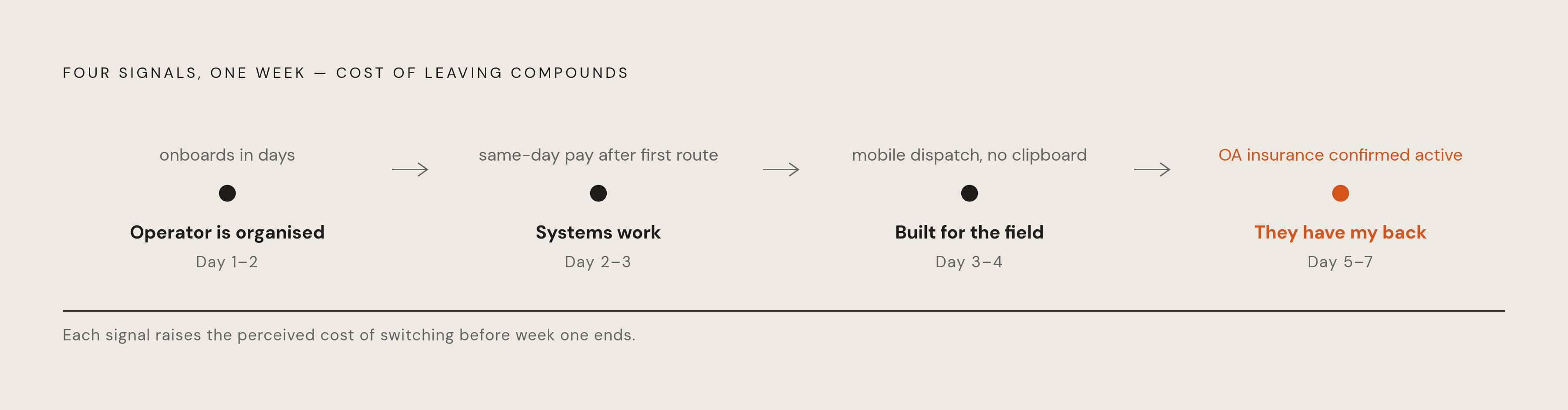
A contractor who onboards in days instead of weeks, gets paid same-day after the first route, works with a dispatch tool built for a phone rather than a clipboard, and knows their OAI coverage is active has picked up four separate signals of operator competence before finishing their first week on the job. Each signal raises the cost of walking away to a competitor. Spoke's retention research describes this as a flywheel: each stage of the driver's experience reinforces the next, so a sound structure early in the relationship compounds into loyalty that's genuinely hard for a rival operator to dislodge.
None of this scales through good intentions or a more motivated HR team. A company running contractor numbers in the hundreds can't deliver fast onboarding, instant pay, active monitoring, and verified coverage by hand, consistently, across every driver, every week. Automation is the only way to deliver it at that scale. The operators who build it first are building a structural advantage that gets harder for competitors to copy as the network grows each month.