Fleet Vehicle Requirements for IC Delivery Contractors
Contractors must navigate federal rules, insurer requirements.

A cargo van can pass its annual DOT inspection, carry a current USDOT number on both doors, and still get turned away at a FedEx Ground facility because it lacks blind spot detection. Nothing about that van is illegal. It just isn't welcome. That gap between "legal" and "eligible" is the whole story of fleet compliance for independent contractor delivery operators, and it exists because three separate authorities write three separate rulebooks: federal regulators set the floor, insurers set their own underwriting bar above it, and client carrier networks layer contractual standards on top of both. Contractors who treat these as one unified checklist get blindsided when a van that satisfies the government fails the insurer, or satisfies the insurer and fails the carrier's technology standard. The requirements flow downhill, from carrier to ISP to the contractor behind the wheel, and whoever sits at the bottom of that chain pays for the truck, the training, and the compliance paperwork while the carrier at the top writes the terms.
Federal Vehicle Requirements: GVWR Thresholds and the Compliance Stack
Federal rules do not apply evenly across a delivery fleet. They switch on at specific gross vehicle weight rating thresholds, and which side of a threshold a given van or truck falls on decides how much federal paperwork follows it around. A standard cargo van or most step vans sit under the GVWR line that defines a commercial motor vehicle, and for those, a state driver's license is the only federal requirement. FMCSA rules simply don't reach them.
But if you cross that GVWR threshold while running interstate commerce, the vehicle becomes a commercial motor vehicle under 49 CFR 390.5. That reclassification brings a medical examiner's certificate, a driver qualification file, hours-of-service limits, and a minimum driver age of 21 for interstate work. Past the weight that triggers a CDL requirement, the stack grows again: a Class B CDL, enrollment in the Drug and Alcohol Clearinghouse, a drug testing program, and motor vehicle record checks that follow a two-part rhythm, a three-year look-back at hire under §391.23 and an annual review after that under §391.25. These are two distinct checks, not one combined requirement, and treating them as interchangeable is an easy way to miss a renewal.
Every CMV running interstate, including anything at or above that commercial motor vehicle weight threshold, hazmat-placarded vehicles, and certain passenger vehicles, needs a periodic inspection at least once every 12 months under 49 CFR §396.17. Vehicle marking rules under §390.21 require the USDOT number on both sides of the vehicle, legible from 50 feet in daylight, in a color that contrasts with the paint. MC numbers no longer need to appear anywhere; they were eliminated as of October 1, 2025. Carriers aren't required to scrape old MC markings off existing trucks, but the USDOT number has to be there and has to be readable.
Emergency equipment rules under §393.95 require a fire extinguisher, with a higher UL B:C rating demanded for hazmat placarded loads than for standard vehicles, plus warning devices for roadside breakdowns. As of March 23, 2026 (91 FR 7867), that warning device list shrank to two options: three bidirectional reflective triangles, or six fusees. Liquid-burning flares are gone.
A handful of other 2026 rule changes sit on top of this structure without rewriting it. Non-domiciled CDL eligibility narrowed to H-2A, H-2B, and E-2 status holders effective March 16, 2026 (91 FR 7044), so any operator running non-domiciled CDL drivers needs to re-check visa category and credential expiry dates. A rule effective March 23, 2026 (91 FR 7893) made electronic DVIRs explicit, but paper DVIRs are still acceptable, so you don't have to force a switch. The spare fuse requirement disappeared effective April 20, 2026 (91 FR 7877), so you need to update pre-trip inspection checklists to match. The ELD operator's manual no longer has to live in the cab as of July 22, 2026 (91 FR 37050). And the registration system used to track motor carriers, Motus, replaced the old URS system in phases, with Phase II going live May 14, 2026 and URS now offline, so operators need to confirm their USDOT profiles migrated correctly and keep up with the biennial filing cycle.
What insurers require beyond DOT minimums
DOT sets a floor. Insurers set a bar that sits well above it, and the distance between the two is where a lot of IC contractors discover, usually at the worst possible moment, that they're underinsured. A full insurance stack for a last-mile IC operator runs four distinct products deep: commercial auto liability, cargo insurance covering goods in transit, general liability covering third-party property damage and injury unrelated to vehicle operation, and occupational accident insurance covering the contractor's own work-related injuries, medical expenses, disability income, and accidental death and dismemberment up to a set policy limit. None of these four substitutes for another. Each one covers a separate exposure, and client carrier networks usually want all four in place before a contractor gets anywhere near a route.
If you do delivery work or drive for hire, your personal auto policy almost always excludes coverage for those accidents. A contractor running deliveries on a personal policy isn't saving money, they're running naked, and so is the platform dispatching them, the moment a claim comes in.
Occupational accident insurance and workers' compensation differ in ways that matter as much operationally as they do legally. Workers' comp was built for W-2 employees. It carries unlimited medical benefits, and extending that kind of benefit to someone classified as an independent contractor can look, to a regulator or a plaintiff's attorney, like an admission that the relationship is really employment. That's the exact fact pattern misclassification suits are built on. OAI covers the same basic territory, medical expenses, disability income, accidental death and dismemberment, but up to a defined limit rather than open-ended, and it runs meaningfully cheaper than comparable workers' comp coverage. Pay-as-you-go OAI is priced against active dispatch periods, not hours of availability, so when dispatch volume varies, networks get a direct cost advantage over flat-rate coverage.
California offers the clearest working model of what a structured OAI program looks like. Prop 22 requires app-based transportation and delivery companies that operate there to carry occupational accident coverage for contractors, and the California Supreme Court upheld that requirement in Castellanos v. State of California in July 2024. A fourth, underused layer of coverage sits alongside these four: contingent liability coverage, which protects the platform itself by funding a legal defense if a contractor files for workers' compensation benefits on the theory that they were actually an employee. Most IC network operators skip it, which is a gap worth closing given how often misclassification claims arrive exactly in that form.
Client Carrier Networks: A Third Layer of Vehicle Requirements
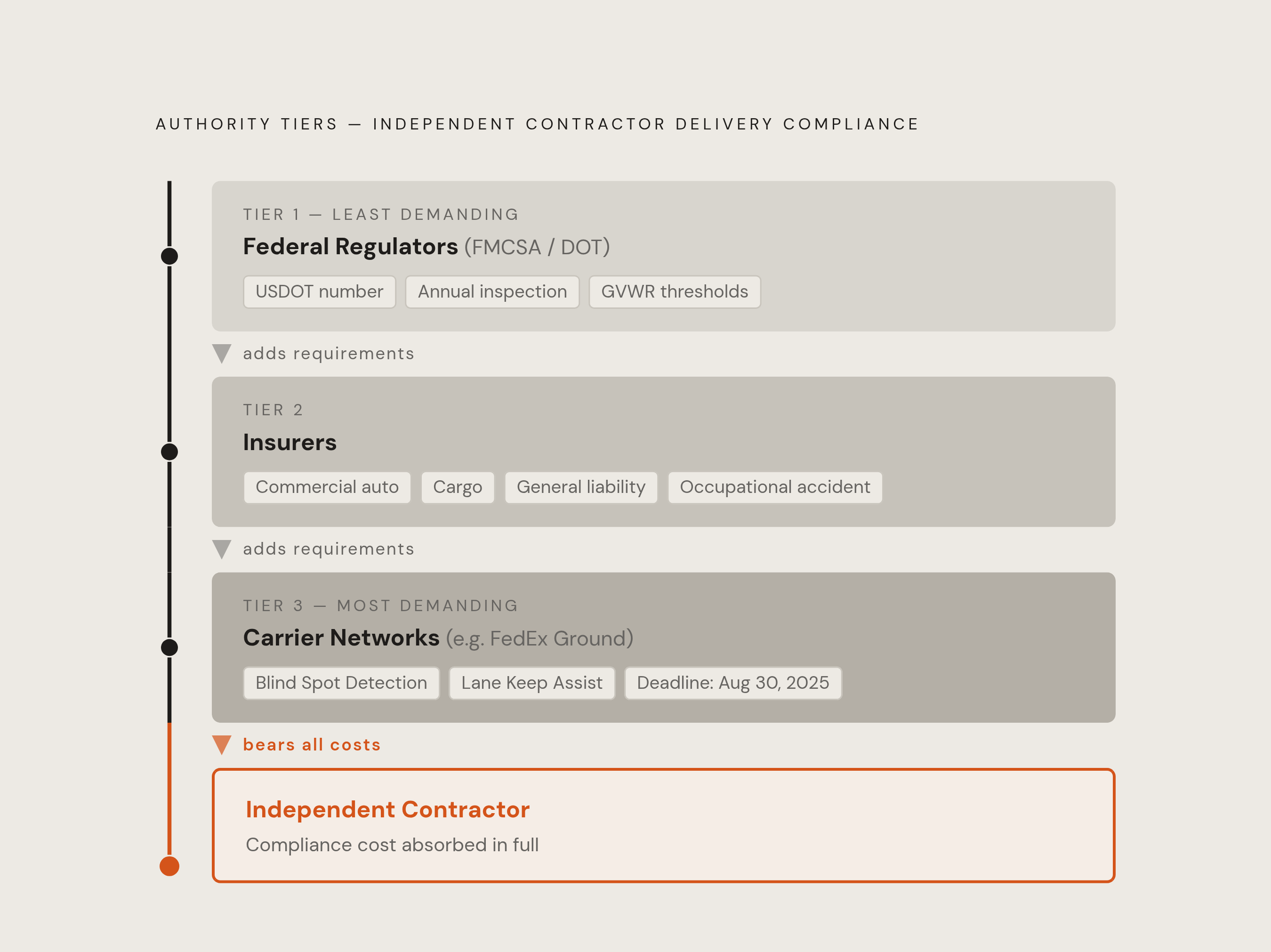
Carrier networks write the most demanding rulebook of the three, and because their requirements flow down contractually from the carrier to the ISP to the contractor, it's the contractor who buys the truck, installs the hardware, and sits for the training, while the carrier decides what's required.
FedEx Ground is the clearest, most dated example. Its TSP safety technology requirements took effect August 30, 2025, and any tractor newly added to Schedule B of the Operating Agreement now has to include Blind Spot Detection and Lane Keep Assist. For anyone buying or selling a FedEx route, this is a real capital question: a recently added truck may or may not already meet the standard, and finding out after the purchase is an expensive way to learn. FedEx also added a one-week pre-approval class that new contractor candidates have to complete before their stand-up date, stretching the onboarding timeline well past the standard approval window.
J.B. Hunt's Final Mile Services runs a parallel but distinct set of requirements: IC carriers have to show up with a properly sized truck, dollies, and installation tools for home deliveries, carry insurance that meets or exceeds DOT minimums, and complete account-specific training before touching a route. That training isn't uniform. It changes from account to account, so a contractor moving between J.B. Hunt accounts can face a different training load without any change in the underlying federal rules.
The pattern holds across the industry: equipment specs, vehicle features, and training content are set by the carrier network, not the regulator. So when a contractor switches carrier relationships, they can end up facing an entirely different compliance stack while federal law hasn't moved an inch.
California's ABC Test and Vehicle Control Requirements as Misclassification Liability
A carrier writes every vehicle requirement, from equipment specs to model-year limits to mandatory safety technology, so it can manage risk and liability. It can also read, to a regulator, as evidence of employment control. That tension sits at the center of how IC delivery networks operate, and it doesn't resolve itself just because the contract says "independent contractor" on the first page.
California's ABC test starts from a presumption that a worker is an employee, and the burden sits with the operator to establish all three prongs of the test, not just the one that happens to be easiest to argue. The "B" prong is where trucking operations run into the most trouble: it asks whether the contractor performs work outside the usual course of the hiring entity's business. Auditors examining that question look at who owns, leases, maintains, and specifies the equipment; who negotiates rates and decides which jobs to take; whether the contractor presents as an independent business to customers; and who actually controls dispatch, routing, timing, and delivery sequencing. A carrier mandate specifying make, model year, and safety technology can read as functional control over the equipment, even when the contractor holds clean title to the vehicle.
The label in the contract doesn't decide the outcome. What decides it is this: do the actual dispatch practices, equipment arrangements, compensation structure, and supervision on the ground support independent contractor treatment or employee treatment? A last-mile automotive parts distribution company found this out directly: a state found it had misclassified a large number of delivery drivers as independent contractors and the company settled the resulting charges. Scale didn't protect it. If you run legitimate safety and carrier requirements, you need records that clearly separate regulatory oversight from employment-style control, because that is the line an auditor will draw.
The Compliant Contractor Vehicle Record
Satisfying three layers of vehicle requirements at once means keeping a documentation record that proves all three, not just the one that feels most urgent at the moment. The operators who survive an audit are the ones who built this record before the audit started.
Federal documentation for any contractor running a vehicle at or above the commercial motor vehicle weight threshold includes a driver qualification file: medical examiner's certificate, motor vehicle record with the three-year look-back for CDL holders, and drug and alcohol program records. Add an annual inspection sticker less than 12 months old from a qualified inspector, a current USDOT number on both sides of the vehicle with no MC number anywhere on it, and a pre-trip inspection checklist that's actually been updated to drop liquid-burning flares, drop the spare fuse requirement, and stop requiring the ELD manual in the cab.
Insurance documentation means current certificates of insurance across all four coverage products, commercial auto, cargo, general liability, and OAI, with policy limits checked against both FMCSA minimums and whatever the carrier contract demands, since those two floors rarely match. Carrier-specific documentation follows the same logic: FedEx ISPs need proof that any truck on Schedule B meets the August 30, 2025 technology requirements, plus records showing new contractors completed the pre-approval class. J.B. Hunt accounts need account-specific training completion records and an equipment manifest confirming the right-sized truck and tools are actually on hand.
The record most operators skip is the one that would actually hold up under an ABC test audit. So you need to keep evidence that contractors genuinely accept or decline loads, evidence that they control their own routing and timing, vehicle ownership documentation showing the contractor holds title, and records that draw a clear line between carrier safety requirements and anything that looks like operational control. Most operators have their DOT paperwork in order and have never built this second file, which is exactly backward given where enforcement risk actually concentrates. Good onboarding for last-mile IC networks also covers chain-of-custody procedures, OSHA bloodborne pathogens training, and account-specific protocols, and where HIPAA, CAP, OSHA, FSMA, or DSCSA requirements apply to a given account, even a small documentation gap carries outsized consequences.
Why manual compliance tracking breaks down at scale
The arithmetic of a single delivery station makes manual tracking untenable fast. Running a full daily route schedule seven days a week, with drivers working four-day weeks, takes more than a few dozen contractors on the roster before a single person calls out sick. Typical annual turnover in this industry means a station is hiring dozens of new contractors a year, each one needing a complete compliance file that spans federal, insurer, and carrier requirements at once. Spreadsheets don't fail gracefully at that volume; they fail quietly, which is worse.
Real-time monitoring beats periodic audits because compliance failures don't wait for the next quarterly review to happen. A medical examiner's certificate that lapses in March creates liability in March, the moment that driver gets back on the road, not whenever someone next opens the file. Automated credentialing systems that run verification, insurance enrollment, and carrier-specific training in parallel can compress onboarding that used to take weeks into a matter of days.
If you buy occupational accident insurance in bulk across a contractor network, your per-contractor costs come down compared to individual policy procurement, and because pay-as-you-go OAI is tied to actual dispatch periods, your network isn't paying premiums during slow weeks. On the payment side, RTP and FedNow are the only genuinely real-time rails, settling in seconds, every hour of every day of the year, while same-day ACH still runs on business-day windows. Pay speed has become a straightforward retention lever: contractors compare platforms by how fast money lands, and the ones still waiting on business-day ACH are competing with one hand tied behind their back. Compliance that's built into the contractor relationship from the first day on the roster is what lets an operator scale without quietly accumulating risk it won't notice until an auditor, an insurer, or a plaintiff's attorney points it out.