DSP Business Model and Amazon Delivery Service Partner Structure
Amazon outsources delivery logistics to vetted small-business owners running their own operations.
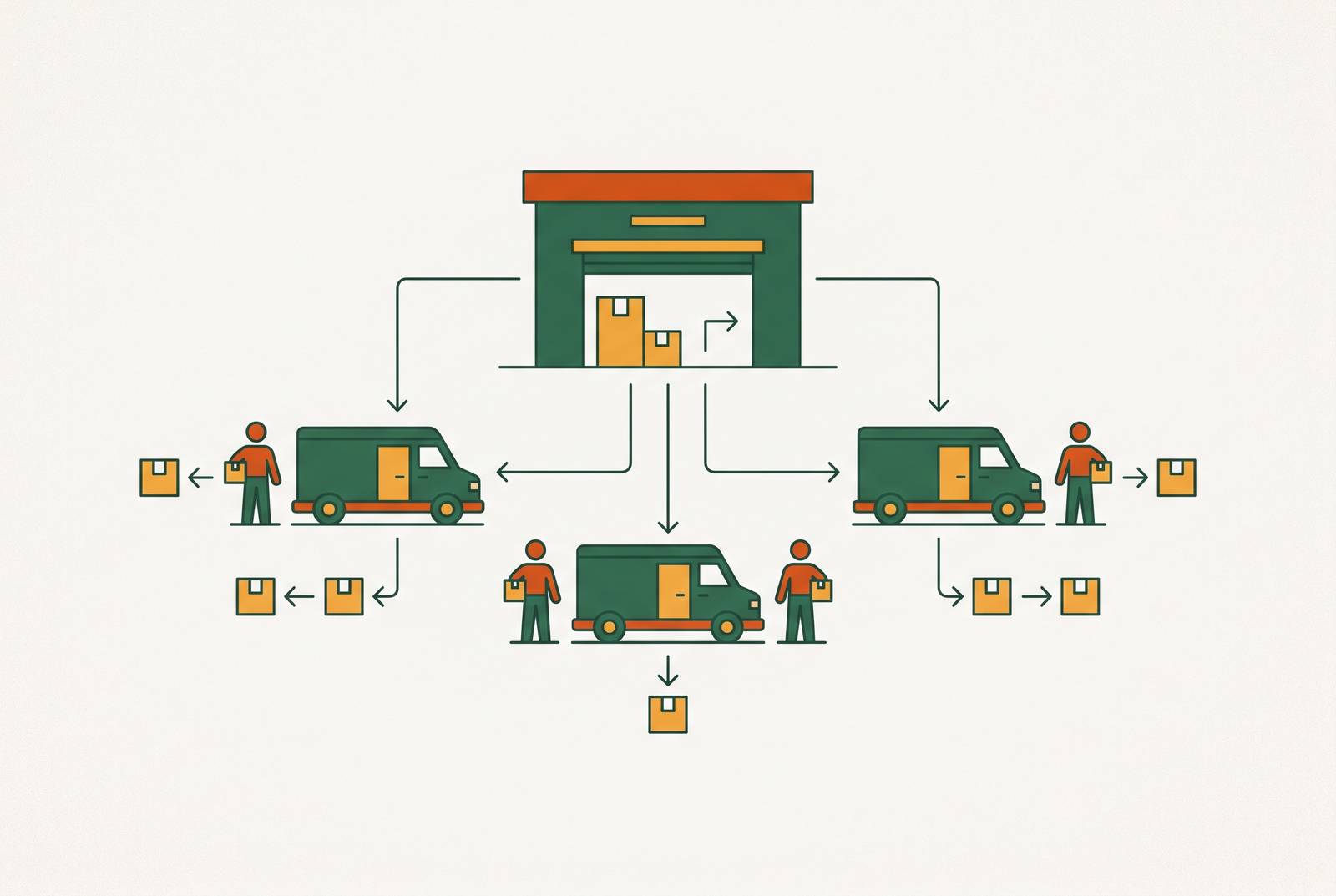
The Delivery Service Partner program licenses last-mile delivery to independent small-business owners instead of putting every driver on Amazon's own payroll. That one design choice explains most of what follows in this piece: who hires whom, who carries the insurance, who answers when a regulator calls. Amazon launched the program in 2018 to connect aspiring entrepreneurs with a ready-made delivery infrastructure, and it borrowed the small-business partnership logic it had already run for years in its retail marketplace. The thinking was straightforward: people who live in a neighborhood know its loading docks, its gate codes, and its dog situations better than a dispatcher sitting in a regional hub ever will. The program now operates in multiple countries, and Amazon's own program overview reports that thousands of entrepreneurs have built businesses through it, generating hundreds of thousands of driving jobs and billions of dollars in revenue across those businesses combined. Amazon decided it did not want to own the delivery workforce outright before any of that could happen. It wanted to own the system around it instead.
How a DSP owner's business works day to day
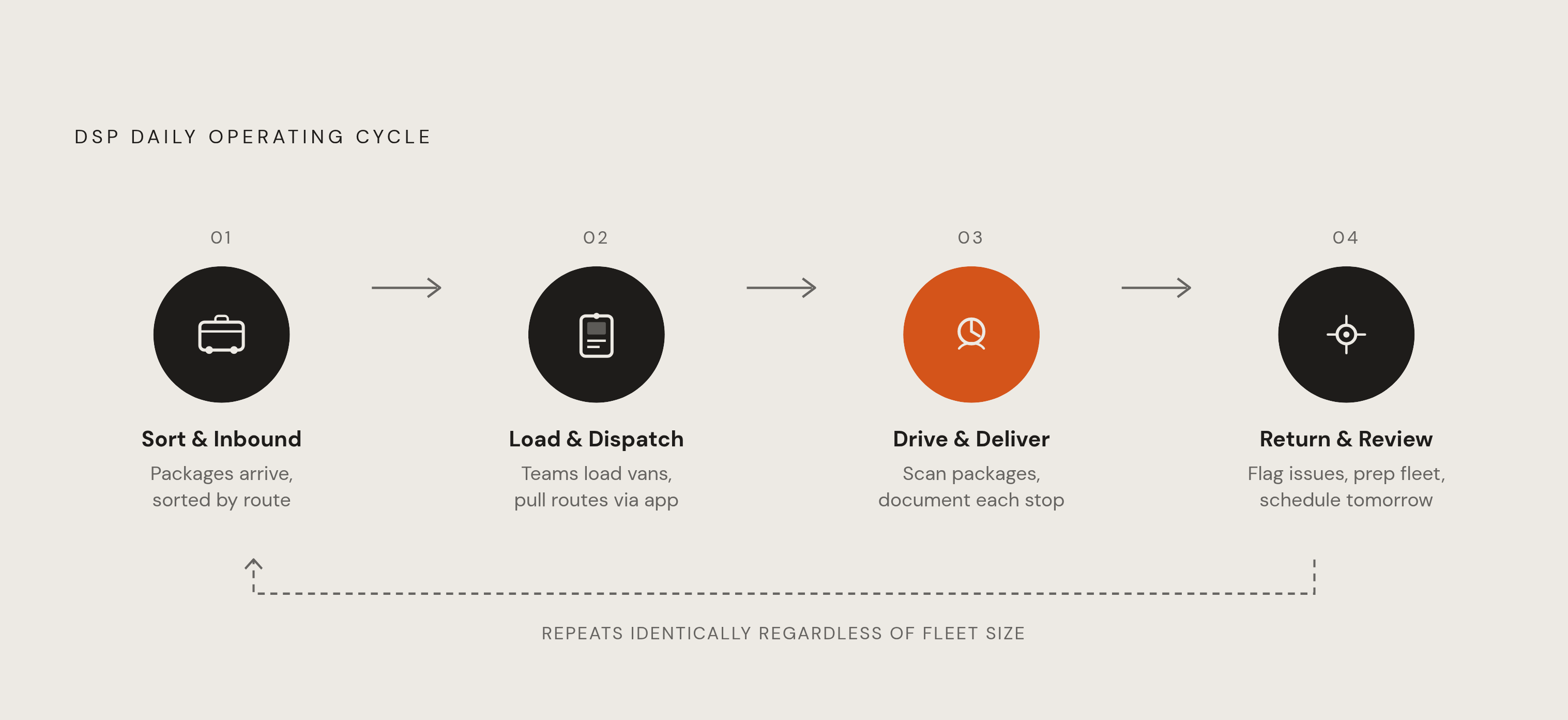
Running a DSP means running a business with Amazon as the client, not Amazon as the boss. Owners hire, schedule, and manage their own teams of Delivery Associates, while Amazon supplies the packages, the technology, and the surrounding infrastructure. The daily cycle repeats in four stages, and it repeats the same way whether a DSP is running a small fleet or a much larger one. Packages travel through regional fulfillment centers, land at a local delivery station, and get sorted by route. DSP teams then show up, collect their assigned loads, pack the vehicles, and pull route details through Amazon's delivery app or connected handheld devices. From there, Delivery Associates drive the route itself, scanning packages, confirming addresses, and documenting each stop as they go, whether that stop is a house, an apartment building, or a loading dock behind a dentist's office. At the end of the shift, drivers return to the station, flag any issues from the day, and get vehicles ready for the next morning, while DSP managers look over route performance and sort out the next day's schedule.
Vehicle upkeep belongs to the DSP as well. The same logic extends to the people driving those vans: wages, shift structure, and whatever extra benefits a DSP chooses to offer are decisions the owner makes, inside the boundaries set by Amazon's rate-card payments to the business. Those payments are expected to support average driver pay near $24 an hour nationally, but how that money gets split between a driver's base rate, overtime, and incentives is an owner's call, not Amazon's.
How DSP owners get paid and spend it
Money moves through the DSP model by way of rate cards: payments Amazon makes to DSPs per delivery or per route, which owners then use to cover payroll, operating costs, and whatever reinvestment the business needs. Almost every dollar a DSP owner has to work with traces back to the rate card, so it is what makes a DSP's year look healthy or thin. Amazon's most recent investment commitment, announced September 21, 2026, directs new money toward the DSP program for 2027, including rate-card support aimed at pushing Delivery Associate pay to a national average near $24 an hour. Amazon has said that over three years, its investments are expected to help owners raise driver pay meaningfully across the country. The program's cumulative investment over eight years adds up to a substantial figure, a scale that reflects just how much financial infrastructure Amazon has built around DSP economics over time.
None of this lands the same way for every owner. Amazon's own release is explicit that rate-card increases are not handed out uniformly: the specifics shift by DSP and by geography, and each owner decides how to divide the money across wages, benefits, and whatever the business needs to grow. That flexibility cuts both ways. It gives a well-run DSP room to compete for drivers in a tight labor market, and it gives a poorly run one enough rope to misallocate funds and end up short. On the cost side, the obligations are fixed regardless of how generous the rate card feels in a given quarter. Amazon's announcement confirms that every DSP provides healthcare coverage and paid time off for full-time Delivery Associates, many also offer 401(k) plans, and DSPs that choose to participate can offer tuition reimbursement through Amazon's Next Mile program. Those costs come straight out of rate-card revenue before an owner ever sees a margin. The economics here are bounded: income rises and falls with the rate card, costs are mostly fixed by program terms, and the margin in between depends entirely on how tightly an owner runs the operation.
What Amazon provides beyond the package
Amazon's support layer runs deep enough that it works like an operating system for the entire DSP business, and that is a meaningful part of why the model draws entrepreneurs who would never touch independent trucking or last-mile contracting on their own. Technology, safety hardware, AI-driven routing, and formal training all arrive pre-built. A new DSP owner is not stitching together a delivery operation from spare parts.
The AI tooling in particular has gotten specific. Wellspring, Amazon's generative AI mapping system, learns from every delivery it touches, and Amazon's 2026 update reports that since 2024 it has identified hundreds of millions of parking locations, mapped millions of building entrances, and cataloged tens of thousands of mailrooms and package lockers. The result is a physical-world model that gets sharper with use, helping a Delivery Associate find the actual door, not just the street address on the label. Separately, Amazon's AI-based routing adjusts for the kind of conditions that make a route harder without making the address wrong: reduced visibility after sunset, tight parking downtown during rush hour, a snowstorm rolling through. None of that requires the driver to stop and recalculate. Amazon has also started applying more advanced AI to spot driving patterns that tend to precede accidents, and it hands those insights to DSP owners for coaching before an incident happens.
The honest version of this story has two parts that sit next to each other without canceling each other out. The support is substantial, and it genuinely lowers the barrier for someone with no logistics background to open a delivery business. The technology, though, belongs to Amazon. A DSP owner is licensing access to Wellspring and the routing engine, not acquiring ownership of them, and that distinction turns out to matter quite a bit once the conversation shifts to who is legally responsible for what.
The compliance and classification obligations DSP owners carry as employers
DSP owners are employers of W-2 workers, so they sit in a different compliance category than the gig-platform operators who manage networks of independent contractors. The obligations are different in kind, not lighter in weight. A DSP owner handles payroll taxes, workers' compensation, unemployment insurance, and the healthcare coverage and paid time off that Amazon's program terms require for every full-time Delivery Associate. None of that is optional, and none of it is Amazon's problem to solve on the owner's behalf.
Insurance stacks up in layers. DSP operators carry commercial auto liability, cargo coverage, and general liability, typically at contract minimums that run well above what a small local courier service would need. Vehicles must be maintained and insured by the DSP no matter how they were acquired, so who holds the policy does not change. Driver credentialing sits with the owner too: verifying valid licenses, running background checks, and keeping records that show compliance with Amazon's operational standards is work the DSP does, not work Amazon does for them.
The regulatory backdrop keeps shifting under all of this. State-level wage and hour laws, classification standards, and labor regulations vary enough that a DSP operating in California, New Jersey, or Massachusetts faces a tougher compliance environment than one in a state with lighter labor-law enforcement. The stakes of getting this wrong are not hypothetical. In New Jersey, a delivery operator called PDX North settled misclassification charges in March 2026 after the state found it had misclassified a large number of delivery drivers as independent contractors, even though that operator was not a DSP in Amazon's program. The case is a clean illustration of what happens when the line between employer and contractor-platform gets blurry or gets managed carelessly: state labor departments notice, and the settlements that follow are not cheap.
How Amazon's ongoing investment shapes the program's trajectory
Amazon keeps putting more money into the DSP program, not less, and that pattern tells a DSP owner something concrete about how to plan. A program that was treated as a transitional experiment would see its funding plateau or quietly shrink. Instead, the September 2026 announcement commits a substantial sum for 2027, covering driver-pay support, routing and safety technology, and an expansion of Smart Glasses, following a comparably large investment announced in September 2024. Amazon described both announcements, at the time each was made, as the largest investment in the program's history.
The investment is not limited to pay and hardware. A multiyear community-impact commitment supports DSP-led local initiatives, with Amazon Local Good, which routes donated goods to nonprofits through the existing last-mile network at no cost, as one of its main pieces. That program extends the same logic the DSP model was built on from the start: these businesses sit inside the communities they serve, and Amazon keeps building infrastructure that leans into that presence.
Smart Glasses are scaling to tens of thousands of devices, AI coaching on driving behavior is becoming standard, and weather-aware routing is resetting what a normal day looks like across the network. A DSP owner who adopts these tools stays level with everyone else who adopted them too. The safety numbers back up the idea that this investment is producing results that owners can actually feel in their performance scores: Amazon has put more than $543 million into safety initiatives, programs, and technology since 2022, and serious vehicle crashes dropped more than 23 percent across the network last year.
What prospective and current DSP owners need to manage
Amazon's infrastructure covers the delivery operation end to end: the app, the routing, the mapping, the safety coaching. What it does not cover is the back office, and that gap is where a DSP's long-term survival actually gets decided. Credentialing, compliance monitoring, payment workflows, and employee record-keeping are the owner's responsibility in full, with no Amazon system standing behind them to catch a mistake.
Growth makes this harder before it makes it easier. A DSP scaling up quickly has to onboard, credential, and verify a growing roster of drivers on short timelines, and a back office still running on spreadsheets and email threads will not keep pace with a fleet that Amazon's own rate-card investments are explicitly designed to grow. Compliance checks cannot be a one-time event at hiring either. License status, insurance verification, and background check currency need continuous tracking, because a single driver operating out of compliance behind the wheel of a delivery van is an exposure the DSP owner carries alone, not something Amazon absorbs on the business's behalf.
Payment speed carries its own weight in driver retention. Amazon has integrated services like PayActiv so DSPs can offer Delivery Associates early access to wages they have already earned, and that matters because driver turnover is a constant, expensive drain on any delivery business. Fast pay is a retention tool that keeps drivers from walking across the street to the next DSP offering the same rate-card pay with faster access to it.
The real risk in this model was never Amazon adjusting a rate card by a few cents per stop. A DSP owner can let compliance, credentialing, or payment infrastructure fall behind the pace of the very business Amazon's investment is pushing them to build.