Route Density Optimization for Independent Contractor Fleets
Contractors decline loads and compliance lapses create density gaps W-2 playbooks can't fix.

Route density optimization aims at the same target no matter who's behind the wheel: more stops per mile, fewer empty-mile miles between them, a lower cost per delivery. For independent contractor fleets, the goal is identical but the machinery that gets there is not. A dispatcher managing W-2 drivers can mandate a sequence, require a pre-shift checklist, and correct a deviation the moment it shows up on the board. An operator managing 1099 contractors cannot do any of that without wandering into legally dangerous territory, because the contractor relationship itself limits how much direction a company can exert over how the work gets done. If operators import employed-fleet playbooks wholesale and expect the same density curve, the plan will hold up on paper but come apart in the field.
Three variables explain most of that gap, and none of them carry the same weight in a W-2 network. The first is availability fluctuation: a contractor can decline a load, something an employee generally cannot do without consequence. The second is credential and compliance status: when a driver falls out of compliance, they become instantly undispatchable, so the active pool shrinks without warning. The third is weak enforcement of standard operating procedures, since an operator has far less leverage to correct how a contractor executes a stop than it would with a direct employee. None of these variables are disqualifying. They just mean the density plan has to be built around a workforce that behaves less like a fixed asset and more like a market.
Where IC availability breaks the density foundation
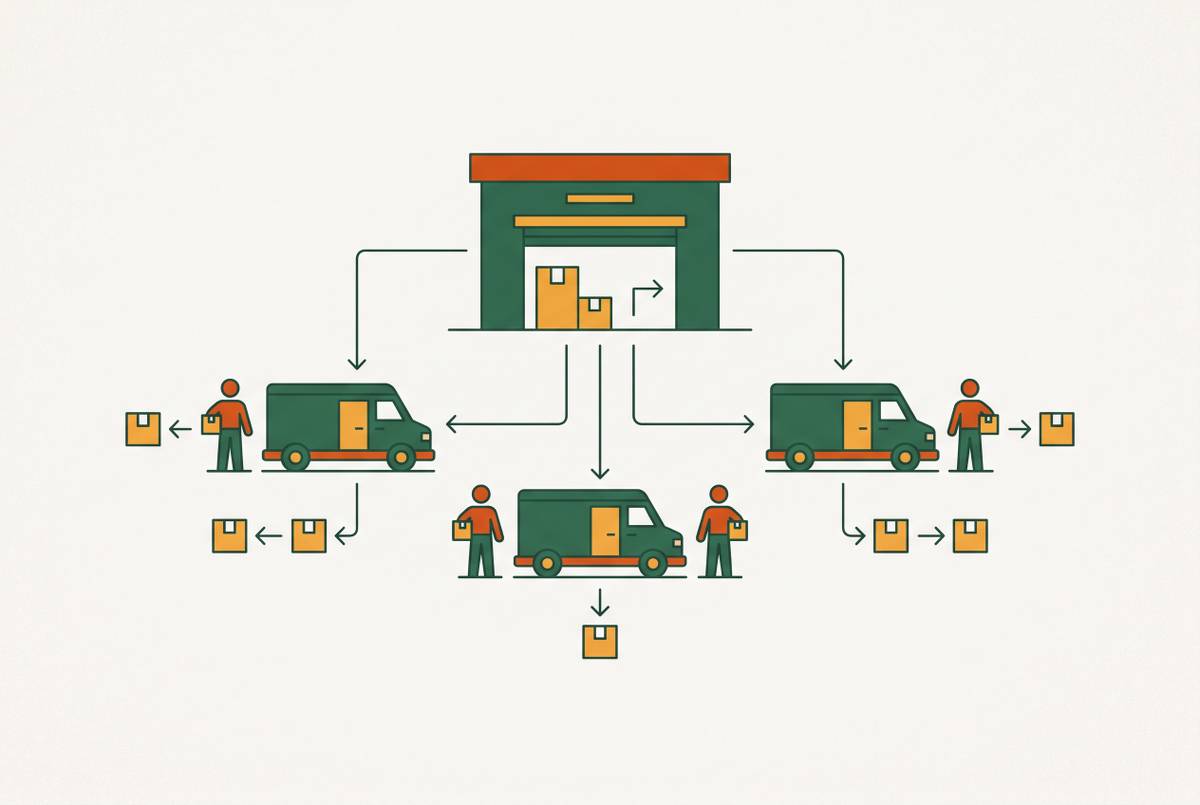
Clustering stops into tight geographic groups and assigning those clusters to defined driver zones is still the foundation of route density, in IC fleets just as it is in employed ones. The logic doesn't change: fewer inter-stop miles per zone means more stops per hour, and more stops per hour means a lower cost per delivery. That part of the math is fleet-agnostic.
What breaks is the assumption that the driver pool assigned to each zone is stable and shows up, since territory zoning only compounds density gains if that assumption holds. An employed fleet can treat that assumption as close to fixed. An IC fleet cannot, because a zone built around eight contractors doesn't operate at eight-contractor density the day two of them decline their loads. When that happens, the remaining six either stretch their coverage to absorb the gap, which destroys the density the zone was built around, or the declined stops simply go unassigned. Neither outcome is a routing failure. The tactic itself, clustering and zoning, is still correct. What's missing is the operational layer that keeps the assumption of coverage true on the days it matters.
Compliance status as a hidden dispatch constraint that collapses density
A contractor declines a load, and the gap appears immediately in availability. Compliance status is a quieter, more dangerous version of the same problem, because it can remove a driver from the dispatchable pool without any warning. A contractor whose credential file has lapsed cannot legally be put on a route, full stop on the legality, not on the convenience. If that driver happens to sit inside a dense zone's coverage area, the zone collapses just as it would from a availability gap, except the operator often doesn't find out until the dispatch board is already being built for the day.
The regulatory floor here is specific. FMCSA requires every commercial carrier to maintain a driver qualification file for non-CDL van drivers operating above the interstate commerce GVWR threshold, covering medical certificates, motor vehicle record checks, applications, and annual compliance reviews. A lapsed credential leaves the file incomplete, and an incomplete file makes the driver non-dispatchable no matter how reliable that contractor has been for the past year. A zone engineered around five drivers loses its density geometry the moment one of those five has a medical certificate expire unnoticed. The zone then has to be redrawn on the fly, or its stops bleed into neighboring zones and inter-stop distances creep back up, erasing the gains the original plan was built to capture.
Misclassification risk and the dispatch controls density planning relies on
The instinct to fix density slippage is to tighten control: specify the start time, mandate the stop sequence, cap how long a driver can spend at each address. Those are exactly the levers an employed-fleet dispatcher reaches for, and they work. They're also the same behaviors that state and federal regulators look for when deciding whether a "contractor" is functioning as an employee in practice. Worker-classification rules vary by jurisdiction in their specifics, but the underlying pattern is consistent across states: the more an operator directs how, when, and in what order the work happens, the more that relationship looks like employment regardless of what the contract says.
That leaves IC fleet operators with a trade-off that employed-fleet operators never have to make. Density has to be engineered into the structure of the work, not commanded in its execution. Territory geometry, order-cutoff timing that clusters stops before they're ever offered, and load-assignment logic can all shape density. But you can't use direct behavioral instruction the same way, because that invites misclassification exposure. An operator can design a better opportunity for a contractor to accept. It cannot script the contractor's day the way it could an employee's, and treating those two things as interchangeable is where density planning runs into a wall that has nothing to do with the routing software.
Plan execution rate as the metric that reveals where IC density breaks down
Most IC fleet operators only track whether the route plan looks efficient on paper. Far fewer track plan execution rate, the share of stops completed as planned divided by the stops the plan called for, and that gap in measurement hides the gap in performance. A route plan is a financial model of the day: fuel, labor cost, service-level commitments, all built on the assumption that the plan runs close to as designed. Every deviation from that plan is unbudgeted cost, whether it comes from a missed stop, a rerouted driver, or a contractor who never logged on.
Plan execution rate is especially revealing in IC fleets because low execution can trace back to more root causes than it would in an employed network. In a W-2 fleet, poor execution usually points to a routing or dispatch error, and the operator can trace and fix it directly. In an IC fleet, the same low number might reflect a contractor declining a load, a compliance removal that happened mid-shift, or SOP drift the operator has limited power to correct after the fact. A route that looks tight on the map but forces a driver to improvise from stop nine onward produces a worse actual day than a slightly longer route that runs exactly as planned, and plan execution rate is the number that captures that divergence between the model and what happened. Operators optimizing the route plan without tracking this metric are optimizing a simulation, not the operation, and in IC fleets that simulation drifts further from reality than it does in employed networks.
The operational layer IC fleets need to make density gains stick: real-time monitoring, onboarding speed, and dispatch architecture
Routing software builds the plan. It doesn't keep the plan's assumptions true, and in an IC fleet, those assumptions, that the pool is available, compliant, and ready, need their own infrastructure to hold.
Real-time compliance monitoring is the first piece of that infrastructure. A quarterly audit finds a lapsed credential after the capacity loss has already happened. Continuous tracking of MVR status, medical certificates, insurance currency, and training completions catches a driver sliding out of compliance before dispatch has to pull them, giving the operator time to backfill the zone ahead of the gap. Onboarding speed is the second piece. Manual onboarding, chasing paperwork, collecting documents one driver at a time, has historically prevented qualified contractors from starting work promptly, leaving zone gaps unfilled exactly when availability fluctuates. A fleet that can activate a credentialed contractor in days rather than weeks has a standing buffer against exactly the kind of availability shock that collapses a territory zone overnight.
Dispatch architecture is the third piece, and it has to work within the legal limits already described. Since operators can't direct contractor behavior the way they direct employees, density has to be built into the load offer itself: zone-based assignment, cutoff timing that clusters stops before they ever reach a driver's app, incentive structures that reward zone consistency without requiring it. When a contractor drops mid-day, the system should rebuild only that zone's plan rather than recomputing the entire network, which keeps one driver's absence from cascading into a fleet-wide disruption. Routing systems that learn from historical adherence data refine their service-time models over time, and that refinement matters more in IC fleets precisely because driver-level variation is higher and average service times are harder to pin down than in a workforce under direct supervision.
Insurance structure as an operational input to density planning, not just a compliance requirement
If a contractor is uninsured, underinsured, or carrying the wrong coverage product, they aren't fully dispatchable, even if their credentials are otherwise in order. An operator that discovers this gap at the moment of dispatch rather than at onboarding has a density problem on its hands, not merely a paperwork problem, because that contractor just became as unusable as one with a lapsed medical certificate.
The coverage choice itself carries structural weight beyond cost. Occupational accident insurance is the appropriate product for a properly classified 1099 contractor; extending workers' compensation to that same contractor can function as evidence that the relationship is actually employment, the exact fact pattern misclassification litigation is built around. OcAc is also typically meaningfully cheaper than workers' comp, and bulk purchasing compresses that cost further: the legally cleaner choice is also the cheaper one. California's Prop 22, upheld by the state supreme court in July 2024 in Castellanos v. State of California, requires app-based delivery companies to carry OcAc for contractors, and that ruling settles the question as durable law, not a temporary arrangement subject to the next ballot cycle. Commercial auto liability premiums for delivery operators are projected to rise meaningfully in 2025, squeezing margins further, so managing these costs through bulk purchasing and the right IC-specific product protects the economics that make density investment worth making.
Most OcAc policies cover acute injury only and typically exclude occupational disease unless it's specifically scheduled into the policy, a distinction that matters for contractors dealing with repetitive-stress conditions from repeated lifting and driving. Operators should confirm this gap is covered rather than assume it is, because last-mile operations already carry significant misclassification exposure, and if the coverage structure fits the IC model correctly, it both reduces that exposure and keeps the contractor pool dispatchable.
What to audit first when density underperforms the route plan
When actual density falls short of the route plan, the routing engine is rarely where the problem lives. The gap almost always sits in the contractor pool, the compliance pipeline, or the onboarding infrastructure that determines who's actually available on the day the plan gets executed, so the audit should move in that order. The first comparison is the planned pool against the active pool: how many contractors the route plan assumed would be dispatch-ready versus how many actually were, since this single gap is the most direct read on the availability and compliance problems driving the shortfall. From there, the roster's credential currency deserves a hard look: the share of contractors with a current MVR, a valid medical certificate, verified insurance, and completed required training, because this is precisely the compliance-monitoring gap that real-time systems catch and that periodic quarterly reviews miss by weeks.
The onboarding pipeline itself needs auditing next: how many qualified contractors sit within days of activation against how many are stuck in manual document collection, since that bench depth determines how fast a zone gap can actually be filled once it opens up. Plan execution rate should then be broken out by zone rather than viewed as a single fleet-wide number, because the zones showing the widest gap between planned and executed stops, especially if they correlate with higher turnover or more compliance volatility, point directly to where the density architecture needs to be rebuilt first. Driver app adoption is worth checking too, measured by actual use per stop rather than whether the feature exists, since low adoption signals that drivers are working around the execution layer, and that means whatever density gains the plan modeled are not being captured in the field. Finally, put insurance and classification alignment on the list and confirm the coverage structure matches the IC model correctly, because a mismatch there is exposure that becomes a denied claim or a regulatory penalty at the worst possible moment.
Every item in that sequence is a variable that doesn't exist, at least not at the same intensity, in an employed fleet's density diagnostics, which is the point this piece opened with. Route density optimization for IC fleets is a workforce infrastructure problem, not just a routing problem with a few HR complications bolted on, and routing software, however good the algorithm, was never going to be the thing that solved it alone.