Instant and Same-Day Payout Options Across Contractor Workforce Platforms
Faster payouts have become the key lever for retaining delivery drivers.

Payment speed used to be a back-office setting. For delivery companies running high-volume independent contractor networks, it has become a line item that shows up in retention numbers, support tickets, and which platform a driver opens first on a Tuesday morning.
Payment speed as a competitive variable for IC-network operators
Contractors who work across multiple platforms at once, which describes most delivery drivers, do not owe loyalty to any single app. They owe loyalty to whichever one puts money in their account fastest and most reliably. That single fact has turned payout speed from a payroll detail into a lever that moves driver supply between competing networks in real time.
Last-mile delivery feels this harder than almost any other segment of the gig economy. Route businesses in this space routinely replace a majority of their driver workforce within a single year. Contractor acquisition and retention are a constant operational cost, running every week of the year. The infrastructure to pay contractors fast now exists at scale. The real question facing delivery companies is which platforms have built that infrastructure into how they operate, and which ones have slapped a fast-pay button on a system that was never designed to move money quickly.
The four payment rails
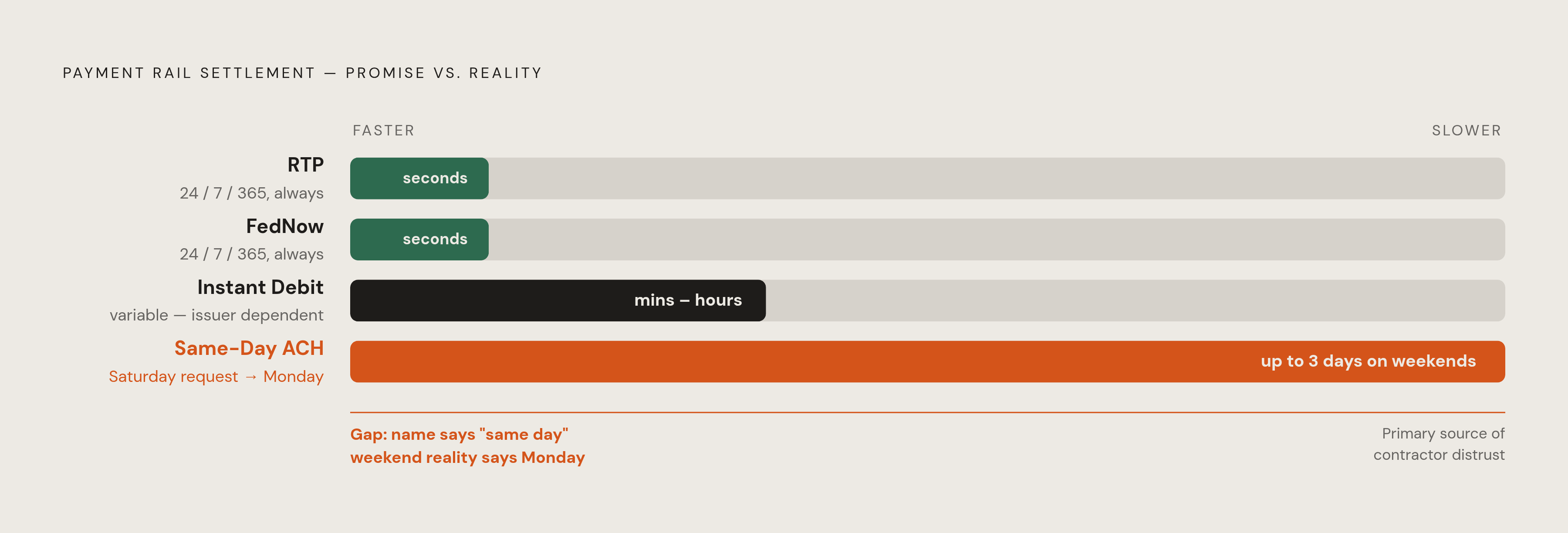
Marketing copy tends to use "instant," "same-day," and "fast" as if they describe the same thing. They don't, and the differences matter enough that conflating them is probably the single biggest source of contractor distrust toward platforms that promise speed they can't consistently deliver.
| Rail | Speed | Availability | Key limitation | |---|---|---|---| | RTP (Real-Time Payments) | Seconds | 24/7/365, including weekends and holidays | Requires receiving bank enrollment | | FedNow | Seconds | 24/7/365, including weekends and holidays | Requires receiving bank enrollment | | Same-Day ACH | Same business day | Business-day windows only | A Saturday request doesn't land until Monday | | Instant debit (push-to-debit) | Often fast in practice | Depends on card network and issuing bank | Not a true rail, speed varies by issuer |
RTP and FedNow are the only rails that settle funds in actual real time, seconds, any day of the week, with no batch processing and no business-day cutoff. Same-Day ACH sounds like it should match that, but it runs on business-day windows only. If a driver asks for a payout on Saturday through Same-Day ACH, it doesn't land until Monday, and that gap generates support tickets when a platform's marketing implied otherwise. Standard ACH, the older sibling of Same-Day ACH, settles over one to three business days, and it was never built for urgency. Instant debit, or push-to-debit, isn't a rail at all but a delivery method: it pushes funds to a contractor's debit card over card network infrastructure, and speed in practice depends heavily on the issuing bank.
NACHA approved a substantial increase to the Same-Day ACH per-transaction limit in May 2026, raising it from $1 million to $10 million per payment, effective September 17, 2027, a regulatory shift worth tracking closely. When that takes effect, Same-Day ACH closes much of the value gap with RTP and FedNow for high-dollar disbursements, but it still won't touch weekend settlement.
That gap between rails explains the most important practical consequence for delivery companies evaluating a payout platform: not every contractor's bank is enrolled in RTP or FedNow receiving networks. A platform advertising "instant pay" without disclosing its fallback behavior may be quietly routing a meaningful share of payouts over Same-Day ACH, delivering the appearance of speed to some contractors and a Monday surprise to others.
The onboarding moment and fast pay
None of the four rails matter if the platform doesn't have a verified, tokenized bank account on file for the contractor before the first job wraps. Onboarding isn't a separate workflow that happens before payments start, it's the gate that makes fast pay possible or impossible.
Every new contractor who joins a network triggers a new round of banking-information collection. Platforms that handle this by hand are perpetually dealing with void cheque submissions, manual data entry, and verification delays, each one a chance for an error that surfaces later as a failed payout. Bank details don't stay fixed either. Contractors switch banks, open new accounts, and update their information on their own schedule, so a tokenized record that was accurate six months ago can be dead on arrival today. Platforms without automated re-verification find this out the same way contractors do: through a failed payout, after the fact.
TIN validation belongs in this same moment, not a quarter later. The IRS TIN Matching Program lets a business check vendor names and TINs against IRS records before filing, and it returns interactive results in real time for batches of up to 25 name and TIN pairs. A missing or mismatched TIN triggers backup withholding automatically, and platforms that run this check at onboarding catch the problem at the source.
Delivery work raises the stakes on all of this because a disorganized first week is one of the most common reasons a new contractor quits before becoming a regular. Platforms that handle manual payment setup keep chasing void cheque submissions and verification delays, but purpose-built contractor management systems like GigSafe fold payment destination verification directly into onboarding: they capture and tokenize banking details at the point of activation, so fast pay is live from the first completed job.
Embedded payments versus bolted-on processors
Having a payment processor is not the same thing as having embedded payments, and most contractor platforms operate somewhere in the space between the two. That gap appears at the moment a contractor gets paid, which happens to be the moment they're paying the closest attention.
With embedded payments, the bank account connection happens inside the platform's own onboarding flow, so payout notifications carry the platform's name and look instead of a generic third-party sender's, and the platform sees payment status in real time instead of waiting on a batch report the next morning. Failed payments behave differently too: embedded infrastructure surfaces a failure immediately at the point of processing, with enough detail attached to fix it, instead of appearing three business days later as an unexplained return.
When a 1099 workforce platform treats payments as a core function instead of a bolted-on processor, the contractor notices right away: payouts arrive faster, fewer transactions fail, and switching a payout destination or payment method doesn't require re-onboarding from scratch.
There's a brand cost to getting this wrong, too. When a payment notification arrives from a third-party processor's name instead of the platform's own, the highest point of positive contact a contractor has, the moment money lands, belongs to a vendor the contractor has never heard of. Fixing that isn't just a matter of experience. It changes the economics. So when platforms with embedded payments charge a modest premium for the instant tier, they can recover disbursement costs against volume they were already processing anyway, and fast pay turns from a cost center into something closer to a revenue line.
How leading contractor workforce platforms handle payouts
Platforms don't just differ in which rails they support. They differ in whether payout infrastructure connects to compliance, onboarding, and credentialing, or sits off to the side as a feature grafted onto an otherwise generic system.
GigSafe's payment speed comes directly from its onboarding design. Its 25-plus onboarding modules capture and verify payment destination information at the point a contractor is activated, so fast pay is available starting with the first completed job. Compliance monitoring runs continuously alongside payment processing, so if a contractor's credentials lapse, that gets flagged before a payout creates liability for the operator, not after the money has already gone out. Insurance is built into the same system: GigSafe gives delivery companies access to occupational accident and commercial auto coverage through a partnership with USI Insurance Services, a licensed insurance broker, compressing costs through pooled purchasing across the network. The architecture is built to handle thousands of contractors without growing the back office in step, so payment operations scale with headcount. The result serves both sides of the relationship: contractors get fast, low-friction access to what they've earned, and operators get one system of record covering compliance, payments, and credentialing together.
Deel positions itself as an all-in-one platform for managing contractors internationally, handling payments across more than 150 countries with built-in compliance automation for tax documents. It fits companies running cross-border contractor networks well, but it isn't built for domestic last-mile delivery operations or for high-volume IC networks that need real-time credentialing and occupational accident coverage, and it lacks the insurance and compliance integration delivery operators need.
Tipalti is strong for mass payouts against supplier invoices, offering accounts payable and mass payments as separate monthly subscriptions, which suits high-volume accounts-payable workflows well. Its architecture is built around invoice-based payables rather than contractor lifecycle management, so it doesn't address onboarding, credentialing, or insurance for IC networks.
Gusto handles both W-2 and 1099 payroll with automated 1099 filing and multi-state compliance, and it's positioned well for small to mid-size businesses managing a mix of employees and contractors. It isn't designed for high-volume IC networks or delivery-specific compliance needs, and payout speed isn't a feature the platform is built around.
Papaya Global processes payments across a large number of currencies and countries, backed by AI-powered KYC and AML verification and bulk onboarding capacity, which makes it strong for globally distributed contractor workforces. Like Deel, its core strength is cross-border reach, not the domestic last-mile compliance and insurance integration that delivery companies need.
The compliance layer that fast pay depends on
A platform that pays contractors instantly while misclassifying them, misreporting their earnings, or skipping real-time credentialing has traded a retention benefit for an exposure that dwarfs it.
Worker misclassification is the larger risk by a wide margin. If the IRS determines that a contractor was functionally an employee, the business owes back payroll taxes, plus penalties and interest, a bill that makes a 1099 under-reporting problem look small by comparison. State law adds another layer regardless of what happens federally: California, Massachusetts, and New Jersey all start from the presumption that a worker is an employee unless the business proves otherwise. California's Proposition 22, upheld by the California Supreme Court in Castellanos v. State of California on July 25, 2024, preserves the independent contractor model for app-based drivers under California law, but only for platforms that meet its specific qualifying conditions.
Real-time compliance monitoring, checking credentials, insurance status, and classification indicators continuously rather than at scheduled audits, is the only approach built for a workforce that onboards, works, and churns on a daily basis. A platform that connects payment initiation directly to compliance status can stop a payout before it goes out to a contractor whose credentials have already lapsed. That turns compliance from a periodic audit that happens after the fact into an active control sitting inside the payment process itself.
What to evaluate before choosing a payout platform
Don't ask a payout platform whether it offers instant pay. It's which rail each payout actually uses, what happens when that rail isn't available, and whether the whole system connects to onboarding and compliance or just sits next to them.
Rail transparency matters first: does the platform disclose which rail handles each payout, and does it fall back gracefully when a contractor's bank isn't enrolled in RTP or FedNow, or does it quietly route that payout over Same-Day ACH and still call it instant?
Onboarding integration matters just as much: is payment-destination capture built into contractor activation, or is it a separate step that leaves a gap between finishing the first job and actually being eligible to get paid for it?
Compliance connection decides whether fast pay is safe at all: does the payment process check credential and insurance status in real time before releasing funds, or does compliance run on its own separate schedule invisible to the payment workflow?
Scale architecture separates platforms that grow from platforms that strain: operators managing thousands of contractors through manual payment processes, exporting files, chasing exceptions, resolving failed-payment notifications, reprocessing returns, are running a function whose labor cost climbs in direct proportion to contractor headcount. Automated infrastructure is the only design that holds up as that number grows.
For delivery companies facing annual turnover rates that require replacing much of the driver workforce every year, payout speed functions as a retention lever with measurable weight. If a platform delivers same-day or instant pay reliably, without generating a pile of support tickets from failed transactions, it gains a real edge both in recruiting new contractors and in keeping the ones already on the road. If a platform serves only the operator's compliance needs, without making the contractor's actual pay experience fast and dependable, it will keep losing drivers to whichever platform solved both problems at once.