IC Compliance Software Comparison for Delivery Companies
Delivery firms need compliance software built for moving vehicles, not remote workers.

Restaurants run on independent contractors, agencies run on contractors, and app development shops run on contractors too, and delivery companies are no different. The resemblance ends there. A driver's compliance file touches a moving vehicle, a public road, and a package that has to arrive before the customer cancels the order, and no freelance-management system built for a general-purpose independent professional was ever asked to account for any of that. This piece lays out why that gap exists and builds a five-requirement framework for closing it, then measures the platforms delivery operators actually consider against it.
Why delivery companies have a different compliance problem
Most IC compliance software got built for a specific kind of company: one hiring remote developers, designers, or marketers scattered across a dozen countries, where the central risk is paperwork and the central question is whether a contract is properly localized. Delivery operators have a different animal to manage. A driver's compliance status is not just a legal classification sitting in a database; it is tangled up with whether a vehicle is registered, whether an insurance certificate is still active, whether a background check needs renewal, and whether the driver got paid fast enough to show up for tomorrow's shift. Insurance credentialing, vehicle documentation, real-time driver status, and pay-speed expectations all interact with classification risk, and a freelance-management platform simply was not built to track any of it.
Federal rulemaking adds another layer without subtracting any old ones. On February 26, 2026, the U.S. Department of Labor's Wage and Hour Division proposed a revised economic reality test built around two core factors, control and opportunity for profit or loss, plus three secondary factors, five in total. Several states keep stricter-than-federal classification standards. If a compliance system only tracks federal status, it misses the state layer, and an operator can be compliant on paper at the federal level while exposed under state law.
The five requirements a delivery IC compliance platform needs to meet
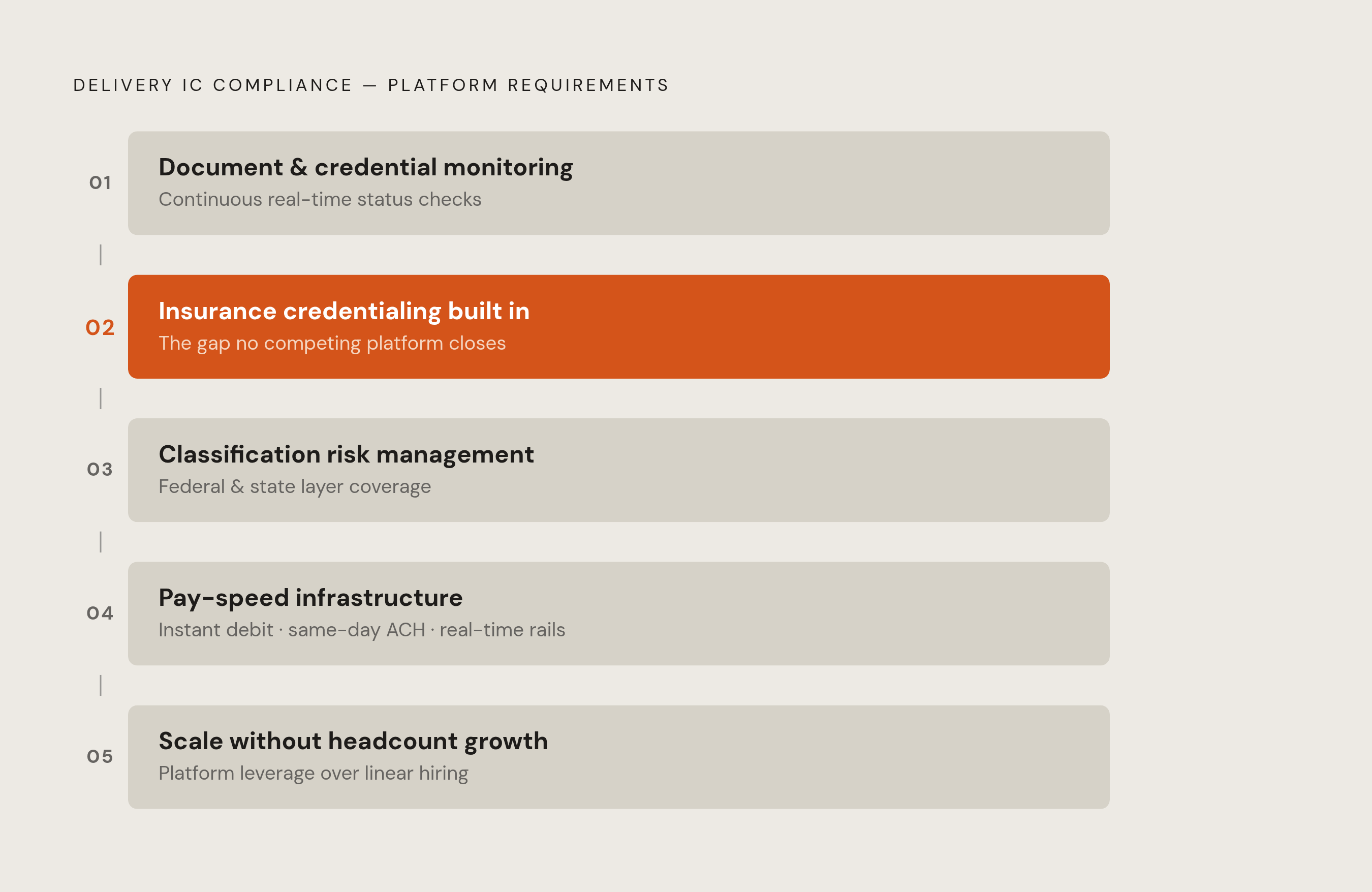
Judging a platform for a delivery network means starting from what the network actually does, not from a generic HR-tech feature checklist. Most published comparisons of IC compliance software skip at least two of the following five requirements, usually because the comparison was written with an office-based contractor workforce in mind.
The first requirement is real-time document and credential monitoring. Driver's licenses, vehicle registrations, insurance certificates, and background checks all expire on their own unpredictable schedules, and a platform that checks these boxes once at onboarding but never again leaves a blind spot between audits where a driver can run non-compliant and nobody notices until the next review.
The second requirement is insurance credentialing built into the platform itself. Occupational accident coverage for independent contractors, commercial auto, and motor truck cargo are not optional add-ons bolted onto a contractor file; they are the core risk layer for any last-mile operation. A platform that cannot verify, track, or administer these policies alongside the contractor record forces the operator to run a second, manual process in parallel, which is exactly the kind of gap that turns into a lawsuit.
The third requirement is classification risk management that covers the state layer, not just the federal one. Federal economic-realities factors set a baseline, but a platform needs to surface state-specific exposure, including stricter state-level classification standards, instead of reducing classification to a single binary flag.
The fourth requirement is pay-speed infrastructure built for how gig workers actually expect to get paid. Instant debit, same-day ACH, and real-time payment rails affect driver retention directly, and a platform that settles everything on a standard ACH timeline is mismatched to what gig workers have come to expect from every other app on their phone.
The fifth requirement is the ability to scale without adding headcount in proportion to driver count. Delivery networks onboard and offboard drivers continuously, so the platform needs to automate W-9 collection, TIN checks, 1099-NEC filing, onboarding workflows, and ongoing compliance monitoring without requiring a bigger back office every time the fleet grows.
GigSafe: purpose-built for delivery IC networks across all five requirements
GigSafe's monitoring runs continuously rather than on a scheduled audit cycle, tracking driver credentials, insurance certificates, and document expirations across a contractor network regardless of size, so an operator is not left exposed in the gap between one manual review and the next.
Insurance is built directly into the platform. GigSafe offers occupational accident and commercial auto insurance with USI Insurance Services, a licensed and authorized insurance broker, and bulk purchasing is available to delivery companies that want to bring down per-contractor insurance costs. The platform includes insurance credentialing as one of its 25 or more onboarding modules, a native step built directly into the process.
Onboarding itself compresses from a process that used to take weeks into one that runs in days. Agreements, background checks, credentials, insurance, and tax forms all move through a single automated workflow built to handle driver networks at scale without forcing an operator to add back-office staff every time the roster grows.
The design accounts for both sides of the relationship. Operators get compliance automation and an audit trail that holds together end to end. Drivers get faster onboarding, they get real insurance protection built into the process rather than assumed, and they get paid at the speed gig work expects. That dual design, serving the operator's risk management and the driver's day-to-day experience at once, is where generic IC platforms built around enterprise HR workflows tend not to follow.
Deel: strong global compliance coverage, limited fit for driver-network operations
Deel built its reputation on global contractor onboarding, localized contracts, classification support, and multi-currency payments across more than 200 countries, and for the use case it was built for, that reputation holds up. A company hiring remote knowledge workers in a dozen time zones gets a platform that handles the legal and payment complexity of that arrangement well.
Measured against the five requirements, the fit loosens. Continuous expiration monitoring for driver-specific credentials, the kind that catches a license or registration lapsing mid-route, is not a documented core feature; Deel's strength is centralized document management and onboarding workflows, which is a different thing. There is no built-in occupational accident or commercial auto administration, so a delivery operator would need to run insurance as a separate process outside the platform. Classification safeguards and localized contract templates exist, but the platform does not document that it tracks state-level classification standards for U.S. delivery operations natively. Multi-currency payment support is a genuine strength for global payroll, but instant debit or same-day ACH tuned to U.S. gig driver retention is not a documented differentiator. And while the centralized dashboard and onboarding automation serve distributed remote teams well, nothing in available documentation establishes that the same automation extends cleanly to continuous driver onboarding and offboarding at last-mile scale.
Deel's natural home remains international contractor programs, SaaS companies, agencies, and remote-first businesses managing freelancers across borders, which is a different operational problem than running a fleet of delivery drivers.
Rippling: broad workforce platform with contractor capabilities built for IT-intensive operations
Rippling's pitch is unification: contractor management sits alongside HR, payroll, finance, and IT in one platform, which matters a great deal to a technology company that needs to provision a laptop, a system account, and a contractor agreement for the same new hire on the same day. For distributed teams built around system access, that is a genuine advantage.
These priorities fail to map onto a driver network. Rippling supports contractor onboarding with KYC verification and document collection, but continuous real-time monitoring of expiring driver credentials is not a documented capability. Insurance administration for occupational accident or commercial auto coverage is absent from the documentation; the platform's strength runs toward IT and app access provisioning, a different kind of credentialing. Global compliance coverage is broad, spanning more than 80 countries for employer-of-record onboarding and more than 185 countries for contractor management, but state-specific classification-standard monitoring for U.S. driver networks is not established by available sources. Payroll automation across multiple currencies is solid, but it is not documented as tuning instant debit or same-day ACH to gig driver pay-speed expectations. And the automation that makes Rippling valuable across HR, IT, and finance is oriented toward office and distributed teams rather than the kind of continuous onboarding pipeline a delivery fleet runs.
Rippling fits best with technology companies, distributed enterprises, and operations that need contractor management tied tightly to IT provisioning and internal system access, which is a real and common need, just not a delivery company's need.
WorkMarket by ADP: document and credential management for large U.S. contractor workforces
WorkMarket by ADP narrows its focus to onboarding, verifying, managing, and paying independent contractors and freelancers in the U.S. and internationally, with explicit support for collecting licenses, certifications, contractor agreements, and background checks and drug tests facilitated through third-party providers on the platform. That U.S.-first orientation and documentation depth puts it closer to delivery-relevant territory than a purely global platform.
The gaps against the framework appear in continuous monitoring, insurance administration, state-level classification tracking, and pay speed. Whether document collection extends into continuous, real-time expiration monitoring for driver-specific credentials is not established by available sources; it may store the certificate without watching the clock on it. There is no documented built-in administration of occupational accident or commercial auto policies; the platform can hold a certificate on file, but holding a file is not the same as administering the policy behind it. The U.S. focus is a relevant strength for classification purposes generally, but it is not documented as monitoring state-specific classification standards for delivery operations specifically. Contractor payments are supported, but instant debit or same-day ACH for gig driver retention is not a documented differentiator. Where WorkMarket earns its placement is document collection and onboarding automation for large U.S. contractor workforces, which is a genuine strength.
WorkMarket suits large U.S.-based companies managing varied contractor workforces where document collection and credentialing depth outweigh the need for delivery-specific insurance administration, a profile that overlaps with delivery operators without quite matching them.
The insurance gap that no generic platform closes on its own
Every platform covered above can store an insurance certificate as a file. None of them administers the occupational accident policy or the commercial auto policy sitting behind that file, and that gap is the single one that matters most to a last-mile operator.
Three separate insurance instruments cover a 1099 delivery network, and managing all three together is required. Commercial auto and hired and non-owned auto coverage operate against a floor: FMCSA sets a minimum financial responsibility requirement for for-hire carriers above a specified gross vehicle weight rating under 49 CFR Part 387, and brokers frequently contract for limits above that floor. Personal auto policies almost universally exclude commercial delivery use. So if a driver crashes while running a delivery app, they can file a personal claim and watch it get denied on the spot. Motor truck cargo coverage handles the goods in transit, the third leg of the stool alongside occupational accident and commercial auto.
A platform that only collects and stores a certificate cannot confirm the policy behind it is still active, correctly scoped to delivery work, or current, and that is precisely the gap enforcement agencies and plaintiffs' attorneys look for first when a claim gets filed. Requirement 2 in the earlier framework exists because of this exact failure mode: occupational accident coverage, commercial auto, and motor truck cargo need native integration into the contractor record itself, not a parallel manual process that someone in the back office has to remember to check. Platforms built specifically for 1099 workforces, GigSafe among them, administer insurance directly instead of simply filing away a PDF, and bulk purchasing is available to bring down per-contractor costs. Managing insurance credentialing inside the same system that holds contractor agreements, onboarding records, and payment history produces one continuous audit trail with no seams between vendors. Fragmented vendor relationships create exactly those seams, and seams are where compliance gaps hide.
Real-time monitoring versus periodic audits in the compliance risk profile
A license that expires on a Tuesday, an insurance certificate that lapses on a Thursday, a background check that hits its review date in the middle of a route: each one creates liability at the moment of expiration, not at the moment some future audit happens to catch it. That timing gap is the entire argument for continuous monitoring over periodic review.
The exposure compounds once state law gets involved. California's misclassification penalties under Labor Code § 226.8 accrue per violation, so if a network runs hundreds of drivers under incorrect or lapsed documentation at the moment of an audit, per-driver penalties can exceed a year's operating profit in a single enforcement action. Monthly, quarterly, even weekly audit cycles all leave a predictable window where non-compliance can sit undetected between reviews. Real-time monitoring closes that window by triggering an alert and a workflow step the instant a credential approaches or crosses its expiration date, rather than waiting for a human to notice on the next scheduled pass.
At the scale a real delivery network operates, manual review of hundreds of expiring credentials across a constantly shifting roster is not a function that scales by adding a few more people to the back office. It requires a system built to surface exceptions automatically, because a human reviewer checking a spreadsheet once a month cannot catch a license that expired three weeks into the gap. State-level exposure makes this worse, not better. A platform that tracks federal classification status alone, without flagging stricter state-level classification standards, gives an operator a false sense of coverage: a contractor correctly classified under federal rules can still trigger state misclassification liability the moment a state-specific risk signal goes unflagged. Closing that gap requires a system tracking both federal and state layers continuously, replacing the quarterly checklist that only checks federal status.
Pay speed as a retention and operational tool, not just a payment-processing choice
A driver who delays activation, or who churns to a competing network because pay arrives too slowly, does not create an abstract HR problem to deal with next quarter. The driver creates an immediate hole in route coverage, today, with packages sitting in a warehouse waiting for someone to pick them up.
The payment rails available to delivery operators differ sharply in speed. Real-Time Payments and FedNow settle funds in seconds, around the clock, every day of the year, the only rails currently available that are genuinely instantaneous. Same-Day ACH, by contrast, only runs within business-day windows, and its per-transaction limit is set to rise to $10 million effective September 17, 2027, up from a lower limit established as of May 2026, a change that affects transaction size far more than it affects settlement speed. For a driver deciding which app to open tomorrow morning, funds landing in seconds signals a platform that understands gig work, while funds landing on the next business day signals one still running payroll on banker's hours.