Subcontractor Agreement Requirements for 1099 Delivery Networks
Five contract clauses determine whether your delivery network survives misclassification lawsuits.

A subcontractor agreement for a 1099 delivery network is the first document a regulator pulls when a worker files a misclassification complaint, and it is the first document a plaintiff's attorney pulls when deciding whether a lawsuit is worth filing. The relationship it creates runs from principal contractor to independent subcontractor, a worker who is not an employee and who handles their own recordkeeping and self-employment taxes. Regulators and courts look past the label on the cover page to the operational facts the agreement actually sets out. Every clause on control, financial risk, credentialing, insurance, and pay exists because one of those classification tests will eventually ask about it. Get the clauses wrong and the exposure runs past fines, into unpaid overtime claims, minimum wage violations, and benefits liability, all triggered by a single word: misclassified.
To survive a worker misclassification audit or lawsuit, a subcontractor agreement for a 1099 delivery network must address five categories of provisions, each one tied directly to the classification tests that regulators and courts apply. Behavioral-control language must state that the contractor sets their own hours, chooses which assignments to accept, controls the method of completing deliveries, and is free to work for competing platforms simultaneously; exclusivity clauses and mandatory routes read as evidence of employment. Financial-control provisions must tie pay to output rather than hours, enumerate the contractor's vehicle and fuel costs, and preserve both the upside and downside of profit and loss in a way that looks like a genuine business relationship. Credentialing requirements must appear in the agreement itself, stacked by vehicle class, cargo type, and shipper contract, with re-certification schedules and a contractual trigger for termination when credentials lapse. The insurance section must name minimum commercial auto liability limits, address the gap personal auto policies leave for active deliveries, and specify the occupational accident or equivalent arrangement in place. Payment terms must use per-delivery or per-route structures, require a completed Form W-9 before the first payment, and state plainly that the contractor carries their own self-employment tax obligations. Because California, Massachusetts, and New Jersey run ABC tests or similar standards stricter than any current federal rule, the only defensible drafting approach is to write the agreement to the strictest standard in force anywhere the network actually operates.
Why is a subcontractor agreement for a 1099 delivery network treated as a legal document rather than a business document?
The paperwork people call a "driver agreement" or an "onboarding packet" is, in the eyes of a labor board, a sworn description of how the company actually runs its delivery operation. When a dispute lands in front of a state labor agency or a federal court, the agreement is the central piece of evidence. Everything else, the app interface, the dispatch logs, the training materials, gets read against what the contract said the relationship was supposed to be.
That is why the drafting sequence affects how well the contract holds up when a classification test is applied to it. A contract that reads well and protects nobody is worse than no contract, because it shows the company understood the stakes and still left gaps. The provisions that matter most, control, financial risk, credentialing, insurance, and payment terms, are the exact inputs that classification tests interrogate, so each one needs to be written with a specific test in mind rather than copied from a template built for a different industry.
The cost of getting this wrong has grown beyond litigation risk. Unresolved independent contractor classification exposure now shows up as a deal-level liability in the M&A process for last-mile delivery companies, and a buyer's counsel flags it in diligence and uses it to negotiate the purchase price down. A business that cannot show a defensible contractor relationship is selling a smaller company than its revenue suggests, because a chunk of that revenue comes with a matching liability attached.
The overlapping classification tests a 1099 delivery agreement must satisfy simultaneously
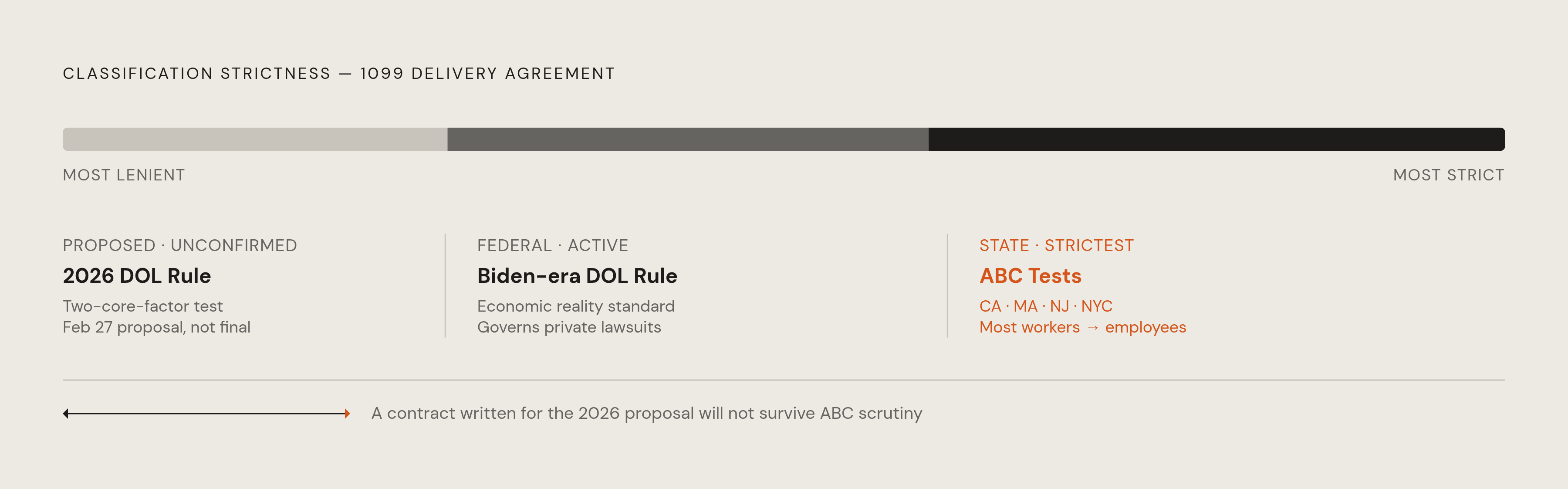
No single legal standard governs whether a delivery driver is a contractor or an employee right now. Three overlapping standards apply at once, and a subcontractor agreement has to survive the strictest one actually in force for a given driver, not the most convenient one.
On February 27, 2026, the U.S. Department of Labor published a proposed rule, and it would replace the 2024 independent contractor framework from the Biden administration with a simpler economic reality test built around two core factors, with three secondary factors held in reserve. The two core questions are whether the worker controls how, when, and for whom they work, and whether the worker carries real financial risk tied to the outcome of the work. If a delivery driver supplies their own vehicle and sets their own hours, they tend to pass both questions. A driver locked into assigned routes and a fixed paycheck looks like an employee under the same test, regardless of what the contract calls them.
The February 2026 proposal has not taken effect, which puts delivery networks in an odd three-way bind: the stricter prior rule still governs private lawsuits, the DOL's current enforcement posture is more lenient, and the new proposal is in between, unconfirmed. A contract written for the most favorable of the three will not hold up once the others get applied.
State law does not defer to any of this. California, Massachusetts, and New Jersey run ABC tests or similar standards that classify far more workers as employees than the federal tests do, and federal rulemaking has no power to override them. New York City is going further still: the City Council is weighing the Delivery Protection Act, which would force operators of certain last-mile warehouses and storage facilities inside the city to employ delivery workers directly. Until the federal rules settle, the only workable approach is to draft and document the contractor relationship to the strictest standard currently in play anywhere the network operates, not the easiest one to satisfy on paper.
Behavioral-control provisions and contractor autonomy
Behavioral control is the first thing every test above checks, and it is the easiest category for a delivery company to get wrong by accident. Silence on a point of control reads as evidence of control. If the agreement does not say the driver chooses their own schedule, a regulator will assume the company set it.
The agreement needs to state, in plain terms, that the contractor sets their own hours and decides which delivery assignments to accept or turn down. It needs to say the contractor controls the method and order of completing deliveries, while the company's only say is in the outcome: package delivered, on time, undamaged. It needs to confirm the contractor supplies and maintains their own vehicle and equipment, since a company that hands out the tools of the job is acting like an employer handing out tools to an employee. And it needs to leave the contractor free to work for other delivery companies at the same time. An exclusivity clause is one of the fastest ways to turn a contractor agreement into an employment agreement in everything but name.
Just as important is what the agreement avoids. Mandatory routes with no driver discretion look like dispatch control, not contracting. Required uniforms or branded vehicle wraps count as behavioral control under most tests, so where a network wants that look, it needs to be structured as something the contractor opts into, not a condition of getting work. Training that goes past safety and compliance, say, a required course in delivery technique, crosses from verifying a credential into directing how the job gets done, and that line is what the control test is measuring.
A delivery network's owner-operator fleet program sits at an interesting point on this spectrum. DSP owners recruit and manage fleets of forty to a hundred or more drivers, keep the vehicles running, and hit Amazon's performance metrics, all under a contract structure that has to answer the same question at a different scale: is the DSP owner running an independent business, or operating someone else's business for them? The answer depends entirely on how that layer of the agreement is written, which is the same lesson that applies to a single owner-operator driver.
How the financial-control provisions document genuine economic independence
If behavioral control asks who directs the work, financial control asks who absorbs the risk when the work goes badly. This is where most delivery network agreements are thinnest, because financial independence takes more than a sentence declaring the driver a business owner. It takes a pay and expense structure that actually looks like one.
Pay needs to be tied to output: structured around the delivery, the route, or the completed job. Hourly pay set by the company looks like a wage, and a wage looks like an employee. The agreement should list out, not imply, that the contractor covers their own fuel, maintenance, and vehicle costs. It should make clear the contractor can increase earnings by working faster, routing smarter, or picking up more clients, the upside half of profit and loss. And it should make equally clear that a missed delivery, a breakdown, or a bad route comes out of the contractor's margin, not the company's payroll, which is the downside half.
Access to other clients matters as much as the pay structure itself. A driver who can run deliveries for a competing platform on the same day is financially independent in a way the tests recognize. If a bonus structure requires minimum daily availability, it can quietly recreate exclusivity through incentives rather than through a clause, and that undermines the independence the rest of the agreement is trying to build.
Payments for a contractor's labor and services are what trigger Form 1099-NEC reporting, while payments for materials or supplies the contractor buys on the company's behalf are treated differently under the tax code and need their own tracking. Lumping the two together on one invoice line makes the 1099 filing less accurate and muddies the financial-control record at the same time, since reimbursed materials are not evidence of profit or loss the way service fees are.
Credentialing requirements the agreement must document by role and shipper
Credentialing for delivery contractors is not one list that applies to everyone. It stacks in layers, a base layer every driver needs, and additional layers determined by what they are hauling and who the shipper is. The agreement needs to reflect that layering directly, not point to a separate onboarding packet nobody reviews after the first week.
The base layer is consistent across the industry: a valid license for the vehicle class being driven, a clean driving record over a defined lookback period, a passed background check from a named standard, and current vehicle registration and insurance meeting the network's coverage floor.
Above that base, credentials shift by cargo and by shipper contract. The subcontractor agreement is what actually pushes those requirements down onto the individual driver, and if the agreement language does not name them, there is no contractual basis to enforce them. The same logic applies to hazmat handling, temperature-controlled freight, or high-value cargo, where the specialized certification you need depends entirely on which shipper contract the delivery falls under. None of this is universal. It applies exactly where a shipper's contract calls for it, and the agreement is what carries that requirement from the shipper down to the driver.
Putting credentialing in the agreement rather than leaving it to onboarding does two things at once. It gives the company a contractual trigger for termination when a license lapses or a certification expires, and it builds a running record of verification instead of a one-time check that goes stale within a year. It also strengthens the classification case: a contractor who renews their own license and keeps their own insurance current is demonstrating financial independence, which feeds directly into the relationship-type factor the IRS and DOL tests both weigh. Diakon Logistics runs contractor validation and onboarding as a staffed, formal function, not a form drivers fill out once, and that shows how delivery operators treat credentialing as an operational discipline once they scale past a handful of trucks.
Agreement language should require the contractor to certify their credentials at signing, authorize independent verification of them, require prompt reporting of any change in status, and set a fixed schedule for re-certification. Without that last piece, a license that lapses in month four sits undiscovered until something goes wrong.
Insurance provisions that close the coverage gap the agreement creates
An agreement that says "contractor must provide proof of insurance" and stops there is leaving two structural gaps unaddressed, not minor exceptions but built-in features of how 1099 delivery work functions.
The first gap sits in the driver's own auto policy. Most personal auto insurance excludes commercial delivery use entirely, so a driver who crashes while running an active delivery can have the claim denied outright by their own insurer. The agreement has to name a minimum commercial auto coverage threshold and require the contractor to maintain it on an ongoing basis, not just show proof of it once at signing and never again.
The second gap sits in workers' compensation. Most states require it for W-2 employees and exclude independent contractors from that requirement by definition, though several states push back against that default: Louisiana, Florida for construction work, and Washington all extend workers' comp obligations to certain categories of contractors by statute. Occupational accident insurance has become the standard response to that gap, and it covers medical expenses and disability income for injuries that happen during an active delivery. Buying it in bulk across a network tends to cost less than carrying workers' comp coverage would, and it doubles as a retention tool for drivers who want some protection without giving up contractor status.
That coverage has its own edge, though. It pays while a delivery is active. It pays nothing between deliveries, between apps, or once a driver has logged off for the day, and the agreement needs to say so in plain language, so neither the contractor nor the company is guessing where the company's liability actually ends.
The insurance section of the agreement should nail down five things: minimum commercial auto liability limits, stated per occurrence and in aggregate; whether cargo insurance applies and at what level; the specific occupational accident or equivalent arrangement in place; a requirement to submit updated certificates whenever a policy renews or changes; and a stated consequence, suspension or termination, for any lapse in coverage.
Payment terms that reinforce contractor independence while meeting IRS reporting obligations
Payment terms carry two jobs in a 1099 delivery agreement, and they are often treated as one. The first job is reinforcing financial independence for classification purposes. The second is building the documentation trail that 1099-NEC filing actually requires. A well-drafted payment section does both without extra effort.
Per-delivery or per-route pay supports contractor status in a way an hourly rate set unilaterally by the company does not. The agreement should state directly that no taxes come out of contractor payments and that the contractor alone handles their self-employment tax obligations, language that functions as evidence for the financial-independence factor in a classification review, not just a disclosure buried in the fine print.
On the filing side, the agreement should require a completed Form W-9 before the first payment goes out, not at year-end, not after the first job is done. Treat it as a gate: no W-9, no payment. The W-9 supplies the contractor's legal name, address, and taxpayer identification number, the exact information needed to file an accurate Form 1099-NEC, and collecting it late is how networks end up scrambling every January to track down information they should have had before the first delivery was ever made.
Sources
- 1099 Threshold 2026 Changes for Contractors Explained - BKKPRS
- Frequently Asked Questions - Final Rule: Employee or Independent Contractor Classification Under the FLSA
- Behavioral Control Instructions Example Training Financial Control
- Subcontractor 1099 Requirements for Contractors (What Actually Matters) — Edgestrat Finance
- Final Rule: Employee or Independent Contractor Classification Under the Fair Labor Standards Act, RIN 1235-AA43
- Who Gets a 1099? - Landmark CPAs