IRS 20 Factor Test for Delivery Contractors
Self-audit your contractor classifications now before the IRS does it for you.

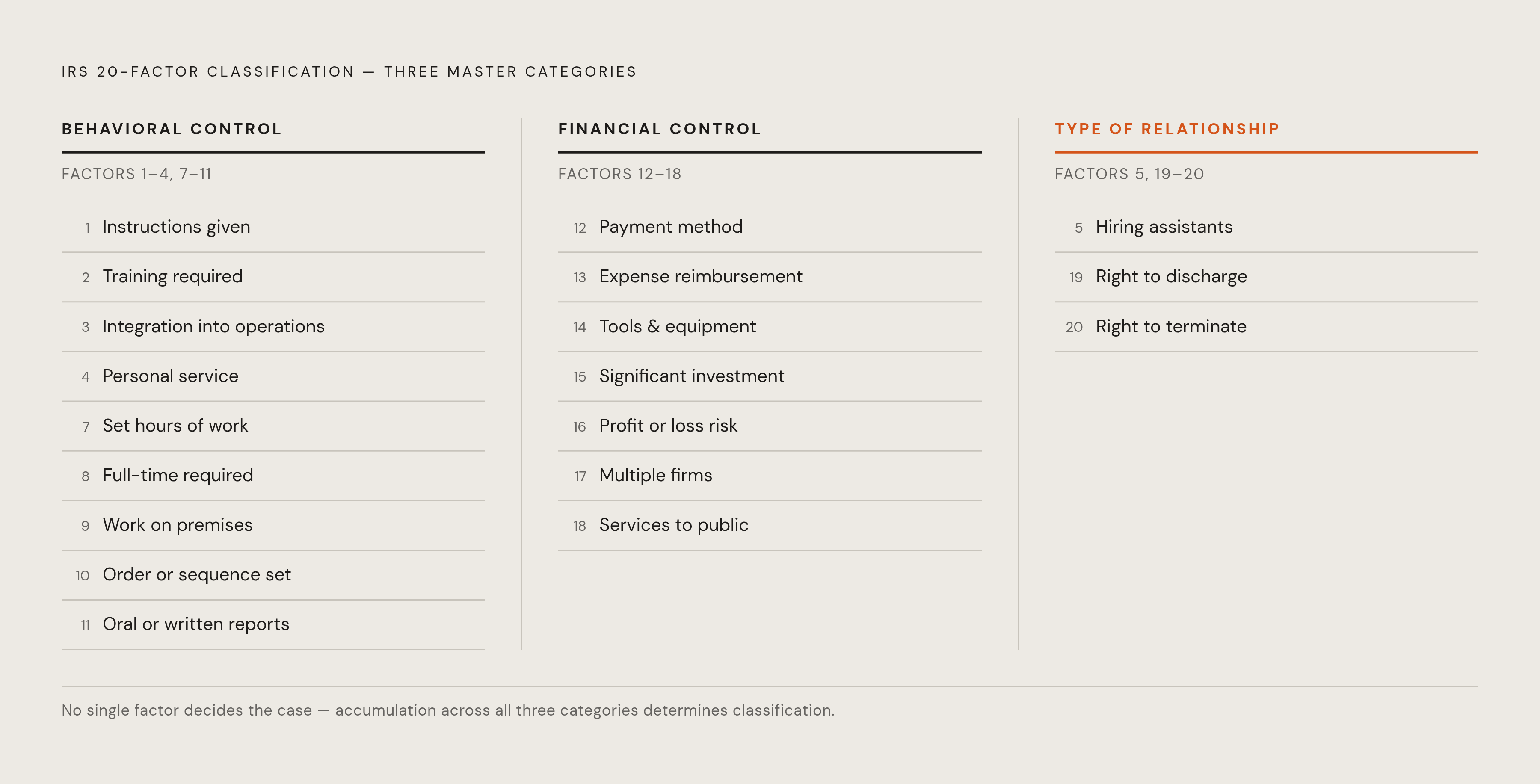
The IRS 20-Factor Test is old enough to buy a beer in most states, and it still runs the table on how delivery companies get evaluated for contractor misclassification. The IRS technically folded the 20 factors into three broader categories: behavioral control, financial control, and type of relationship. But Revenue Ruling 87-41, the document that birthed all 20 factors, has never been revoked. So the granular test didn't retire. It just got a new haircut and moved into the three-category house.
That distinction is not academic hairsplitting. Self-audit beats regulator-audit every time, if only because one of them doesn't come with a penalty notice attached.
The stakes scale with the size of the workforce in question. That is not a niche compliance issue affecting a handful of app-based startups. That is a workforce classification question touching more than a third of working America Carry. Get the framework wrong at that scale, and the exposure is measured in class actions, not individual disputes. It is measured in class actions. But the 20 factors remain an authoritative diagnostic resource; the questions map directly onto those three categories and help companies self-audit before regulators do.
How the three controlling categories organize all 20 factors
Behavioral control, financial control, and type of relationship are the three buckets, and the 20 factors are simply the fine print inside each one. Behavioral control covers instructions, training, integration into the business, work sequence, reporting requirements, and hours. Financial control covers how the worker gets paid, who eats the expenses, who owns the equipment, and the worker's ability to actually profit or lose money based on their own decisions. Type of relationship covers the structural signals: how long the arrangement runs, whether either side can walk away, and what the contract actually says about that.
None of the three categories operates alone, and no single factor decides the case by itself. A delivery company can look pristine on financial control, drivers own their vans, drivers set their own rates, drivers work for three competing platforms, and still lose the classification fight because dispatch assigns stop-by-stop routes and demands hourly check-ins. Regulators read the whole file. A single clean category does not offset a category that fails badly.
For delivery operations specifically, the mapping is fairly intuitive once you see it laid out. Dispatch, routing, scheduling windows, and credentialing requirements sit under behavioral control. Vehicle ownership, fuel costs, and whether a driver works multiple platforms sit under financial control. Contract length and how termination actually works are part of relationship type. Three categories, three different sets of operational levers, and a delivery company touches all three every single day without necessarily realizing it.
How delivery dispatch practices implicate behavioral control factors
Start with instructions, factor one, because it's the factor delivery dispatch trips over most often. The test asks whether a company controls the outcome (a package arrives) or controls the process (the exact route, sequence, and timing used to get there). Giving a customer a delivery window doesn't instruct the driver. Telling the driver which stop to make first, which road to take, and when to check in at the depot starts to look a great deal like an instruction to an employee. Sources are explicit that route and location control counts as an instructions-type factor, which puts routing software squarely in the crosshairs of this analysis.
Training is factor two, and it hinges on a distinction that's easy to blur: safety-mandated credential training, the kind regulators require independent of the company, reads differently than company-run training on how to execute a delivery. Onboarding that covers compliance requirements and platform mechanics can be framed to stay IC-consistent, so long as it doesn't drift into "here is how we want you to do the job".
Integration (factor three) asks whether the business depends on this specific worker or on the network as a whole. Delivery companies want to be able to say, credibly, that no single driver is load-bearing. Related to that is factor four, personal service: an independent contractor should be free to send a substitute. Building substitution rights into the IC agreement is one of the cheapest, most direct ways to shore up this factor.
Set hours (factor seven) and full-time requirements (factor eight) hit at the same nerve from two directions https://www.rsa-al.gov/uploads/files/IRS_20-Factor_Test.pdf. Requiring drivers to be available in company-defined windows looks like control, while letting drivers pick their own slots looks like independence. Exclusivity requirements, or volume minimums so high they consume a driver's whole schedule, quietly convert a contractor into a de facto employee even if the paperwork never changes.
Premises work (factor nine) rarely applies cleanly to a mobile workforce, but mandatory depot check-ins or company-owned dispatch terminals can reintroduce it. Order and sequence (factor ten) asks whether the driver can choose a pattern versus have one dictated. And reporting (factor eleven) turns on a distinction that matters more than it looks: a customer tracking their own package is not the same thing as a company demanding a driver log status updates on a fixed schedule. One serves the customer. The other supervises the driver.
Financial control factors and the vehicle, pay, and expense decisions that shape them
Money talks, and in this test it talks louder than almost anything else. Method of payment (factor twelve) is a bright line: hourly, weekly, or monthly pay reads as employment, while payment by the job, by the route, or by commission reads as independent contracting. Delivery companies that pay per delivery or per route are working with the grain of the test. Companies that pay something functionally identical to an hourly wage, dressed up in different language, are not.
Expense reimbursement (factor thirteen) cuts the same direction. Employers typically cover a worker's costs; contractors are expected to price their own fees to cover fuel, maintenance, and the rest. A company that reimburses mileage or covers fuel directly is, functionally, absorbing the cost structure of an employee relationship, whatever the 1099 says.
Tools and equipment (factor fourteen) and significant investment (factor fifteen) run together. Furnishing meaningful equipment signals employment, while a driver who owns the delivery vehicle and carries personal insurance builds a materially stronger independent case. Dispatch software provided by the platform is close to universal industry practice and doesn't move the needle much either way; the vehicle, insurance, and fuel are where the real weight sits.
Profit or loss (factor sixteen) asks whether the worker bears any real economic risk or upside. A driver who can choose volume, manage costs, and earn more by working smarter, not just longer, supports contractor status. Working for multiple firms (factor seventeen) and offering services to the public (factor eighteen) both point the same way: a driver who services multiple platforms or clients and advertises availability beyond a single company relationship looks like a business, not an employee. Exclusivity clauses undercut both factors at once. They deserve real scrutiny before they go into a contract.
Insurance sits just outside the 20 factors but shapes the financial picture anyway. This usually gets addressed at onboarding, since an uninsured injury turns into a dispute fast, and disputes turn into downtime. Buying occ/acc coverage in bulk at the platform level, spreading it across the whole contractor network, is structurally sound: the company facilitates access to coverage without stepping into the role of employer for workers' comp purposes.
Relationship-type factors in contract and termination terms and their signal to regulators
The relationship category is where paperwork meets reality, and reality usually wins. A continuing, indefinite relationship with no defined end point resembles employment; sequential, project-based engagements read as independent, even if they repeat with the same driver over years. The practical fix is straightforward: structure work as load-by-load or project-by-project acceptance rather than a standing, open-ended assignment.
Hiring and supervising assistants (factor five) asks who controls the driver's own help. If the company manages a driver's sub-contractors or helpers, that's employer behavior. If the contractor hires and pays their own team, that supports independence.
Then come the two factors that decide how a relationship ends. The right to discharge (factor nineteen) matters because an employer can fire at will, while a contractor relationship should tie termination to contract terms or deliverables, not an at-will trigger indistinguishable from firing an employee. The right to terminate (factor twenty) works in reverse: an employee can quit anytime without consequence, while a contractor typically carries some liability for walking away from a contract early. A contract that lets either side exit penalty-free, anytime, for any reason, is quietly describing an employment relationship no matter what label sits on page one.
The trucking industry offers the clearest cautionary case. Port and carrier misclassification patterns typically involve drivers required to lease company trucks, follow company dispatch schedules, wear company uniforms, and follow company rules, with almost no independent business activity outside that single relationship. No single factor sank those arrangements. It was the accumulation, behavioral and relational failures stacking on top of each other, that made the classification indefensible. Documentation of actual day-to-day operations is what regulators weigh, and the contract language rarely saved anyone.
What misclassification costs when regulators find what the 20 factors reveal
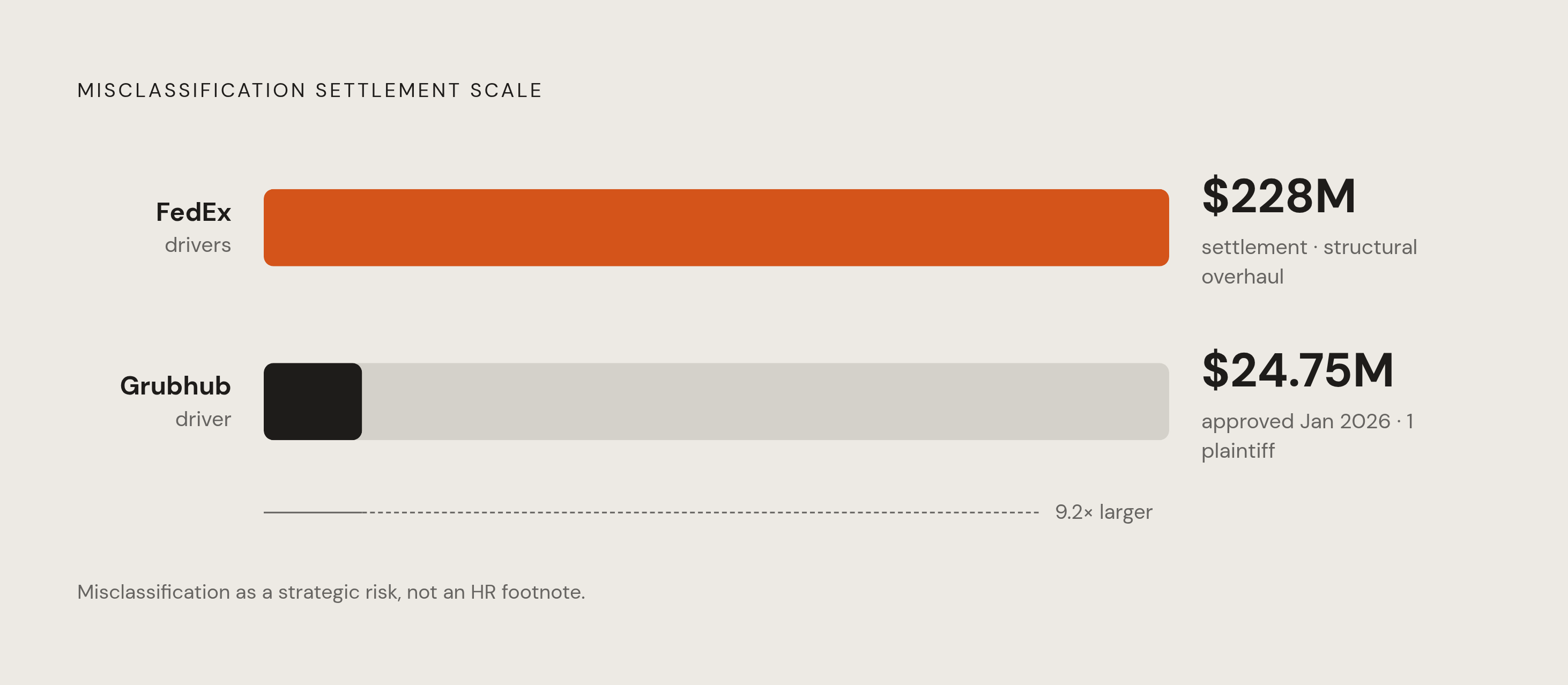
The penalties are not subtle. Back taxes, unpaid employment taxes, civil fines, interest, and retroactive damages are all on the table, and both the IRS and DOL treat classification enforcement as a standing priority. FedEx paid $228 million after delivery drivers were found to be misclassified as contractors, in a case that dragged into years of litigation and forced structural changes to how the company ran its network. That is not a rounding error on a balance sheet. That is a strategic redirection forced by a classification argument the company lost.
A nearly decade-long California lawsuit against Grubhub, brought by a former delivery driver alleging misclassification as an IC, resolved with a $24.75 million settlement agreement finally approved on January 15, 2026 KMK Law Oysterlink. Ten years is a long time to litigate a question the 20-factor framework could have flagged at onboarding https://www.rsa-al.gov/uploads/files/IRS_20-Factor_Test.pdf. Enforcement isn't slowing down either: 2026 trends show regulators pursuing wage violations, consumer protection claims, contract disputes, and supply-chain liability, and misclassification risk appears inside those cases even when it isn't the headline charge.
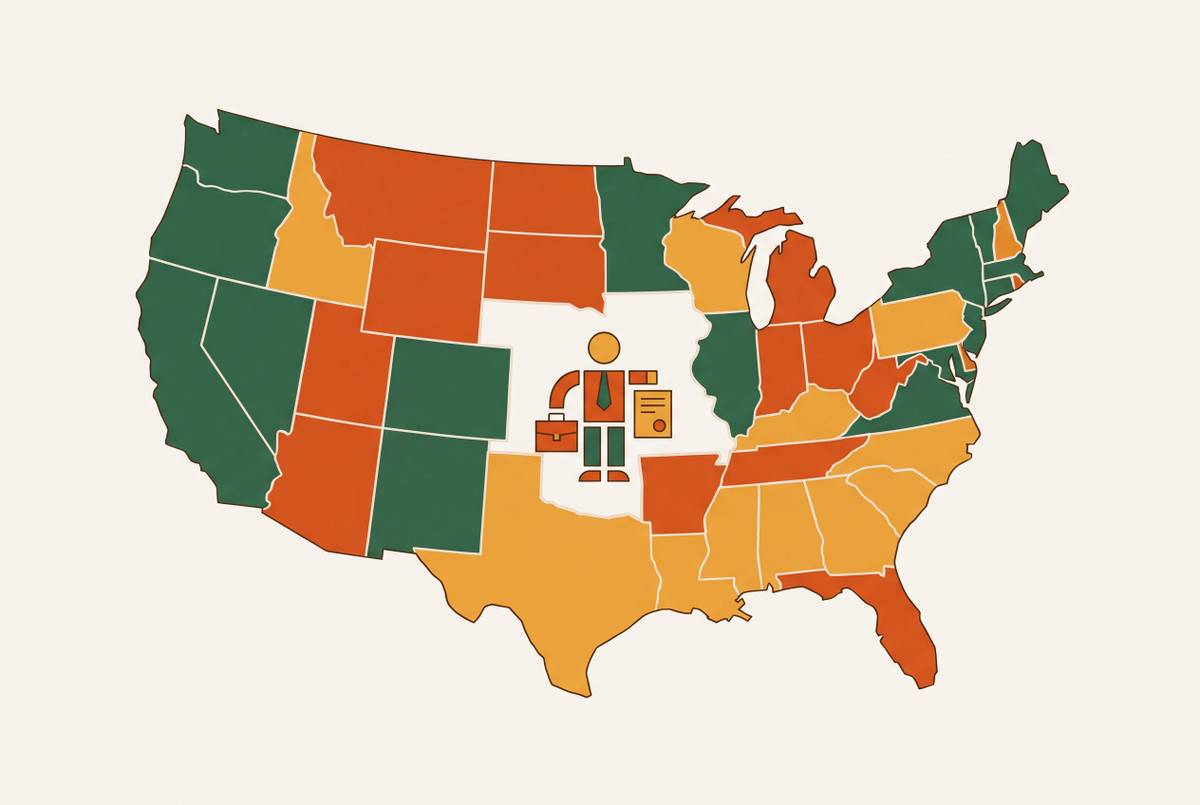
Layering state law on top makes the picture more complicated. California's ABC test under AB5 sets a stricter bar than the IRS framework, and it doesn't care how well a company scores on the 20 factors if it fails the ABC prongs Poster Compliance. New York City requires app-based delivery drivers to be paid at least $17.96 an hour, rising to $21.44 as of April 2025 (the $19.96 base plus a 7.41% inflation adjustment), and Seattle has its own version of the same idea Poster Compliance. It's solving three or four simultaneously, and passing the federal test buys no exemption from the state and city ones https://www.rsa-al.gov/uploads/files/IRS_20-Factor_Test.pdf.
The current federal regulatory picture and the 20-factor framework's role as the stable reference point
The DOL, to its credit, cannot seem to make up its mind. The 2024 DOL rule ran a six-factor balancing test with no dominant factor, which created genuine uncertainty for platforms whose operations scored differently depending on which factor got weighted heaviest. In May 2025, the DOL backed off that rule via Field Assistance Bulletin 2025-1, telling investigators to revert to the older "economic realities" test. That reversal didn't make misclassification risk disappear. It just changed which test enforcement staff were told to apply that particular week.
Then, on February 26, 2026, the DOL published a new proposed rule (91 FR 9932) that prioritizes control and profit opportunity, nudging the federal labor standard closer to the IRS's own approach DOL NPRM. Under that proposal, a delivery driver using their own vehicle and choosing their own hours typically qualifies as a contractor, while a worker following strict routes and receiving fixed pay more often appears economically dependent, mirroring the IRS factor analysis directly. Convergence, for once, rather than divergence.
Meanwhile the IRS made its own quieter update. Revenue Procedure 2025-10 refined the rules governing Section 530 relief, which protects employers from retroactive liability if they've consistently treated a worker as a contractor, filed accordingly, and had a reasonable basis for doing so, judicial precedent, a published ruling, a prior audit that didn't penalize similar workers, or longstanding industry practice. That protection rewards documented consistency. Filing Form SS-8 to get an official IRS determination sounds tempting, but tax specialists warn the IRS tends to default to "employee" when the facts are ambiguous, and requesting a ruling can forfeit protections a company already had. Not a move to make on a whim. The IRS 20-Factor Test remains the foundational lens for assessing contractor classification risk, and delivery companies operating IC networks need to understand how each factor maps to real-world dispatch, scheduling, and operational practices, since the way they manage contractors daily either builds or erodes their compliance posture.
The through-line across all of this regulatory churn: DOL standards move around like weather, but the IRS's common-law right-to-control doctrine, the foundation the 20-Factor Test was built on, has not shifted at all. It remains the stable baseline underneath every other framework layered on top of it.
Daily operational decisions that build or erode a defensible compliance posture
None of this is a one-time legal exercise settled at contract signing. The 20 factors describe ongoing behavior, and every dispatch decision, every payment structure tweak, every contract renewal is its own separate classification event, evaluated fresh.
Assigning specific routes and stop sequences, requiring drivers to be available inside company-set windows, reimbursing fuel or vehicle costs directly, handing out company-branded vehicles or phones, running mandatory performance reviews or demanding status reports beyond what a customer-facing tracker already shows, and enforcing exclusivity or volume minimums that function as full-time requirements in every way but name are daily habits that are high-risk on sight. Each one of these is individually survivable. Stacked together, they start to resemble the same pattern that sank the trucking cases: not one fatal factor, but an accumulation nobody bothered to add up until a regulator did it for them.
The fix isn't complicated, even if the discipline required to maintain it is. Pay by the job, not the hour. Let drivers pick their own windows. Let them own the truck, carry their own insurance, and work for a competitor on their day off. Keep the contract's termination terms honest about risk on both sides. None of that guarantees immunity from an audit, nothing does, but it means the daily operational record actually matches the paperwork, which is the only thing regulators have ever really been checking.
Sources
- IRS 20-Factor Test: Independent Contractor or Employee
- Labor Law Compliance for Gig Workers: Employer Guide 2026
- Understanding IRS Worker Classification: From the 20-Factor to Three-Category Test
- No Free Delivery Misclassification Comes at a Price: Keating Muething & Klekamp PLL
- New Industries Subjected to Lawsuits Alleging Independent Contractor Misclassification: March 2026 IC Legal News Update - Lexology