Fastest Path From Signed Agreement to First Delivery Run for Independent Contractors
Compress contractor activation from weeks to days with automated handoffs between teams.

The fastest path from signed agreement to first delivery run is a defined sequence with automated handoffs. Last-mile delivery operators can compress contractor activation from weeks to days by confirming classification first, mapping six required steps, and making each completed checkpoint trigger the next. The aim is to remove idle time without removing safeguards or adding back-office staff.
Why the gap between a signed agreement and a first delivery run is a sequencing problem, not a paperwork problem
A contractor signs the agreement, then sits idle for days while the operator waits for the account to become dispatch-ready. Legal has the contract, finance needs payment details, IT needs an access request, and operations needs clearance. Each team owns a piece of the work. But no one may be in charge of moving the work between them. The operator has already paid to recruit the contractor and check credentials, but the contractor has made zero deliveries.
That gap is easy to mistake for a document backlog because documents are what people chase. Onboarding spans at least four internal domains without necessarily having one workflow connecting them. So when one team finishes a task, its message to the next team can sit unread. The remedy is to give every step a defined trigger, an owner, and a condition for handing work onward.
A fixed sequence need not make every engagement identical. Required checks still have to happen, even when the scope of delivery work differs. Flexibility belongs in how those checks are completed.
Confirming contractor classification before anything else moves
Classification is step zero, before onboarding begins. A signed independent contractor clause cannot make an employment relationship independent, and thorough onboarding cannot repair the wrong classification. It can instead produce a more complete record of that relationship. Regulators look at actual behavioral and financial control.
The practical warning signs are recognizable. Fixed daily hours, required shift coverage, manager-driven daily task lists, an ongoing role with no defined end state, and a company email identity used as a staff representative can indicate employment. Calling the role “1099” does not neutralize those features. For delivery work, the engagement must reflect contractor control over execution within operational parameters, with route flexibility, scheduling independence, and the ability to work for other platforms relevant to that assessment.
The federal position also requires care. The federal agency’s proposed rule had its comment period close April 28, 2026, with no final rule issued as of that date. The Wage and Hour Division has indicated that it will not use the 2024 rule’s analysis in its own FLSA investigations. Operators should build for the stricter applicable state tests and make classification confirmation a documented gate.
The six steps that must complete in order before a contractor can run a delivery
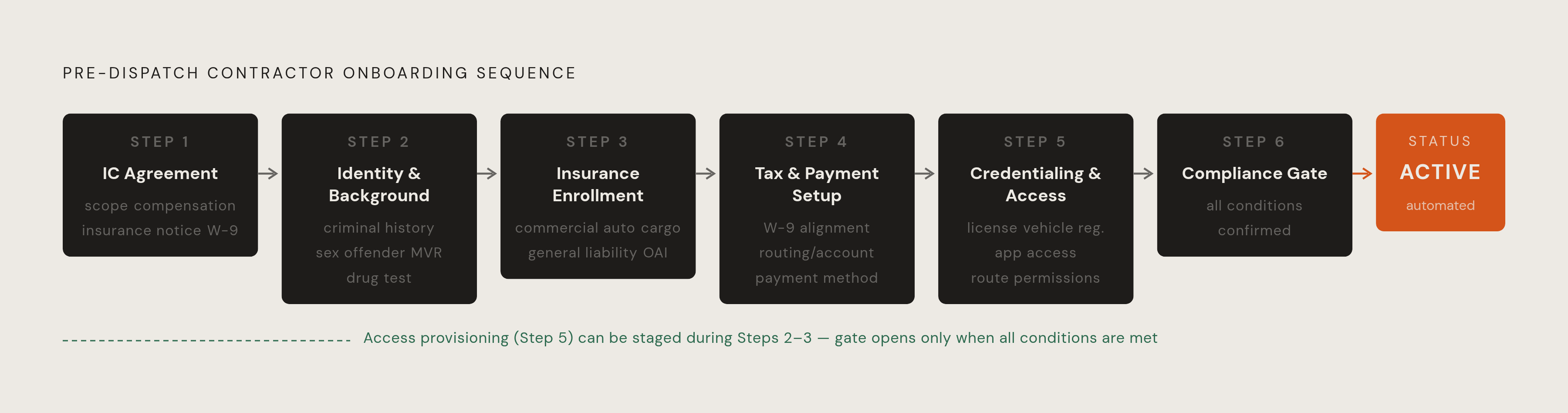
Step 1 is executing the independent contractor agreement. After classification clears, the agreement establishes the scope and deliverables, compensation and payment schedule, IP assignment, confidentiality, termination conditions, independent contractor status, and required insurance. For delivery work, it should also record that the contractor has been informed that personal auto policies exclude commercial delivery use. The signature starts the operational sequence. For US-based contractors, W-9 collection belongs here, before first payment.
Step 2 is identity verification and background screening. Screening follows the signed agreement and the contractor’s authorization, and it must clear before dispatch. Standard checks include identity, criminal history, the national sex offender registry, and the motor vehicle record, or MVR. Drug testing, where required, belongs in the same screening window. FedEx Ground requires new drivers to pass First Advantage’s background check, drug test, and MVR review before they get their first assignment. DeliverThat’s published requirements include review of up to five years of driving history, a minimum age of 21, and a valid U.S. license held for at least two years. Those requirements are specific to the operators. DOT and FMCSA also require MVR checks and Driver Qualification File records for commercial drivers covered by their rules, including non-CDL drivers subject to Part 391.
Step 3 is insurance enrollment and verification. Dispatch must wait until the operator has checked that the required coverage is in force. The insurance stack includes commercial auto liability, cargo insurance, general liability, and occupational accident insurance, or OAI. These cover different risks and are not interchangeable. OAI covers medical expenses, disability income, and accidental death and dismemberment up to policy limits, but it does not replace commercial auto coverage. Personal auto coverage excludes commercial delivery use, and the gap can begin when the app is turned on, before an order is accepted. The protection a platform provides during that wait also varies, so enrollment must deal with the risks the contractor faces as well as collect a policy image. California operators subject to Prop 22 must account for its OAI requirements, upheld by the California Supreme Court in Castellanos v. State of California in July 2024.
Step 4 is filling out tax forms and setting up payment. The W-9 collected earlier now needs to align with validated payment information, including routing and account numbers and the account holder’s name. The contractor also selects the available payment method, such as instant debit, same-day ACH, or standard ACH. Collection alone is not enough. An incorrect account number discovered at the first payment attempt creates reconciliation work after the contractor has already earned the money. Payment readiness therefore belongs before first run.
Step 5 is credentialing, training, and systems access. Before dispatch, the operator needs a valid driver’s license matched to the MVR, vehicle registration, required proof of personal auto insurance, any cargo-specific certifications, and recorded completion of required training. The contractor also needs dispatch app access and route assignment permissions. This is where preparation differs from permission. Access provisioning can be triggered by the signed agreement and staged while other checks proceed, rather than waiting for someone to file a request after screening. That preparation does not authorize an uncleared contractor to work.
Step 6 is compliance verification and dispatch authorization. A structured record must establish that the agreement is signed, screening has passed, insurance is in force, payment details are validated, credentials are current, and training is complete. An email thread is not an adequate substitute. Once those conditions are met, the transition from “onboarding” to “active” should be an automated status change. The sequence governs clearance, while allowing preparatory work where dependencies permit. After activation, continuous monitoring must keep testing the conditions that made dispatch permissible in the first place.
Where the delays actually hide and why manual handoffs are the primary cause
Screening has its own turnaround time, which varies by vendor and jurisdiction. But an operator can add days before the vendor even receives the order. In a manual workflow, the signed agreement might wait in an inbox until someone notices it and requests screening. If the vendor has not been selected and configured, setup adds another delay. None of that time is spent assessing the contractor.
If insurance enrollment depends on a person reviewing the result, a passing contractor waits for that person’s review schedule. After insurance clears, an unstaged IT request can impose another pause just before first run. The contractor is ready for the next task. The organization is still passing the baton.
Manual collection adds rework to those pauses. A missing document or invalid banking detail can send part of the sequence backward, and the cost grows as more contractors move through the same process. A team of three may track five contractors by email, but as that number grows, it gets harder to keep records consistent and check credentials. The objection that automation is unnecessary at small scale overlooks the exposure attached to a missed check, an uninsured incident, or failed payment.
The fastest preparation happens before the contractor arrives. Internal stakeholders are briefed, the agreement is ready, the screening vendor is prepared to act once authorization is obtained, payment workflows are configured, and access is staged. This preserves every gate while removing the avoidable work of assembling the process after someone is already waiting to use it.
How to speed up delivery driver onboarding without hiring more admin staff
Automation replaces a notification with a trigger. Signing initiates the authorized screening order, a screening pass opens insurance enrollment, and verified completion of the required conditions permits activation. The distinction is practical. A notification tells a person that work could begin, while a trigger starts the next permitted action. This compresses waiting time without pretending that a background check or insurance requirement can simply disappear.
A self-serve portal makes it easier to get the information that sequence needs. Contractors enter tax forms, banking information, credentials, and personal details in structured fields, which saves someone else from having to re-enter them from attachments. Validation at intake catches payment errors before they become failed payouts. The workflow also ties document collection to how far the contractor has moved through the steps.
Work to set up system access can start when the agreement is signed and continue while screening and insurance are handled, with access held until final authorization. Insurance enrollment can likewise be integrated into onboarding instead of requiring separate sourcing and repeated verification. Bulk purchasing can pass savings through to contractors while reducing that administrative detour.
Among integrated options, GigSafe provides 25+ onboarding modules, OAI and commercial auto capabilities, instant debit payments, and real-time compliance monitoring, connecting intake, protection, payment, and ongoing oversight. Its published onboarding page lists next-day ACH rather than same-day ACH, and operators should keep that difference in mind when checking how soon payments arrive.
The selection criterion is whether the workflow closes the actual gaps. Agreement execution, screening triggers, insurance enrollment, validated payment setup, credential collection, and ongoing monitoring need to operate as connected work. Dispatch authorization should still depend on records showing that the work is complete, whether the platform or the operator’s connected workflow handles it. Automation earns its place by reducing coordination.
Keeping contractors active after first run: pay speed, credential monitoring, and the compliance loop
First-run readiness is only a snapshot of compliance. Licenses expire or are suspended, insurance lapses, MVRs change, and drug testing windows reopen. A contractor who qualified at activation may no longer qualify later. Real-time monitoring should therefore place a hold on dispatch authorization when a required credential lapses, before another delivery exposes the gap.
Pay speed supports that continuing readiness. Slow payment leaves contractors with less cash on hand, including money they need for insurance premiums and vehicle registration. Faster payment cannot guarantee renewal, but it reduces one source of strain. NACHA reported that the number of Same Day ACH payments was large and growing in Q1 2026, showing that the systems for faster payment are well established and widely available. The operational choice is whether the payment setup made during onboarding gives contractors timely access to their earnings.
Continuous oversight also does not erase scheduled legal duties. DOT rules require annual MVR checks for CMV drivers subject to Part 391 qualification requirements, including covered non-CDL drivers. FMCSA Driver Qualification File requirements call for compliance reviews each year for commercial carrier drivers covered by the rules. At scale, they need more dependable coordination than a collection of manual calendar reminders.
The resulting infrastructure serves both sides of the relationship. Contractors gain prompt payment and ongoing protection, while operators retain classification documentation, agreements, credential records, insurance verification, and payment records for audit purposes. Those records support a defensible relationship only when the underlying classification is sound. As the network grows, the same workflow can handle a hundredth contractor without requiring proportionally more back-office coordination. The lasting gain is not just an earlier first delivery, but a repeatable way to keep delivery capacity qualified, insured, and earning.